To find your Blue Rhino or Endless Summer patio heater manual, locate the model number on the label attached to the base or lower pole of your heater, then search that exact number at EndlessSummerHeat.com or MrBarBQProducts.com. The Blue Rhino brand and Endless Summer brand are closely linked (both distributed by Blue Rhino/Worthington) and their heaters often share parts, but the manuals are model-specific. Using the wrong manual means wrong wiring diagrams, wrong thermocouple specs, and wrong lighting sequences, so getting the right one upfront saves a lot of frustration. If you are dealing with a Shinerich unit instead, the shinerich patio heater manual will spell out the correct wiring, sensor type, and lighting steps for that exact model.
Blue Rhino Patio Heater Manual: Find Model and Fix Issues

How to confirm your exact Blue Rhino / Endless Summer model
The most common mistake people make is assuming all Blue Rhino or Endless Summer heaters are the same. They are not. Models differ in igniter type (piezo push-button vs. electronic), burner layout (mushroom-top vs. table-top vs. infrared), gas type (propane vs. natural gas), and safety sensor configuration (some use a thermocouple, others a thermopile, and some have both plus a tilt switch). The wrong manual will list parts you don't have and skip parts you do.
Here is exactly where to look for your model and serial numbers:
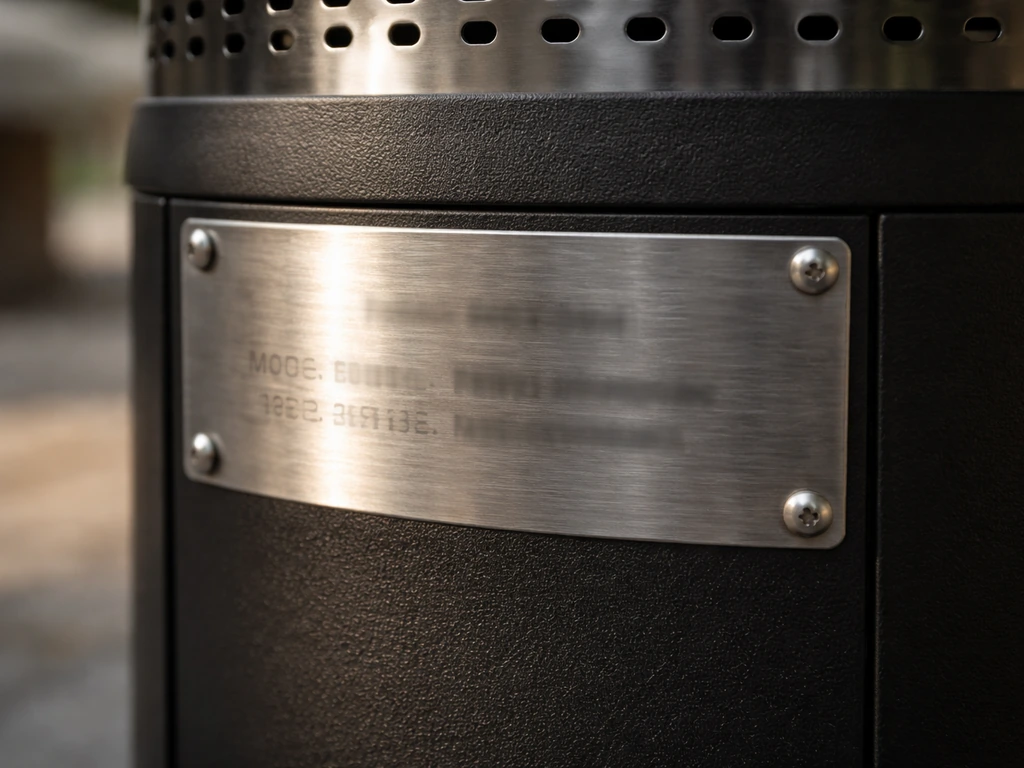
- Base of the heater: most freestanding mushroom-style heaters have a sticker or embossed plate on the lower pole or base ring. Check around the entire circumference since it is sometimes on the back.
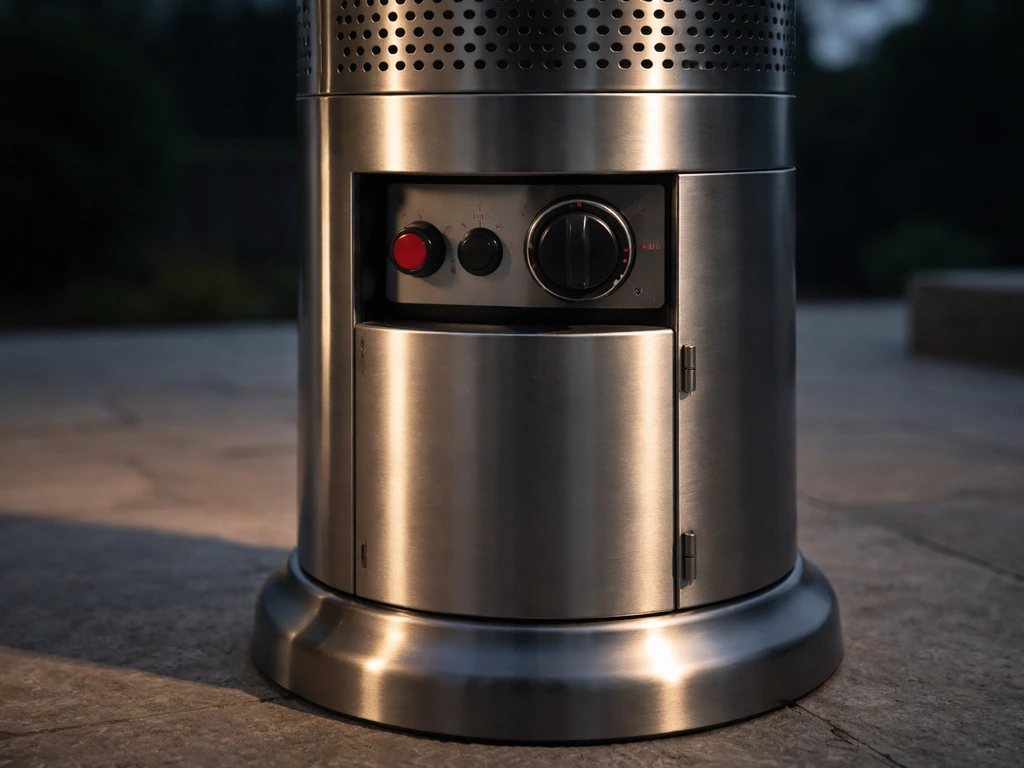
- Inside the access panel: open the small door that covers the propane tank compartment. The label is often on the interior wall of that enclosure.
- On the burner head: table-top and infrared models sometimes stamp the model number directly onto the burner housing.
- On the original box: if you still have the box, the model number is printed on at least two sides as part of the UPC block.
The model number format typically looks like GAD17107ES, GAD19105ES, or a similar alphanumeric string. Write down the full string including any suffix letters (like -NG for natural gas or -LP for propane) because those suffixes indicate different valve configurations and different manuals. The serial number is also worth recording, but it is the model number that gets you the right documentation.
Where to find the manual (and what to do if you can't)
Your first stop should be EndlessSummerHeat.com, which is the official product site and maintains a library of owner's manual PDFs organized by model number. Make sure you use the exact briza infrared patio heater manual for your model so the wiring, sensors, and lighting steps match what your heater requires. Type your full model number into their search or browse the manuals section. If you find a document with a filename like GAD19105ES-EF-OM-F100, that alphanumeric file code confirms you have the correct revision for your unit. Download it and keep a local copy because these PDFs occasionally move. If you cannot find your exact model there, you may need to locate a Kirkland Signature patio heater manual that matches the same configuration and components.
If the official site does not have your exact model, try these options in order:
- MrBarBQProducts.com: this is a major parts and documentation source for Blue Rhino/Endless Summer heaters and often has older model manuals that have been removed from the official site.
- ManualsLib.com: search for Endless Summer plus your model number. The user-uploaded library frequently has older or discontinued models.
- Blue Rhino customer support (1-800-762-1142): they can email you a manual PDF or confirm which current manual applies to your unit if the model has been updated.
- Cross-reference a similar model: if your heater shares a burner, valve, and igniter assembly with a current model, that model's manual is usually close enough for troubleshooting purposes. Call support to confirm before proceeding.
If you genuinely cannot find a match, take photos of your control knob, gas valve, pilot assembly, and any wiring and email them to Blue Rhino support. In my experience they are reasonably helpful at identifying mystery models from photos.
Understanding the controls and correct lighting/shutdown sequence
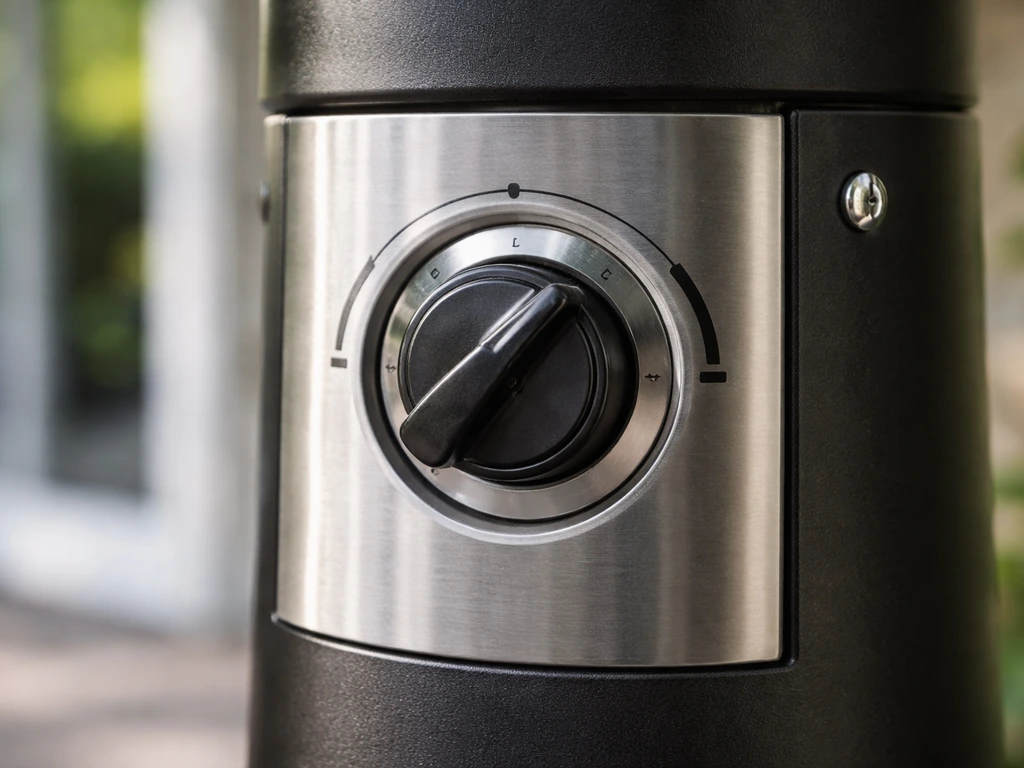
Most Blue Rhino and Endless Summer freestanding heaters use a push-and-turn gas valve knob with three or four positions: OFF, PILOT, LOW, and HIGH. Some models add a MEDIUM position. The logic is identical across most of their lineup even when the physical knob looks different.
Standard lighting sequence
- Open the propane tank valve slowly (counterclockwise) about one full turn. Do not fully open it.
- Turn the control knob to PILOT and press it in fully. This opens the pilot gas line.
- While holding the knob pressed in, press the igniter button repeatedly (or hold it if it is an electronic auto-igniter) until the pilot flame lights. You should see a small blue flame at the pilot assembly.
- Keep the knob pressed in for 30 to 45 seconds after the pilot lights. This heats the thermocouple or thermopile so it generates enough voltage to hold the safety valve open.
- Slowly release the knob. The pilot flame should stay lit. If it goes out, wait 5 minutes and repeat from step 2.
- Once the pilot is holding, turn the knob to LOW, then to HIGH as desired. The main burner should ignite from the pilot flame.
- To shut down, turn the knob back to PILOT, then to OFF. Close the tank valve.
One thing many people skip: after connecting or reconnecting the propane tank, you need to purge air from the line before the pilot will light reliably. Press and hold the control knob in the PILOT position for up to 1 to 2 minutes to bleed the line, stopping as soon as you smell gas. Then wait a full 5 minutes for any accumulated gas to dissipate before attempting to light. This is not optional, it is a safety step baked into the official Endless Summer manual. This matches the manual’s explicit warnings in its opening safety section, including that it is “FOR OUTDOOR USE ONLY,” with a “CARBON MONOXIDE HAZARD” warning and examples of enclosed spaces where use can be deadly opening safety warnings.
Shutdown and storage
Always turn the control knob to OFF before closing the tank valve. Closing the tank first and letting the heater run the line dry is a common habit that is actually fine for the heater but leaves the control knob in a gas-passing position overnight, which is a bad habit if the tank seal is ever imperfect. Get into the routine of knob first, tank second.
Quick symptom-based troubleshooting checklist
Use this table to match your symptom to the section that covers it in detail below. This is the same diagnostic logic laid out in the official Endless Summer service documentation, just organized for faster lookup.
| Symptom | Most likely cause | See section |
|---|---|---|
| No click when pressing igniter | Dead igniter module or disconnected wire | Ignition issues |
| Click present but no spark visible | Fouled or cracked igniter tip, bad ground | Ignition issues |
| Spark present but pilot won't light | Air in line, clogged pilot orifice, low gas pressure | Ignition issues |
| Pilot lights but goes out when you release knob | Thermocouple/thermopile not heated enough, faulty sensor | Won't stay lit |
| Pilot stays lit but main burner won't fire | Clogged burner port on pilot assembly, low gas flow | Won't stay lit |
| Heater shuts off randomly during use | Tilt switch triggered, thermocouple intermittent, wind | Tilt switch and safety components |
| Heater won't light at all after moving it | Tilt switch not reset, anti-tip device engaged | Tilt switch and safety components |
| Smell gas but no ignition | Leak at fitting, valve not seating, purge needed | Stop DIY section |
Ignition issues: no spark, weak spark, or won't light
Start at the igniter module. On most Blue Rhino mushroom heaters, the igniter is a piezoelectric unit housed in a small plastic body near the control knob, with a thin wire running up to the pilot assembly. Press the button and watch (or have someone watch) the pilot tip for a visible spark. No click at all usually means the igniter crystal has failed or the button mechanism is broken, and the module needs to be replaced. Clicking with no visible spark usually means the wire or the tip is the problem.
Checking and cleaning the igniter tip
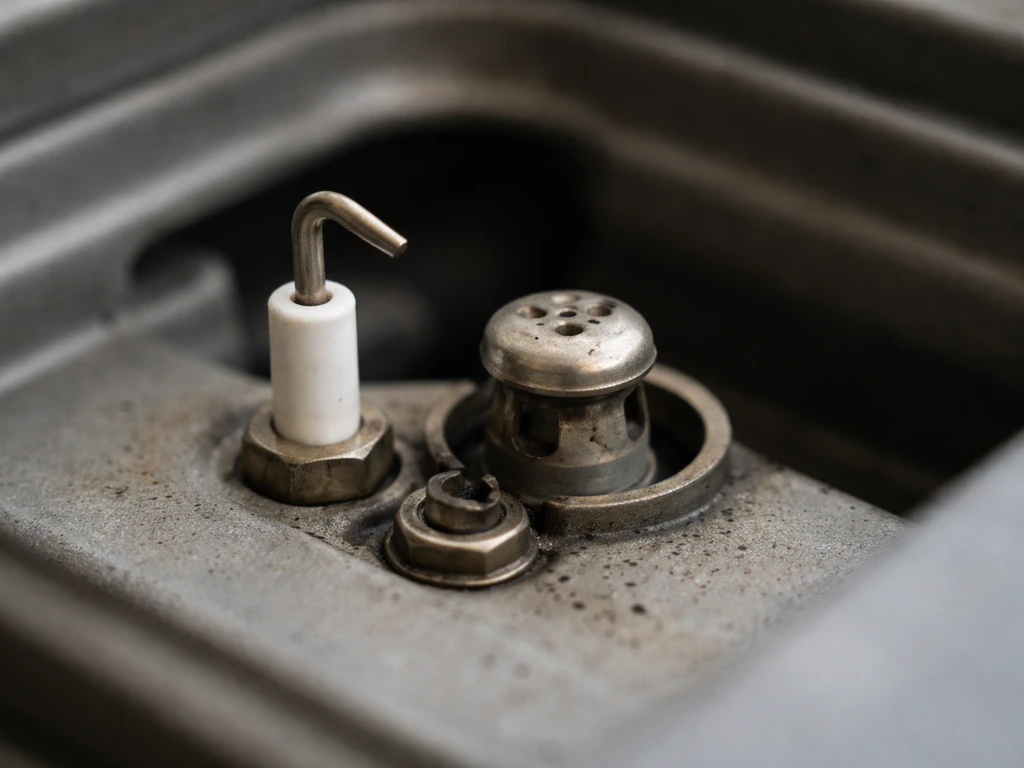
- Turn the tank valve off and disconnect the tank before doing anything near the pilot assembly.
- Locate the igniter tip: it is a small metal rod positioned about 3 to 5mm from the pilot burner orifice.
- Inspect the tip for carbon buildup, corrosion, or a cracked ceramic insulator. Any crack in the ceramic means the spark is shorting to ground before it reaches the tip and the igniter wire needs replacing.
- Clean carbon deposits with fine steel wool or a small wire brush. Do not use sandpaper as it leaves abrasive particles near the gas orifice.
- Check the gap between the tip and the pilot hood: it should be about 3 to 5mm. Too wide and the spark won't jump. Gently bend the tip closer if needed.
- Inspect the igniter wire connection at both ends (module and tip) for corrosion or looseness. Push connectors fully seated.
- Reconnect the tank and test. If sparking is now visible but the pilot still won't catch, the problem is fuel delivery, not ignition.
Fuel delivery problems at the pilot
If the spark is good but the pilot won't light, you either have no gas reaching the pilot orifice or the orifice is clogged. First confirm the tank has propane and the valve is open. Next, do the line purge described in the lighting sequence section above. If after purging you still get no pilot flame, the tiny pilot orifice is almost certainly blocked with spider webs, debris, or oxidation. This is extremely common on heaters that have been stored. Use a can of compressed air to blow through the pilot assembly orifice. If that does not clear it, a single strand from a wire brush can be used to very gently probe the opening. Do not use a drill bit or anything rigid that could enlarge the orifice.
Won't stay lit: thermocouple/thermopile and safety circuit checks
This is the most common complaint on Blue Rhino and Endless Summer heaters, and the official troubleshooting table in the Endless Summer Dualheat manual (GAD19105ES-EF-OM-F100) specifically calls out two causes: dirt around the pilot assembly and a loose connection between the gas valve and pilot assembly. Those two things account for probably 80 percent of "pilot won't stay lit" calls.
How the thermocouple/thermopile works and why it fails
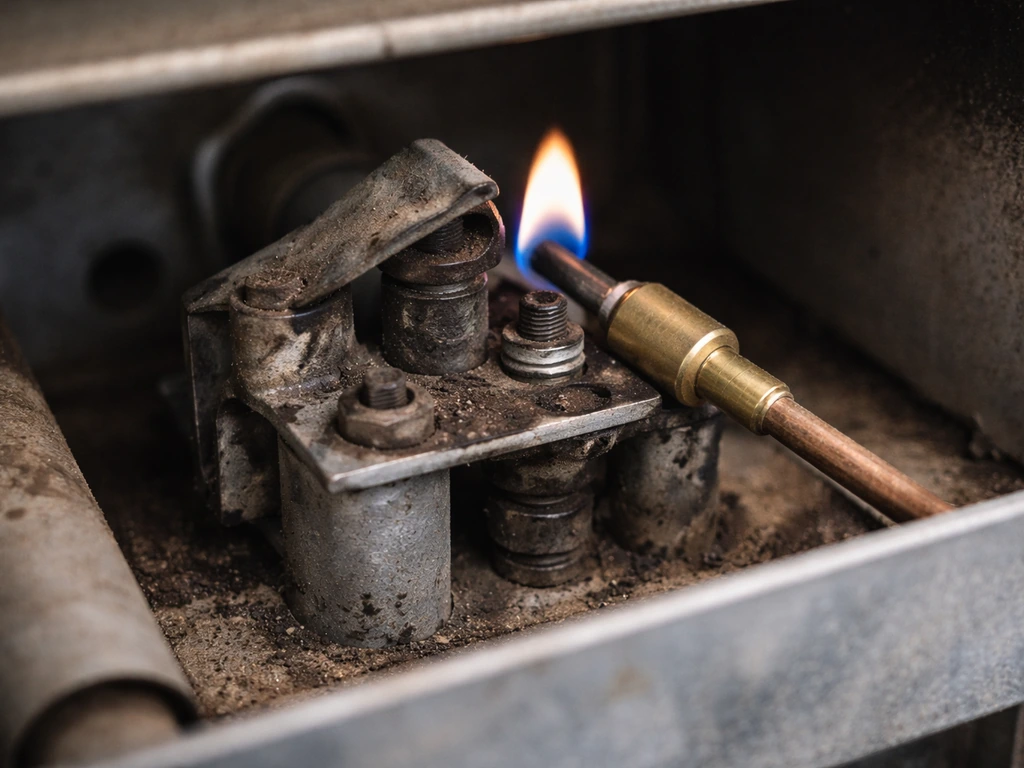
The thermocouple (or thermopile on newer models) is a safety device. It sits in the pilot flame and generates a small millivolt current that holds the gas valve open. When the flame goes out, the sensor cools, the current drops, and the valve closes. If the pilot lights but the heater shuts off when you release the control knob, the sensor either is not getting hot enough or it has degraded and can no longer produce enough voltage to keep the valve open.
- Check for dirt around the pilot assembly first. Accumulated dust, grease, or cobwebs insulate the thermocouple tip from the flame and reduce heat transfer. Clean the entire pilot area with compressed air and a dry brush.
- Check the thermocouple connector at the gas valve. On most Endless Summer models this is a threaded brass nut. Hand-tighten it, then snug it with a wrench (no more than a quarter turn past hand-tight). A loose connection creates resistance and the valve does not receive enough millivolts to stay open.
- Verify flame position. The thermocouple tip must sit directly in the hottest part of the pilot flame (the inner blue cone). If the flame is burning yellow or is offset, the sensor is not heating properly. A slightly bent positioning bracket is the usual cause.
- Test thermocouple output if you have a multimeter: with the pilot lit and the sensor fully heated, a healthy thermocouple should produce 25 to 35 millivolts. Below 20mV and the valve may not hold reliably. Most thermopiles should produce 150 to 750mV. If your readings are consistently low after cleaning, the sensor needs replacing.
- Replace the thermocouple or thermopile if cleaning and tightening do not resolve the issue. These are inexpensive parts (typically under $20) available from MrBarBQProducts.com or hardware stores. Match the length and connector type to your original.
Pilot lights but main burner won't fire
Endless Summer's own FAQ documentation notes that on their heaters the pilot assembly actually produces two flames: one that heats the thermocouple and one that lights the main burner. If the thermocouple flame is fine but the second port (the one aimed at the main burner orifice) is clogged, the pilot stays lit but the main burner never catches. The fix is to clean that secondary port in the pilot assembly using compressed air. If compressed air does not clear it, the pilot orifice kit may need replacing.
Tilt switch/shutoff and other common safety component problems
Blue Rhino freestanding heaters include a tilt switch (also called a tip-over switch or anti-tilt device) that cuts gas flow if the heater is knocked beyond a certain angle. It is a critical safety feature but it is also a frequent source of confusion when heaters shut off unexpectedly or refuse to light after being moved.
How the tilt switch works and how to reset it
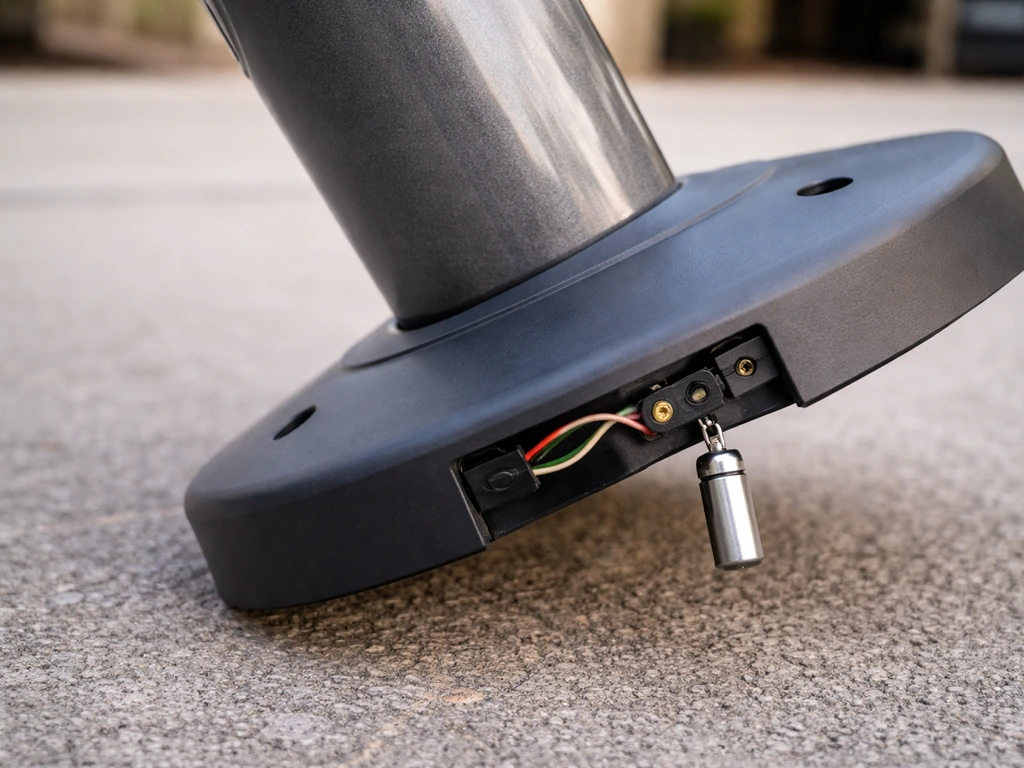
On most Endless Summer models, the tilt switch is a small weighted pendulum switch mounted near the base of the heater, wired in series with the gas valve circuit. If the heater tips beyond roughly 20 to 30 degrees, the pendulum swings, opens the circuit, and the valve closes. To reset it, make sure the heater is on a level surface, then simply ensure the unit is fully upright. On some models the switch resets automatically once level; on others you may need to turn the control knob to OFF and restart the lighting sequence. If the heater is on a slightly uneven surface and keeps shutting off, the tilt switch is doing its job. Level the surface or use adjustable leveling feet if your model has them.
Inspecting and testing the tilt switch
- Turn off the tank and let the heater cool completely before accessing the switch.
- Locate the tilt switch: on most mushroom-style Endless Summer heaters it is in the lower pole section near the base, accessible by removing a small access cover or sliding the pole sections apart.
- Visually inspect the switch for corrosion on the terminals or a broken wire connection. Tilt switches can corrode in outdoor environments and fail in the open (gas blocked) position.
- With the power disconnected and the tank off, use a multimeter set to continuity mode. With the heater upright, the switch should show continuity (closed circuit). Tilt it past the trigger angle and it should open. If it stays open when upright or stays closed when tilted, the switch is faulty.
- Replacement tilt switches are model-specific but widely available. Match the connector type and mounting style shown in your parts diagram.
ODS (Oxygen Depletion Sensor) on some models
Some higher-end Endless Summer models include an ODS pilot, which is designed to shut off gas if oxygen levels drop too low. These look like a standard pilot assembly but are more sensitive and will not light reliably if there is even a light breeze interfering with the flame. If your heater has an ODS pilot and you are trying to light it in windy conditions, find some shelter or use a windscreen. ODS components are not field-adjustable and need to be replaced as an assembly if they fail.
When to stop DIY: safety red flags and service/parts options
Most of the fixes above are well within DIY range if you are comfortable with basic tools and you are working methodically. But there are specific situations where you need to stop, step back, and either call a professional or retire the heater.
- You smell gas and cannot identify the source: this is not a troubleshooting step, it is an emergency. Shut off the tank valve, move away from the heater, and do not attempt to find the leak until the area is fully ventilated. Never use an open flame to check for leaks. Use a soapy water solution and look for bubbles at every fitting.
- The gas valve body is cracked, corroded, or shows burn marks: replace the entire valve, do not attempt to repair it. A failed valve can release gas uncontrolled.
- Any fuel line, hose, or regulator shows cracking, brittleness, or flaking: propane hoses and regulators have service lives. A cracked hose is a fire and explosion risk. Replace the full regulator and hose assembly.
- The heater has been flooded, knocked over into water, or stored in a way that allowed water into the burner or wiring: internal corrosion to the valve and wiring may not be visible. Have it inspected or replace the affected components before using it.
- You are troubleshooting a natural gas (NG) line connection rather than a propane tank: NG systems involve permanently plumbed lines and require a licensed gas technician for any connection, disconnection, or leak issue.
- Carbon monoxide symptoms: the official Endless Summer manual is explicit that these heaters are FOR OUTDOOR USE ONLY and that using them in any enclosed space (camper, tent, car, home) can kill you. If anyone experiences headache, dizziness, or nausea near the heater, get everyone into fresh air immediately and do not use the heater again until it has been inspected.
For parts, MrBarBQProducts.com is the most complete source for genuine Blue Rhino and Endless Summer replacement components including thermocouples, igniter assemblies, tilt switches, gas valves, and burner heads. Have your model number ready. For service, Blue Rhino's support line (1-800-762-1142) can refer you to authorized service centers, though for most homeowners the reality is that parts are cheap enough that a DIY repair is almost always more practical than a service call, as long as you stay within the safe boundaries above.
If you are looking at other brands while comparing options or troubleshooting a second unit, the diagnostic approach for safety sensors and ignition is largely consistent across gas patio heaters. If you are also checking a Kichler basics patio fan setup, keep the same mindset: confirm the exact model first and follow the correct wiring and safety steps from the right manual before troubleshooting patio heaters. The thermocouple and tilt switch logic on a Blue Rhino works the same way as on comparable models from other manufacturers, though the parts and wiring layouts differ enough that you always need the brand-specific manual for anything beyond basic cleaning and adjustment.
FAQ
Can I use a Blue Rhino or Endless Summer manual for a similar model if the heater looks the same?
Yes, but you must match the gas type suffix. If your model number ends in a propane or natural gas indicator (for example, a suffix like -LP or -NG), the valve and orifice sizing in the manual will differ. Using a correct-looking model number with the wrong gas configuration can cause unreliable ignition or incorrect flame behavior, so confirm the full model string before buying parts.
If my manual is missing, can I just replace the igniter or thermocouple based on what failed?
Do not. If the manual calls for a specific igniter type, wire routing, or a particular sensor model, you need that exact procedure. Swapping only a part without verifying the correct wiring diagram revision can lead to repeated shutdowns (thermocouple not holding) or no-spark conditions. Use the manual to confirm connector locations and component compatibility before replacing anything.
What’s the quickest way to narrow down the cause if the pilot ignites sometimes but not consistently?
A single “spark but no pilot” or “pilot won’t stay lit” symptom often has more than one root cause. The fast decision point is to confirm whether you get gas at the pilot after purging and whether the sensor is being heated properly by the flame. If you have spark, focus next on pilot gas flow and pilot assembly cleanliness, then loose sensor connections, before replacing the thermocouple.
My pilot stays lit but the main burner won’t start, what should I check first?
If the pilot lights but the main burner never catches, prioritize the pilot assembly secondary port cleaning (the additional flame path that heats/ignites the main burner). Compressed air is the first step, only probe gently if the manual allows it, and avoid enlarging any orifice.
How long should I purge the propane line if the pilot won’t light after tank hookup?
If you recently reconnected propane, air in the line is a frequent cause of delayed or failed pilot ignition. Hold the knob in the PILOT position and purge for up to 1 to 2 minutes, stop when you smell gas, then wait a full 5 minutes before retrying. Trying again too soon can keep you in a cycle of partial purge and weak pilot ignition.
How can I tell if the sensor problem is “no pilot flame” versus “pilot flame not being detected”?
Yes, and it can be confusing. Many models have a safety sensor and a flame signal sensor, so a failure can look like “no flame” even when the pilot is actually burning. If the heater shuts off as soon as you release the knob, treat it as a thermocouple or thermopile heating problem (flame contact, sensor condition, or connection).
My Blue Rhino heater shuts off after I move it, could the tilt switch be the issue, and how do I reset it?
If the heater keeps shutting off after being moved, a tilt switch is a common reason. Reset by putting the heater on a truly level surface. Some models auto-reset when upright, others require cycling the control knob back to OFF and restarting the lighting sequence. If it still won’t stay on, check that the heater is fully upright and not on a slope or uneven patio.
Why won’t my heater light reliably on windy days, and is that related to an ODS pilot?
Yes. For models with an ODS pilot, even a light breeze can interfere with the flame stability, which prevents reliable ignition or keeps the system from staying lit. Use a shelter or windscreen during lighting, and avoid trying to troubleshoot repeatedly in windy conditions because you can mask the real issue.
What should I check if I hear clicks or see sparks but nothing ignites?
If you see sparking behavior but no pilot ignition, do not assume the gas valve is good. Start by confirming propane is present and the valve is open, then verify you’re following the exact lighting steps for that model, including the purge timing. Only after confirming spark and gas delivery should you suspect a blocked pilot or a connection issue.
Is it safe to clear a clogged pilot or burner orifice if compressed air doesn’t work?
Use gentle cleaning and compressed air for pilot and burner ports, but never use a drill bit or rigid tool to clear an orifice. A slightly enlarged orifice can create an unsafe flame pattern. If compressed air fails, rely on the manual’s guidance and consider an orifice kit replacement rather than forcing the blockage out.
When downloading the right Blue Rhino patio heater manual PDF, what details matter besides the model number?
Check the full model string and gas suffix, then match the manual revision file code if the site provides it. Revision differences can include wiring connector changes or sensor updates, which is why the filename code matters even when the base model number looks identical. If the revision mismatch is uncertain, contact support with photos before proceeding with repairs.