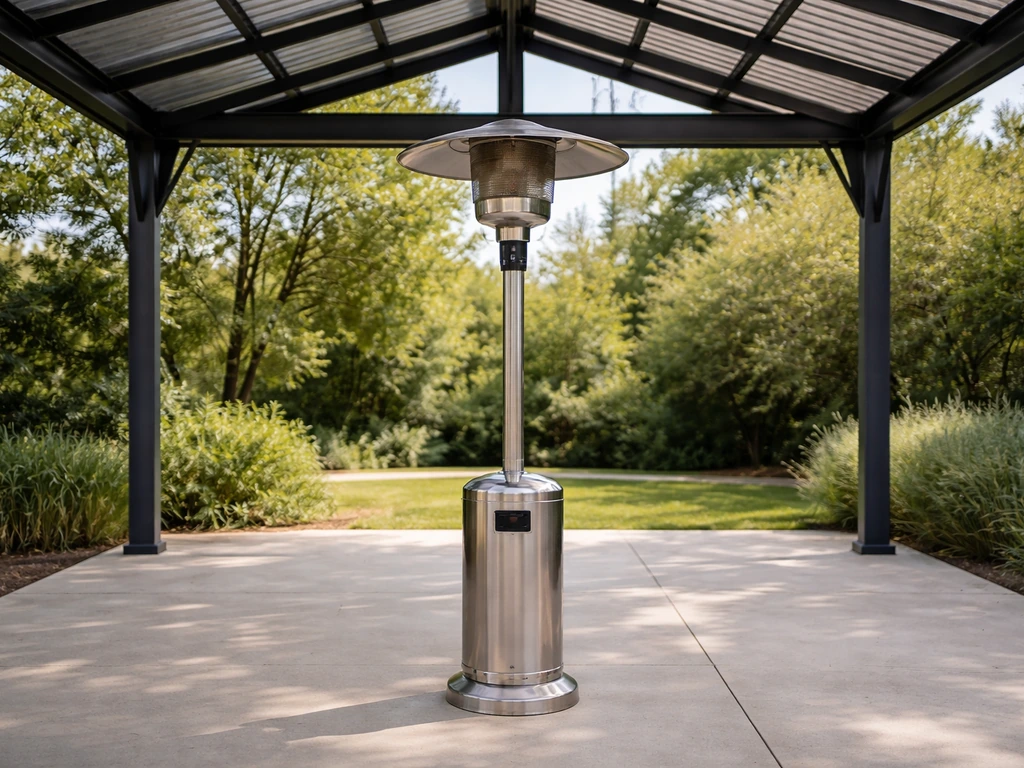
Yes, you can put a patio heater under a canopy, but only if you follow the clearance and ventilation rules specific to your heater type. Get it wrong and you're looking at heat damage to the canopy fabric, incomplete combustion from a gas heater starved of oxygen, or a fire. The short version: electric infrared heaters are the most forgiving under cover, gas heaters require strict clearance distances and open airflow, and a fully enclosed canopy is almost never safe for propane or natural gas.
Can You Put a Patio Heater Under a Canopy Safely?

Grant Mercer
9 Jul 2026
Safety rules for running a patio heater under cover
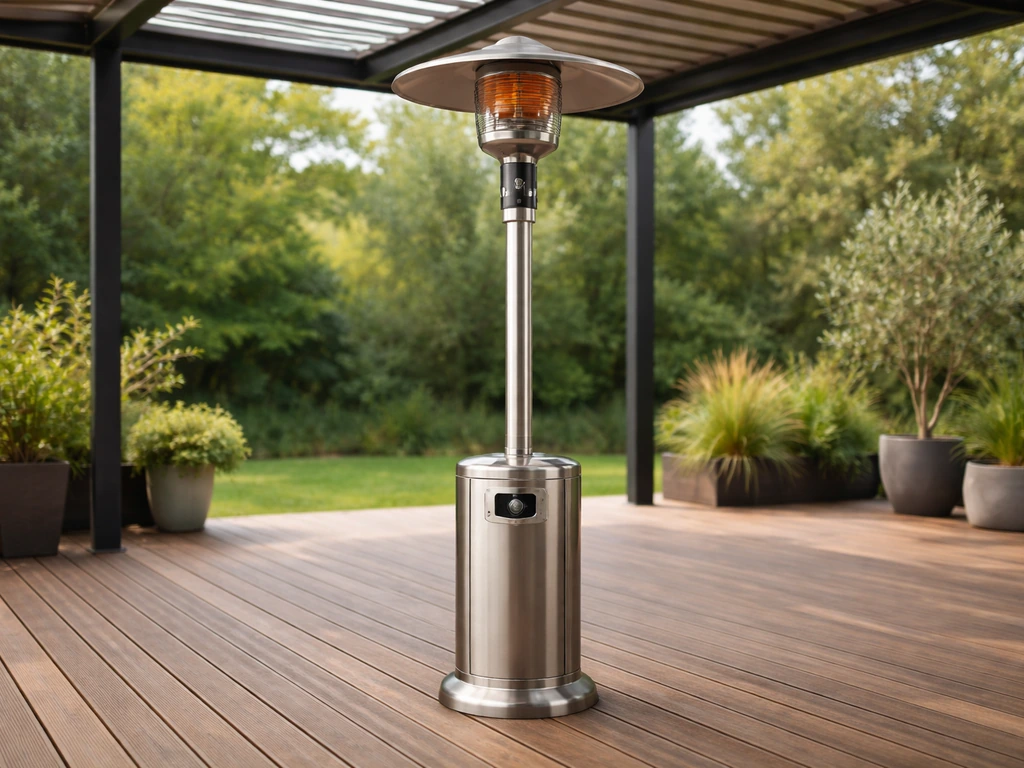
Before you fire anything up under a canopy, these are the non-negotiables. They apply regardless of heater brand or canopy style.
- Never run a gas patio heater (propane or natural gas) in a fully enclosed canopy. It needs open-air combustion pathways on at least two sides.
- Keep all combustible materials — fabric, wood, cushions, plastic — well outside the minimum clearance distances listed in your heater's manual. Those numbers are not suggestions.
- Never leave a gas patio heater unattended while it's burning. This is explicit language in Mr. Heater, Dyna-Glo, and most other manufacturer manuals, and it matters even more in a semi-enclosed space.
- Check the canopy material before assuming it's safe. Aluminum is non-combustible, but polyester, canvas, vinyl, and wood-frame canopies are not. The clearance rules still apply to non-combustible materials in terms of heat buildup, but combustible materials have hard fire-risk minimums.
- If your heater has a tip-over shutoff or ODS (oxygen depletion sensor), confirm it's working before using it under cover. Restricted airflow makes these safety features more relevant, not less.
- Clear the area around the heater of gasoline, flammable liquids, and any loose flammable material before lighting.
How canopy type and heater type change everything
Not all canopies are the same, and not all heaters respond to cover the same way. The combination of these two factors determines whether you're in safe territory or not.
Canopy types and what they mean for safety
| Canopy Type | Combustible? | Airflow Restriction | Gas Heater Risk | Electric Heater Risk |
|---|---|---|---|---|
| Open pergola (wood) | Yes | Low | High — combustible framing overhead | Moderate — watch clearances |
| Louvered aluminum pergola | No (frame) | Low to moderate | Lower but not zero — louvers can trap heat | Low if clearances met |
| Fabric sail shade / canopy | Yes | Low | High — fabric overhead is a fire risk | Moderate — heat can degrade fabric |
| Solid roof canopy (non-combustible) | No | Moderate | Moderate — watch exhaust/venting | Low if clearances met |
| Enclosed tent / gazebo | Usually yes | High | Very high — combustion air starved | Moderate — heat buildup risk |
| Retractable awning (fabric) | Yes | Low to moderate | High when extended overhead | Moderate |
Heater type matters just as much
Gas heaters (propane and natural gas) burn fuel and produce combustion byproducts. They need a steady supply of fresh air to combust properly and a clear path for exhaust to escape. Restrict either one and you get incomplete combustion, which produces carbon monoxide, and you also risk the heater shutting off unexpectedly. If you've ever had a gas patio heater that won't stay lit under a covered area, restricted airflow is one of the first things to check. Electric infrared heaters don't burn fuel, produce no combustion gases, and just radiate heat outward. That makes them significantly safer under cover, though clearance distances to combustibles still apply because the heating element gets extremely hot.
Exact clearances: where to measure and what numbers to use
Every heater manual includes a clearance-to-combustibles section, and those numbers vary by model. MR. HEATER’s owner documentation also includes a “Clearances to Combustibles” section that states the minimum distances you must keep clearance-to-combustibles section. Don't guess. Here are real examples from manufacturer documentation to give you a sense of the range:
| Heater / Source | Top Clearance | Side Clearance | Notes |
|---|---|---|---|
| AZ Patio Heaters (tabletop) | 18 inches (46 cm) | 24 inches (61 cm) | From combustible materials |
| AZ Patio Heaters (NCZH-GH) | 24 inches (61 cm) | 36 inches (91 cm) | Larger model, larger clearances |
| Dyna-Glo DGPH102SS | Varies by model | 24 inches (60.96 cm) minimum | Check top clearance separately |
| Patio-Pal PH series (under non-combustible surface) | 8 inches (20 cm) minimum | Per manual | Minimum to prevent control overheating |
| Rinnai SE Infrared | Per sell sheet dimensions | Per sell sheet dimensions | Orientation-specific; check manual |
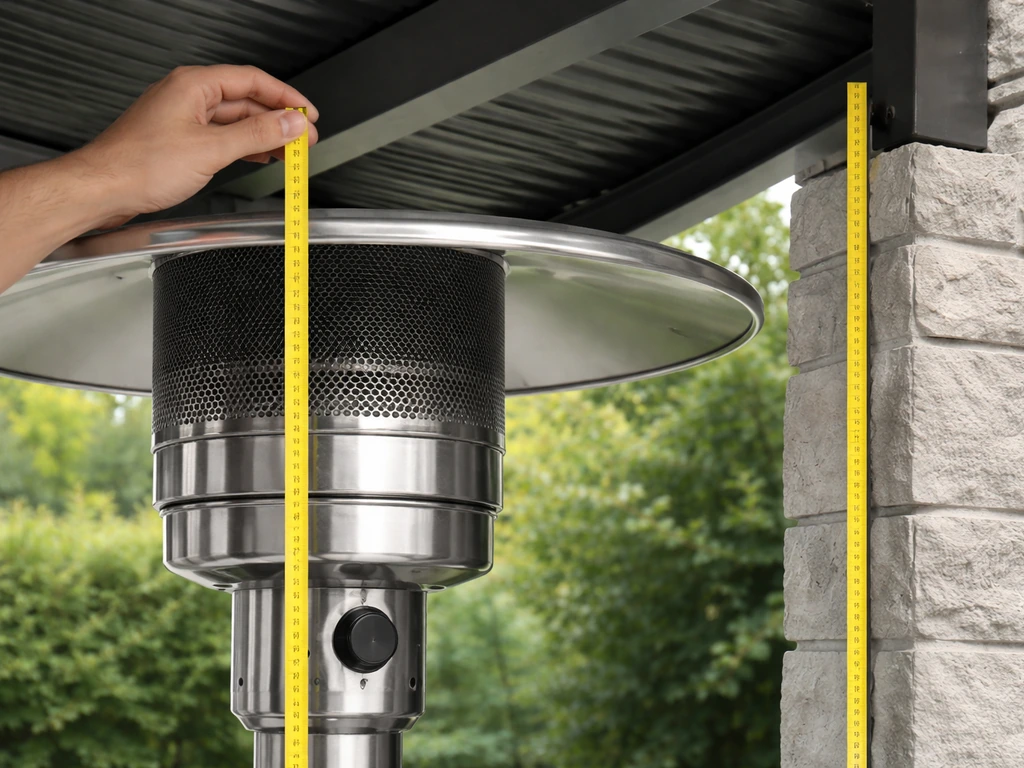
Notice that top clearance and side clearance are different numbers on every model. When you're placing a heater under a canopy, the top clearance is the one most likely to be violated first. Measure from the top of the heater (or the top of the reflector/emitter on a mushroom-style heater) to the underside of the canopy. On a tabletop model, 18 to 24 inches overhead clearance to combustibles is the minimum floor, and many full-size standing heaters need even more. The Patio-Pal note above is interesting because it acknowledges that even a non-combustible surface overhead can cause overheating of the heater's own controls if you get too close, the minimum there is 8 inches just to protect the unit itself.
Where exactly to position the heater under a canopy
Position matters in three dimensions. Here's how to think through each one.
Distance from walls and posts
Side clearances from combustible walls, wood posts, or fabric sides are typically 24 to 36 inches depending on the heater. If your canopy has fabric side curtains, those count as combustibles. Pull them back or tie them away from the heater's radiant zone. The heater should never be tucked into a corner where heat can bounce off two walls and accumulate.
Distance from the canopy ceiling
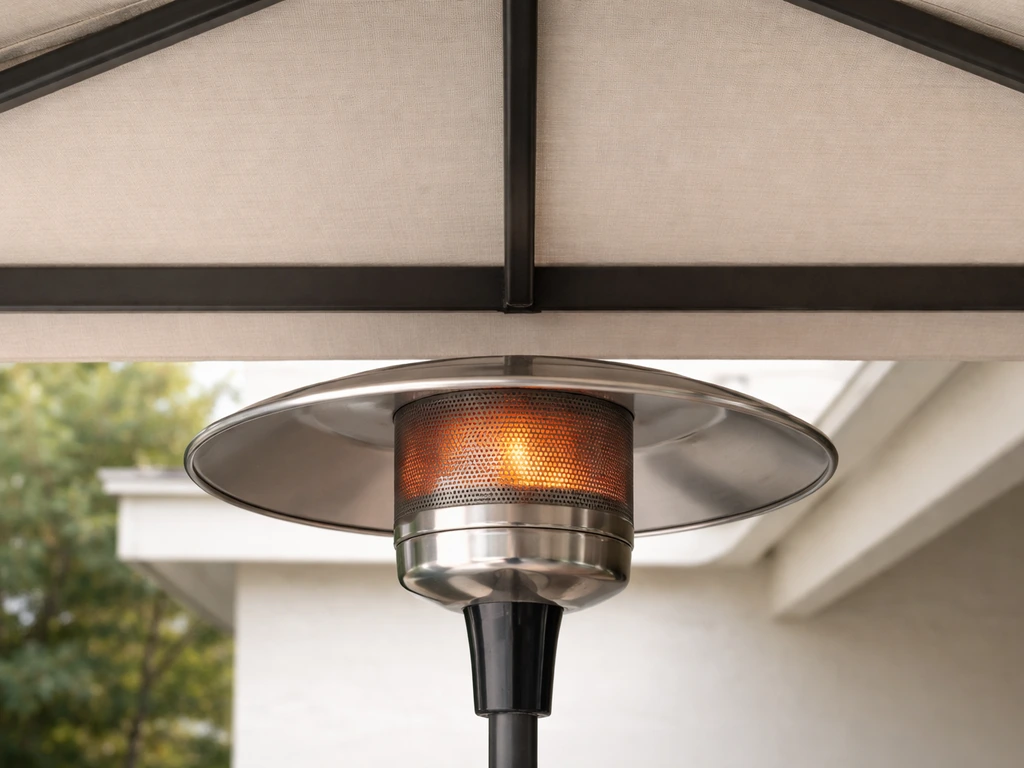
Measure from the highest point of your heater to the canopy underside. If that distance is less than what your manual requires for the overhead combustible clearance, you cannot safely run that heater there. In many cases, you can only use a patio heater under an awning if you meet the manufacturer’s overhead clearance and airflow guidance can you use a patio heater under an awning. A standard 7-foot freestanding gas patio heater under a 9-foot canopy might look fine, but the mushroom head puts the emitter at roughly 7 feet, leaving only 2 feet of clearance to a combustible canopy ceiling. Many manuals require 3 feet or more overhead. Run the actual tape measure before lighting up.
Distance from furniture and cushions
Outdoor cushions, umbrellas, and chair backs are all combustibles. Under a canopy, furniture tends to be clustered closer together. Keep the side clearance rules in mind for the furniture too, not just the structural canopy. An open side clearance to the canopy wall doesn't help you if there's a chair with a fabric cushion sitting 12 inches away from the heater.
Placement relative to canopy edges
Positioning the heater near the open edge of the canopy rather than the center or back wall is almost always the safer choice. If you're wondering can you leave patio heater outside in the rain, the safe approach is to treat rain exposure separately from heat clearance and follow your heater's rain and outdoor use guidance. Near the open edge, heat and combustion exhaust can escape freely, airflow is less restricted, and you have a buffer zone before reaching any combustible wall or fabric. Think of it as keeping the heater at the threshold of the covered space rather than deep inside it.
Airflow and combustion: the part most people get wrong
This is where the canopy situation gets genuinely dangerous for gas heaters, and where problems show up as operational failures before they become safety failures.
Propane and natural gas heaters
Gas heaters need a continuous supply of fresh outdoor air for combustion. The International Fuel Gas Code (IFGC) is built around this principle: blank" rel="noopener noreferrer">combustion air must communicate with the outdoor environment through open pathways, not trapped or enclosed spaces. Under a canopy, especially one with side curtains or panels, you can create a partial enclosure that gradually depletes the oxygen available to the burner. If you are wondering are patio heaters safe in garage, treat that like a partial-enclosure question too, because the same oxygen and exhaust-trapping issues can apply. The result: incomplete combustion, which produces carbon monoxide, and a flame that starts to behave erratically or extinguishes on its own. If you've ever had a patio heater that lights but won't stay lit under a covered space, oxygen starvation is on the diagnostic list alongside thermocouple and ODS issues. The IFGC also contains provisions preventing gas vent terminations directly below eaves and overhangs, because combustion exhaust trapped under an overhang can recirculate back into the combustion air supply.
Electric and infrared heaters
Electric infrared heaters don't burn fuel, so combustion air and exhaust venting are not concerns. That makes them dramatically more practical under a canopy. The main risks are heat buildup against the canopy surface above, and clearance distances to combustibles on the sides. An electric heater positioned too close to a low canopy ceiling can still scorch or melt fabric over time, even if there's no open flame. Use the clearance numbers in your manual, keep at least 18 to 24 inches to the canopy above unless the manual specifies otherwise, and you're in much safer territory than any gas option. Whether a patio heater melts snow depends mainly on the heater type, its clearance to combustibles, and how much heat it can radiate downward melt snow.
Wind and airflow inside canopies
Rinnai's technical documentation for the SE Infrared specifies a wind certification limit of up to 10 mph. Under a canopy, you might think wind is less of an issue, but partial enclosures can actually create unpredictable airflow patterns, channeling gusts through narrow gaps or creating eddies that disturb the heater's flame. A fully open outdoor placement is the baseline that manufacturer certifications assume. Anything else introduces variables that aren't accounted for in the testing.
What your manual says, and why you need to actually read it
Manufacturer clearance requirements are not generic guidelines you can approximate. They are part of the appliance listing under standards like ANSI Z83.26 / CSA 2.37 (the standard referenced directly in AZ Patio Heater manuals, for example). Under Wisconsin's administrative code and similar state rules, clearance values from listed appliance documentation are legally binding installation requirements unless the appliance label shows different values. That's not unique to Wisconsin; NFPA 54 and the IFGC both tie clearance compliance to appliance listing as a code requirement.
Here's what to look for in your manual specifically:
- Find the section titled 'Clearances to Combustibles' or 'Clearance to Combustible Materials.' It's usually a table or a labeled diagram.
- Note whether the numbers are different for top, sides, and front. They usually are.
- Check whether the manual distinguishes between combustible and non-combustible surfaces. Some manuals (like the Patio-Pal example) have separate minimums for non-combustible overhead surfaces.
- Look for any language about enclosures, covered areas, or overhead installation. Some manuals explicitly prohibit enclosed installation entirely.
- Check for notes about fire sprinklers. The Patio-Pal manual, for example, notes that sprinkler head clearance requirements may exceed the standard published clearances, which is relevant if your canopy is attached to a structure with a sprinkler system.
- If you don't have the manual, search for your model number plus 'owner's manual' or 'installation manual.' Most are available as PDFs directly from the manufacturer.
One thing that comes up repeatedly in homeowner discussions online is the question of whether an aluminum pergola counts as 'combustible.' The answer matters because some people assume that since aluminum doesn't burn, clearance rules don't apply. That's not quite right. The clearance-to-combustibles rules apply to combustible materials, so a bare aluminum frame might technically not trigger those specific minimums. But aluminum pergolas often include fabric panels, wood decking, or polycarbonate roofing that absolutely are combustible. And heat buildup under a non-combustible roof surface still matters for the heater's own components, as the Patio-Pal 8-inch minimum for non-combustible overhead surfaces shows.
If the clearances don't work, here are your real alternatives
Sometimes the honest answer is that your specific canopy and heater combination won't work safely, and the right move is to adjust the setup rather than push the limits. Here are practical alternatives that actually solve the problem.
- Switch to an electric infrared heater: If you're running a propane mushroom heater under a low canopy, swapping to a wall-mounted or ceiling-mounted electric infrared heater designed for covered outdoor use is often the cleanest solution. These are purpose-built for exactly this situation, they mount up high and radiate down, and they don't have combustion air requirements.
- Move the heater to the canopy edge: Position the heater at the open perimeter of the canopy rather than underneath it. You still get radiant heat in the covered seating area while the heater itself has unrestricted clearance and airflow. This is the most common practical workaround homeowners actually use.
- Use a tabletop heater with appropriate clearances: Some lower-output tabletop gas heaters have smaller clearance requirements than full-size freestanding models, which makes them more compatible with specific canopy heights. Check the numbers; this only works if the canopy height and material genuinely satisfy the manual's requirements.
- Choose a canopy designed for heater use: Some pergola and canopy products are specifically rated or designed for use with overhead or wall-mounted heaters. If you're building or replacing a canopy, look for models that include heater mounting provisions and non-combustible ceiling panels.
- Use a freestanding electric tower heater: These have a smaller heat footprint than mushroom-style gas heaters and typically require less overhead clearance. For a modest canopy with good side airflow, a quality electric tower heater can be a practical middle ground.
If you're also thinking about adjacent spaces like a screened porch, deck, or garage, the same clearance and ventilation principles apply, though each space has its own specific risk profile. If you're considering a patio heater on a deck, focus on clearance to combustibles and whether the space can provide enough fresh air for safe operation. A screened porch, for example, restricts airflow much more than an open canopy, which changes the gas heater calculus significantly.
Your checklist before turning the heater on under a canopy
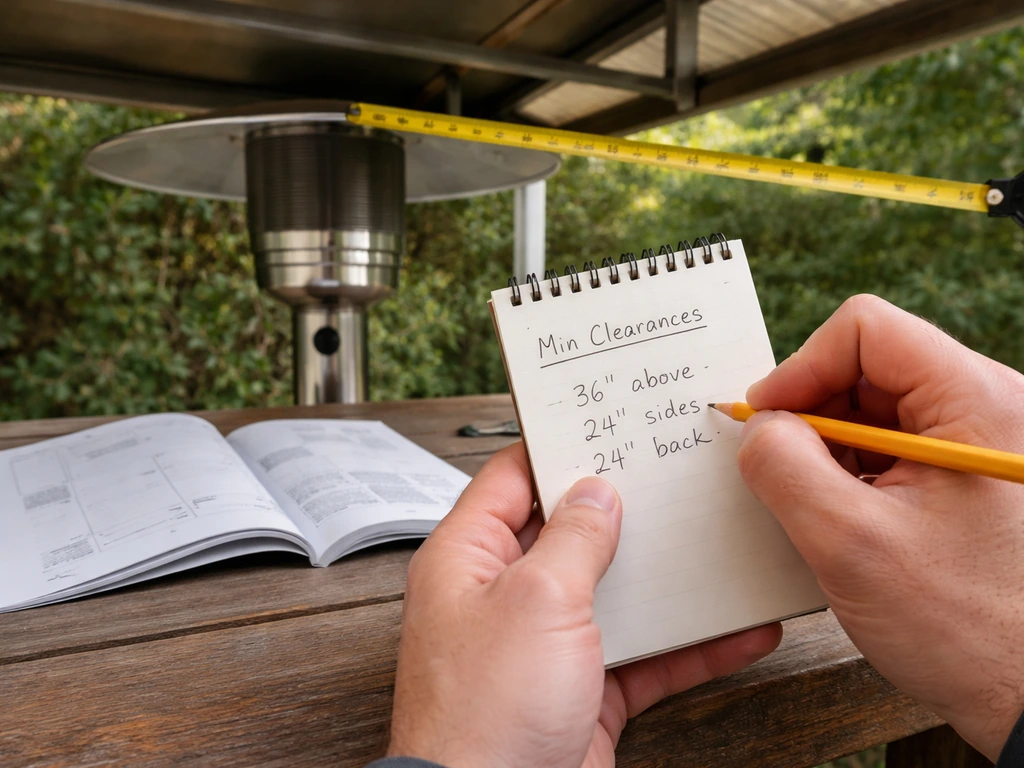
- Pull out the manual and find the clearance-to-combustibles section. Write down the top and side minimums.
- Measure from the top of your heater (not the base) to the underside of the canopy. Compare to the manual's top clearance minimum.
- Identify every combustible material within 36 inches in all directions: fabric, wood, cushions, plastic, paper. Move anything that's too close.
- Check whether the canopy has open sides or is partially/fully enclosed. If it's more than 50% enclosed on the sides, seriously reconsider running a gas heater.
- Verify the heater's safety shutoffs (tip-over switch, ODS pilot) are functioning before placing it in a constrained space.
- Position the heater near the open edge of the canopy, not the back wall or center.
- Never leave a gas heater unattended under cover.
- If any measurement doesn't clear the manual's minimums, use one of the alternatives listed above instead of improvising.
FAQ
What clearance measurements should I take when the heater sits under a canopy (top, sides, or both)?
Measure both the overhead distance and the side distances exactly as your manual states. For overhead, use the distance from the highest point of the heater (often the emitter head) to the underside of the canopy. For sides, measure to nearby combustibles that count, including fabric curtains and cushions, not just the structural posts.
Does an aluminum pergola count as non-combustible, so I can ignore canopy clearance rules for a patio heater?
Not automatically. Even if the frame is metal, many pergolas include materials that do count as combustibles (wood decking, fabric panels, polycarbonate sheets). Also, clearance requirements can still matter for heat buildup that can overheat the heater controls, so you should still confirm overhead limits for your exact roof material.
Can I use a gas patio heater under a canopy if I keep the sides open but there is a roof overhead?
Sometimes, but you must ensure the setup still provides an uninterrupted fresh-air path for combustion and a way for exhaust to escape. Side curtains, close eaves, or partially enclosed layouts can create oxygen depletion and incomplete combustion, which can show up as the heater not staying lit. If your canopy forms any partial enclosure, treat it like a ventilation-restricted situation, not an open outdoor placement.
Why does a gas heater light under a canopy but shut off after a few minutes?
That pattern often points to restricted oxygen supply and incomplete combustion, which can trigger safety shutoffs. It can also be caused by other issues, but under-canopy placement is a primary diagnostic lead. Double-check that the canopy arrangement does not reduce airflow compared with the open-air assumptions used in the heater’s testing and requirements.
Is an electric infrared patio heater always safe under a canopy as long as there is no open flame?
It is generally safer than gas, but not risk-free. Infrared heaters can still scorch or melt nearby materials if overhead clearance is too tight or if fabric side elements sit within the side-clearance zone. Confirm both clearances to combustibles, then keep fabric furniture and curtains pulled back from the radiant area.
What should I do if my heater manual says different overhead clearance than what I assumed (like 8 inches vs 18 to 24 inches)?
Use the number from your specific heater model and heater head style, because controls and emitter design can change the minimums. If your unit allows only a very small overhead clearance for non-combustible surfaces but you have any combustible layers in the canopy (or combustible furnishings nearby), you still must comply with the combustible clearance requirement that applies to your setup.
Does patio heater wind rating matter under a canopy, even though the canopy blocks some weather?
Yes. Partial enclosures can create unpredictable airflow patterns, channeling gusts through gaps or forming eddies that disturb the heater’s operation. If your manual includes a wind certification limit or placement guidance, follow it. If your canopy has side panels or curtains, treat airflow as more variable than you might expect.
Can I place a patio heater near the center of the canopy instead of the open edge?
The open edge is usually the safer placement because it provides more buffer distance before heat and, for gas units, combustion products can reach walls and fabric. Center placement can trap heat in the covered area and, for gas heaters, increase the likelihood of restricted airflow. If the canopy is deep, plan to keep the heater nearer the threshold rather than tucked to the back wall.
Do outdoor cushions, umbrellas, and chair backs count as combustibles for clearance purposes under a canopy?
Yes. Treat soft furnishings and umbrella fabric as combustibles and apply the side clearance rules to them, not just the canopy posts. A chair that is safely spaced from the heater at first glance can still violate clearance once it shifts closer due to how people naturally arrange seating.
Is a screened porch safer than an open canopy for running a patio heater under cover?
Usually no for gas heaters. Screening and partial enclosure often restrict airflow more than an open canopy, which changes combustion-air availability and exhaust escape. If your space is enclosed enough to limit fresh-air communication, follow the gas heater guidance as if it were ventilation-restricted, or choose an electric infrared unit instead.