
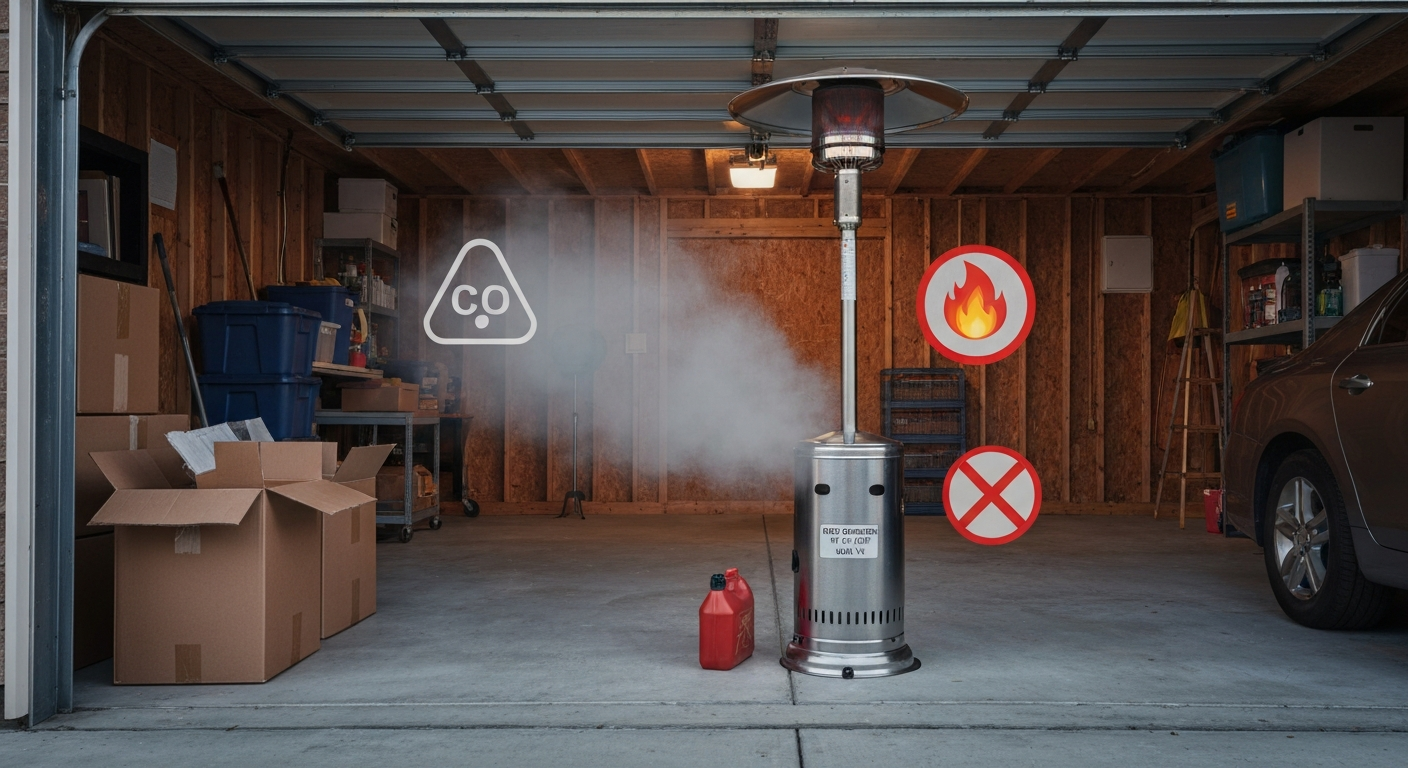
No, most patio heaters are not safe to use in a garage. Nearly every propane and natural gas patio heater on the market carries an explicit 'FOR OUTDOOR USE ONLY' label in the owner's manual, and for good reason: burning fuel in an enclosed space like a garage produces carbon monoxide, depletes oxygen, and creates a real fire and explosion risk. For example, the Mr. Heater Portable Big Buddy, Operating Instructions and Owner's Manual (example) explicitly labels the unit "FOR OUTDOOR USE ONLY." Mr. Heater Portable Big Buddy — Operating Instructions and Owner's Manual (example). Some electric and infrared heaters designed for enclosed spaces are a different story, but you need to verify the specific unit's listing before trusting it indoors. The bottom line is that if your heater's manual says outdoor use only, that guidance exists because the unit was never engineered, tested, or certified for the air-quality demands of a closed space.
Are Patio Heaters Safe in a Garage? Risks, Rules, Safety

Emergency steps first: what to do if something goes wrong
Before anything else, bookmark these steps. If you are already using a patio heater in a garage and something feels wrong, act immediately. Do not wait to diagnose the problem.
If you suspect carbon monoxide exposure (headache, dizziness, nausea, confusion)
- Get everyone, including pets, out of the garage immediately. Do not stop to turn anything off first.
- Leave the garage door open as you exit to begin ventilating the space.
- Call 911 from outside. Do not re-enter until emergency responders have cleared the space.
- Seek fresh air immediately. Anyone with symptoms needs medical evaluation, even if they feel better outside.
- Do not use the heater again until you have identified why CO accumulated and resolved the cause.
If you smell gas (propane or natural gas leak)
- Do not flip any light switches, use your phone, or operate any electrical device inside the garage. Sparks can ignite gas.
- Do not attempt to find or fix the leak yourself.
- Shut off the gas supply at the tank valve or meter if it is safe to reach without entering the affected area.
- Exit immediately and leave doors open behind you.
- Call your gas utility or 911 from a safe distance. Do not re-enter.
If a fire starts
- Evacuate everyone immediately.
- Call 911 from outside. Do not attempt to fight a gas-fed fire yourself.
- If a propane cylinder is involved, assume it can BLEVE (boiling liquid expanding vapor explosion). Stay far away and keep others back.
- Do not re-enter for any reason until fire services arrive.
If you suspect electrical shock from a plug-in or hard-wired electric heater
- Do not touch the person if they are still in contact with the electrical source.
- Kill power at the breaker panel before approaching.
- Call 911 even if the person seems uninjured. Cardiac effects from shock can be delayed.
- Do not use the heater again until a licensed electrician has inspected the wiring and the unit.
How different fuel types stack up for garage safety
Not all patio heaters carry the same risk in an enclosed space. The fuel type is the single biggest variable. Here is an honest comparison of the four main categories you will encounter.
| Heater Type | CO / Combustion Risk | Oxygen Depletion | Fire / Explosion Risk | Typically Rated for Enclosed Use? | Practical Verdict |
|---|---|---|---|---|---|
| Propane / LPG | High — incomplete combustion in low-oxygen environments produces CO rapidly | Yes — consumes oxygen as it burns | High — propane is heavier than air and pools at floor level; ignition sources (water heater, car ignition) are common in garages | No — nearly all consumer patio heaters are 'Outdoor Use Only'; certified ANSI Z83.26 units are not listed for indoor/garage use | Do not use in a garage |
| Natural Gas (piped) | High — same combustion chemistry as propane; incomplete combustion worsens without adequate fresh-air supply | Yes | Moderate to high — gas lines add leak points; ignition sources in garages are common; codes (NFPA 54) require specific combustion-air provisions and appliance placement rules | No — outdoor-certified gas patio heaters are not listed for garage installation; NFPA 54 regulates appliance location and combustion air requirements | Do not use a patio heater; consult a licensed plumber/gas fitter about a properly vented, code-compliant garage heater instead |
| Electric (resistance) | None — no combustion | None | Low to moderate — risk depends on wiring quality, circuit capacity, and keeping clearances from combustibles | Sometimes — depends on the unit's IP rating and listing; many electric infrared and fan-forced units carry indoor/garage ratings if properly installed | Only if the unit is specifically listed and rated for indoor or garage use; verify the label and install to code |
| Electric Infrared | None — no combustion | None | Low — surface temperatures on nearby combustibles can be an issue if clearances are ignored | Sometimes — commercially rated infrared electric units are often listed for indoor industrial or garage use; residential patio-style infrared panels vary | Potentially yes, if the specific unit carries an indoor or garage listing — always check the manufacturer's label and required clearances |
The takeaway is straightforward: any heater that burns fuel (propane, natural gas, or LPG) is off the table for garage use unless it is a purpose-built, code-compliant, properly vented unit installed by a licensed contractor, not a freestanding patio heater dragged indoors. Electric units are the realistic path if you want heat in an enclosed garage, but you still need to verify the specific product's listing and your home's electrical capacity.
Carbon monoxide, oxygen depletion, and what they actually do to you
Carbon monoxide is the reason 'outdoor use only' warnings exist on gas patio heaters. CO is colorless and odorless, which means you will not notice it building up until it is already affecting your brain. Any gas or propane flame produces some CO, and in a properly ventilated outdoor space, it disperses harmlessly. In a closed garage, it accumulates.
NIOSH sets the recommended exposure limit for CO at 35 ppm as an 8-hour average, with a ceiling of 200 ppm that should never be exceeded. OSHA's permissible exposure limit is 50 ppm. At 200 ppm, a healthy adult experiences headache within two to three hours. At 400 ppm, the headache is severe and life-threatening exposure occurs within three hours. At concentrations above 1,600 ppm, incapacitation and death can happen within an hour. A typical two-car garage is around 500 to 600 square feet with 8-foot ceilings, giving you roughly 4,000 to 4,800 cubic feet of air volume. A standard mushroom-style propane patio heater burns at 40,000 to 46,000 Btu/hr. The combustion math works against you quickly in that volume.
Oxygen depletion adds a second, compounding hazard. Gas combustion consumes oxygen from the surrounding air. NFPA 54 (the National Fuel Gas Code) defines a 'confined space' as any area providing less than 50 cubic feet of volume per 1,000 Btu/hr of appliance input. A 40,000 Btu/hr heater requires at least 2,000 cubic feet of free air volume to even qualify as 'unconfined' under that standard, and most residential garages barely meet that threshold before you account for the car, storage, and the fact that garage doors seal better than you think. Units designed for unvented indoor use are certified under ANSI Z21.11.2, which requires a factory-installed oxygen depletion sensor (ODS) that shuts the burner off before CO reaches dangerous levels. Standard outdoor patio heaters certified to ANSI Z83.26 are not required to have an ODS, and most do not have one.
Beyond CO and oxygen, combustion also produces nitrogen oxides and, with propane and natural gas, traces of benzene and other partial-combustion byproducts. These matter for anyone spending extended time in a partially ventilated garage. A cracked door does not reliably dilute combustion gases from a 40,000 Btu burner, it reduces the risk somewhat but does not make it safe.
Fire, tipping, and structural ignition risks
Combustion appliance fires in garages are a recurring pattern in fire department incident reports. Garages are full of ignition hazards: cans of gasoline, motor oil, paint thinner, cardboard boxes, wood shelving, and the car itself. A patio heater adds both an open flame and a pressurized fuel source to that environment.
Propane is heavier than air. If a cylinder connection leaks or the regulator fails (the CPSC recalled Coleman patio heaters in 2005 specifically for regulator leak hazards), propane gas settles at floor level and can travel across the garage to reach a water heater pilot light, a vehicle's hot catalytic converter, or a light switch before you smell anything. The result can be a flash fire or explosion rather than a gradual ignition.
Tip-over risk is real in a garage environment. Tall mushroom-style patio heaters have a high center of gravity, and a garage floor may have a car bumper, garden tools, or a hose on the floor that can catch a heater base. Many outdoor-listed patio heaters do include tip-over auto-shutoff switches, but these are designed to kill the flame after the heater falls, not to prevent structural ignition from a heater that has already tipped against a wooden wall or cardboard box. If the tilt switch is faulty or has been bypassed (a common issue I see on this site), that last line of defense is gone.
Manufacturer manuals for commercial and residential gas patio heaters specify clearance distances from combustibles, and these are specific to each model. Detroit Radiant and similar commercial units, for example, list precise ceiling, side, and front clearances in their installation guides. In a typical home garage, meeting those clearances while also keeping clear of a parked car and standard shelving is often physically impossible.
One more structural note: code guidance (IRC/IMC and NFPA 54 commentary) often requires that fuel-fired appliances with ignition sources in garages be elevated at least 18 inches above the floor to keep ignition sources above the zone where spilled gasoline vapors accumulate. A portable patio heater sitting on the floor violates that requirement outright.
Electrical risks for plug-in and hard-wired electric heaters
Electric heaters do not produce CO or consume oxygen, so they address the two biggest combustion hazards. But they introduce their own set of risks in a garage environment that are worth understanding before assuming an electric patio heater is automatically safe indoors.
Most residential garages have limited dedicated circuit capacity. A 1,500-watt plug-in electric heater draws about 12.5 amps on a 120V circuit. Many garage circuits are shared with lighting, door openers, and outlets, and are often protected by a 15-amp breaker. Running a 1,500-watt heater near the limit of a shared circuit is a recipe for nuisance tripping, or worse, sustained overloading of a circuit that does not trip promptly. Higher-output electric heaters (240V units rated at 4,000 watts or more) require a dedicated circuit and proper hard-wiring by a licensed electrician.
Extension cord use is a consistent fire hazard. The interior-focused, warm-weather design of many patio-style electric heaters means the power cord may not be rated for outdoor or garage environments where moisture, oil, and mechanical stress are present. Using an undersized or damaged extension cord with a high-draw heater causes resistive heating in the cord itself, which can start a fire inside a wall or under debris on a garage floor.
GFCI protection matters in a garage. Model codes (IRC E3902) require GFCI-protected outlets in garages, and GFCI protection is essential for any electric heater used in a damp or partially outdoor-connected space. If your garage outlets do not have GFCI protection, that is a pre-existing electrical safety issue that should be corrected regardless of whether you use a heater.
The IP (ingress protection) rating on an electric heater tells you whether it can handle the dust and moisture conditions typical in a garage. A heater rated IP44 or higher is splash-resistant; a heater with no IP rating or only IP20 is designed for a clean, dry indoor environment. Many outdoor-patio-style electric infrared panels carry higher IP ratings and can be appropriate for a garage if their listing covers enclosed use, but verify this on the label, not in advertising copy.
Reading manufacturer labels and warning stickers
The single most reliable source of information about what a heater is certified to do is its own label plate and owner's manual. Marketing materials, box copy, and retailer descriptions are not safety documentation. Here is what to look for.
- Use designation: look for 'FOR OUTDOOR USE ONLY' or 'Indoor/Outdoor Use Permitted.' This is the most direct guidance. If it says outdoor only, the conversation ends there.
- ANSI/CSA standard listing: gas patio heaters certified to ANSI Z83.26 / CSA 2.37 are outdoor patio heaters by definition. Heaters certified to ANSI Z21.11.2 are listed for unvented indoor use and must include an ODS. These are fundamentally different products.
- Clearance stickers: look for minimum clearance distances to combustibles on the label plate or in the installation manual. These are model-specific — do not apply one model's clearances to a different heater.
- UL, CSA, or ETL listing marks: these indicate the unit was tested by a nationally recognized testing laboratory to a specific standard. The listing is only valid when the heater is used within the conditions of the listing (fuel type, location, clearances, mounting).
- Propane cylinder storage warnings: look for explicit language about disconnected cylinders. Most propane patio heater manuals state that cylinders must not be stored inside a building or garage, even when disconnected. This is a separate hazard from operating the heater.
- Altitude and ventilation requirements: some commercial infrared gas heaters specify ventilation area or air-change requirements. If those requirements cannot be met in your garage, the heater cannot be safely operated there.
If your heater's label plate is missing or unreadable (common on older or secondhand units), contact the manufacturer with the model number for the original documentation. Do not guess at the listing or clearance requirements. The manual, not memory or assumption, is the authority.
Local codes, permits, and who to call before you install anything
Manufacturer instructions set the floor for safety requirements; local codes set the ceiling. In practice, local codes often add restrictions on top of what the manufacturer requires, and in some jurisdictions those restrictions are substantial.
The National Fuel Gas Code (ANSI Z223.1 / NFPA 54) governs gas piping, combustion air requirements, and appliance installation for most of the United States. Most patio heater installation manuals explicitly direct installers to comply with NFPA 54 and local amendments. The International Residential Code (IRC) and International Mechanical Code (IMC) both contain provisions on appliance placement in garages, combustion air, and ignition-source elevation requirements. Locally adopted amendments to these model codes vary significantly by jurisdiction, what is permitted in a rural county may be prohibited outright in a dense city.
New York City, for example, has its own administrative code provisions governing portable heating equipment placement and clearances that go beyond model code minimums. Many other municipalities have similar local amendments. The only way to know what applies to your address is to contact your local building or fire department.
For any gas appliance you are considering installing in a garage, whether a proper through-wall vented unit or an infrared heater hard-plumbed to natural gas, call or visit your local building department and ask whether a permit is required. For most permanently installed gas appliances, the answer is yes. Unpermitted gas appliance installations can void homeowner's insurance coverage and create liability if an incident occurs.
Contact these parties before proceeding with any permanent garage heating installation:
- Your gas utility: to confirm line capacity, meter sizing, and whether outdoor-sited patio heaters require notification or approval for connection.
- Your local building department: to determine permit requirements for gas or electrical work and any local amendments to the model codes.
- Your local fire marshal or fire prevention bureau: especially if you are in a multi-unit building, HOA, or municipality with specific rules about portable fuel-burning equipment.
- A licensed plumber or gas fitter: for any gas line connection or modification. This is not DIY territory.
- A licensed electrician: for any new 240V circuit or sub-panel work for a high-output electric heater.
This article is a starting point for understanding the hazards and the framework. Manufacturer instructions and your local authority having jurisdiction (AHJ) are the final word on what is permitted for your specific heater, your specific garage, and your specific address.
What to do if you absolutely need heat in a garage
If you need to heat a garage for a workshop, car project, or home gym, there are legitimate paths forward that do not involve running an outdoor patio heater indoors.
Safer alternatives worth considering
- Electric resistance or infrared heaters with an indoor/garage listing: units specifically listed and rated for enclosed spaces, installed on a dedicated circuit with GFCI protection and proper clearances, carry no combustion risk and are a practical solution for most one- or two-car garages.
- Through-wall vented propane or natural gas heaters: purpose-built garage heaters (brands like Mr. Heater Big Maxx, Modine, or similar) are engineered for enclosed spaces, have power-vented combustion, and are sized to the space. They require professional gas and possibly electrical installation.
- Mini-split heat pumps: a permanent solution with no combustion, no venting, and heating plus cooling capability. Installation cost is higher but the safety and efficiency profile is the best available.
- Outdoor placement with a nearby workspace: for short tasks, positioning a properly rated patio heater just outside an open garage door can provide radiant heat to the work area without enclosing the combustion source.
- Insulating the garage: adding insulation to the door and walls dramatically reduces how much heating capacity you need and makes electric heating practical even in cold climates.
If you proceed with any gas or electric heater in a partially enclosed space: a safety checklist
- Verify the heater's listing and use designation in the owner's manual before bringing it indoors. If it says outdoor use only, stop here.
- Install at least one UL 2034-listed CO alarm at head height in the garage, placed per NFPA 720 guidance. Test it before first use and monthly thereafter.
- Ensure adequate ventilation. For a gas heater, calculate whether your garage meets the 50 cubic feet per 1,000 Btu/hr unconfined-space threshold under NFPA 54. If it does not, you need mechanical makeup air or combustion-air openings.
- Check and comply with all manufacturer-specified clearance distances from combustibles. Measure, do not estimate.
- Inspect the gas hose and regulator before every use. Apply soapy water to all connections and look for bubbles. Any leak means no operation until the faulty component is replaced.
- Confirm the tip-over auto-shutoff switch is functional. On most gas patio heaters, you can test this by tilting the unit slightly off level with the burner running — the flame should extinguish. If it does not, the tilt switch needs repair before any use.
- Keep the garage door cracked open at minimum during operation. A 6-inch gap at the bottom provides some air exchange but is not a substitute for proper ventilation.
- Remove or relocate gasoline, paint, solvents, and other flammables before operating any heater in the space.
- Never leave a gas heater running unattended in an enclosed or partially enclosed space.
- Store propane cylinders outdoors only, even when disconnected from the heater. Most manufacturer manuals explicitly prohibit cylinder storage inside a building or garage.
Maintenance and safety-related troubleshooting
Safe operation depends on a heater that is functioning correctly. Several failure points directly affect whether a heater's safety systems will work when needed. These are the items worth checking before every season and before any use in a confined or partially enclosed space.
Tilt switch function
The tilt switch is a mercury or ball-bearing sensor at the base of most gas patio heaters that shuts off the gas valve if the heater tips over. A faulty tilt switch either fails to close the circuit in normal operation (heater will not stay lit even upright) or fails to open the circuit when the heater tilts (heater stays lit when knocked over). Both failure modes are dangerous. Testing is straightforward: with the heater lit and running, gently tilt it past about 30 degrees. The flame should go out within a few seconds. If it does not, the tilt switch needs replacement before the heater is used again, especially in any enclosed or semi-enclosed location.
Thermocouple and ignition
The thermocouple is a heat-sensing safety device that keeps the gas valve open only when a flame is confirmed. A weak or failing thermocouple causes the heater to light and then go out within 30 to 90 seconds after you release the ignition button, a very common complaint. This is actually the safety system working, but it signals that the thermocouple needs cleaning or replacement. The underlying issue matters here: a thermocouple that partially fails and allows gas flow without a confirmed flame is a hazardous condition. Do not bypass or tape down the ignition button as a workaround, that eliminates the flame-failure shutoff entirely.
Regulator and hose inspection
Propane hoses degrade with UV exposure, ozone, and physical wear. Inspect the full length of the hose for cracking, brittleness, or bulging before each season. The regulator should click smoothly and the hose connections should be snug. The soap-bubble leak test is the minimum check before every use. CPSC recall history documents cases where regulator failures in patio heaters caused gas leaks at the connection point, a reminder that this is a real failure mode, not a theoretical one. Replace any hose or regulator that is more than five years old or shows visible deterioration.
Related questions homeowners often ask
The garage question is part of a broader set of concerns about where patio heaters can safely operate. A few closely related scenarios come up constantly.
Using a patio heater on a deck follows a different risk profile than garage use because a deck is typically open to the atmosphere and natural ventilation handles combustion gases. Clearance from overhead structures, combustible decking, and railing materials are the primary concerns there. See can you use a patio heater under an awning for tailored guidance on clearances and safe operation under awnings. Similarly, using a patio heater under a canopy or awning raises overhead clearance and ventilation questions: whether a given canopy structure provides enough open volume and air movement to prevent CO accumulation matters, and manufacturer clearance requirements still apply even in semi-covered outdoor settings. See also our guidance on 'can you leave patio heater outside in the rain' for tips on weather exposure, storage, and protecting components from moisture.
Screened porches occupy a middle ground: better ventilated than a garage but more enclosed than open air. The screen mesh allows some air exchange, but a large screened porch with minimal wind can accumulate combustion gases from a propane patio heater operating at full output. Treat a screened porch with the same scrutiny you would apply to a semi-enclosed space: check the heater's listing, verify ventilation is genuinely adequate, and use a CO detector.
For electric patio heaters left outdoors permanently, whether on a deck, under an awning, or in the rain, the relevant concern shifts entirely to electrical safety: IP rating, UV-resistant cord and housing, GFCI protection, and whether the unit is designed to handle moisture. A heater rated for outdoor permanent installation is a very different product from one meant to be brought inside between uses.
And on the lighter side of patio heater questions: whether a patio heater will melt snow depends almost entirely on the output, the proximity, and the wind, a 40,000 Btu propane heater will clear frost and light snow from a small area around it, but it is not a practical snowmelt tool for a driveway or walkway.
The honest bottom line
If your patio heater's manual says 'FOR OUTDOOR USE ONLY,' that is the answer. Using it in a garage, even with a door cracked, even for a short time, puts you in a situation where the heater's own safety engineering was not designed to operate. The specific hazards (CO accumulation, oxygen depletion, explosion risk from pooling propane, structural fire risk from clearance violations) are individually serious and compound each other in a closed space. For anyone who genuinely needs heat in a garage, the right path is an appliance designed, tested, and certified for that environment, installed to code, with CO detection in place. That is a more involved project than rolling a patio heater inside, but it is the one that does not carry a preventable life-safety risk.
FAQ
Short answer: Are patio heaters safe to use inside a garage (for homeowners and renters)?
No—most consumer patio heaters (propane or natural‑gas freestanding/standing models) are labeled FOR OUTDOOR USE ONLY and are not safe for use inside garages. Using an outdoor‑rated gas patio heater in a garage risks carbon monoxide (CO) poisoning, oxygen depletion, fire/explosion and regulatory/code violations. Manufacturer manuals and local building/fire codes are the final authority; check the specific unit’s label and instructions before any nonstandard use (see example: Mr. Heater and other manuals: https://mrheater.com/pages/general-product-info and https://manuals.plus/m/f47a1d3665acec59e7c8e93d87857a79ca83a32f8d5a21d4f60e4ca8ec87594b#manual).
How do patio heater fuel types compare for indoor/garage safety (propane/LPG, natural gas, electric, infrared)?
Propane/LPG: common portable patio heaters run on LP and produce combustion byproducts (CO, NO2); most are outdoor‑only and cylinders must be stored outdoors. Natural gas: similar combustion risks; some permanently plumbed infrared gas heaters are listed for semi‑enclosed commercial use but require code‑compliant installation and combustion air. Electric (resistive): produce no combustion gases and are far safer for enclosed spaces if rated for indoor/outdoor exposure and used per electrical and wet‑location ratings. Infrared electric: safe like other electric heaters if properly rated. Summary: gas fuels introduce combustion/CO hazards—avoid in garages unless the unit is specifically listed for indoor use and installed per codes; electric units are the safer choice for enclosed spaces (but must be weather/electrical rated).
What are the main hazards of using a patio heater in a garage?
Primary hazards: 1) Carbon monoxide and incomplete combustion—CO can accumulate and poison occupants; 2) Oxygen depletion—unvented gas burners consume indoor air; many outdoor patio heaters lack oxygen‑depletion sensors (ODS); 3) Fire and ignition—hot surfaces, clearance breaches, and stored combustibles in garages raise fire risk; 4) Tipping/combustion of nearby items—many freestanding models can tip and cause ignition; 5) Gas leaks and explosion risk from cylinders, regulators and hoses; 6) Electrical hazards—using non‑rated electric heaters, extension cords, or exposure to moisture can cause shock/fire. See CPSC advice and product manuals/recalls for examples: https://www.cpsc.gov/Recalls/2005/CPSC-The-Coleman-Company-Inc-Announce-the-Recall-to-Repair-Coleman-Gas-Grills-and-Patio-Heaters.
Do manufacturer labels and codes allow indoor use of any patio heaters?
Some portable gas heaters are specifically listed by manufacturers for limited indoor use (camp/emergency models) and include required safety features (ODS, tip‑over shutoff, certified hose/regulator). However, most patio heaters are certified only as outdoor gas‑fired patio heaters (ANSI Z83.26 / CSA 2.37) and are labeled FOR OUTDOOR USE ONLY. Codes (NFPA 54 / ANSI Z223.1, IRC, local fire codes) and manufacturer instructions govern allowable locations, combustion‑air provisions and required clearances. Always follow the unit’s manual and local code authority—manufacturer instructions and local permit/code officials are final.
What is a practical 'if you must' decision flow for using a heater in a garage?
Decision flow (short): 1) Check the product label/manual—if it says OUTDOOR USE ONLY, do not use indoors. 2) If the heater is listed for indoor use, verify it includes ODS, tip‑over shutoff and listed hose/regulator and follow manufacturer limits. 3) Confirm garage volume and total BTU: NFPA/ANSI combustion‑air guidance requires >50 ft³ per 1,000 Btu input to be 'unconfined'; otherwise, mechanical outdoor combustion air is needed. 4) Ensure fixed gas supply installations follow NFPA 54; obtain permits if required. 5) If any of the above fail, choose a safer alternative (electric indoor‑rated heater or outdoor placement). Consult local code enforcer or manufacturer tech support for a binding decision.
Step‑by‑step safety checklist for 'if you must' use a heater in a garage
Checklist: 1) Verify the unit is listed/approved for indoor use in its manual. 2) Install and test CO alarms (UL 2034) installed per NFPA 720 (outside sleeping areas and on each level; garages attached to dwellings require alarms). 3) Ensure adequate combustion air or mechanical makeup air (follow NFPA 54/ANSI requirements). 4) Keep required clearances from ceilings, walls and combustibles per the manual. 5) Never store LP cylinders inside; keep disconnected cylinders outdoors. 6) Use listed hose/regulator assemblies and fittings; leak‑test with soapy water before each use. 7) Provide stable anchoring and ensure tilt‑switch operates. 8) Use permanent hard‑wired or properly rated electrical connections for electric heaters; avoid temporary cords. 9) Have a fire extinguisher nearby and a clear exit path. 10) Follow local permit/installation rules and call your AHJ (authority having jurisdiction) if unsure.