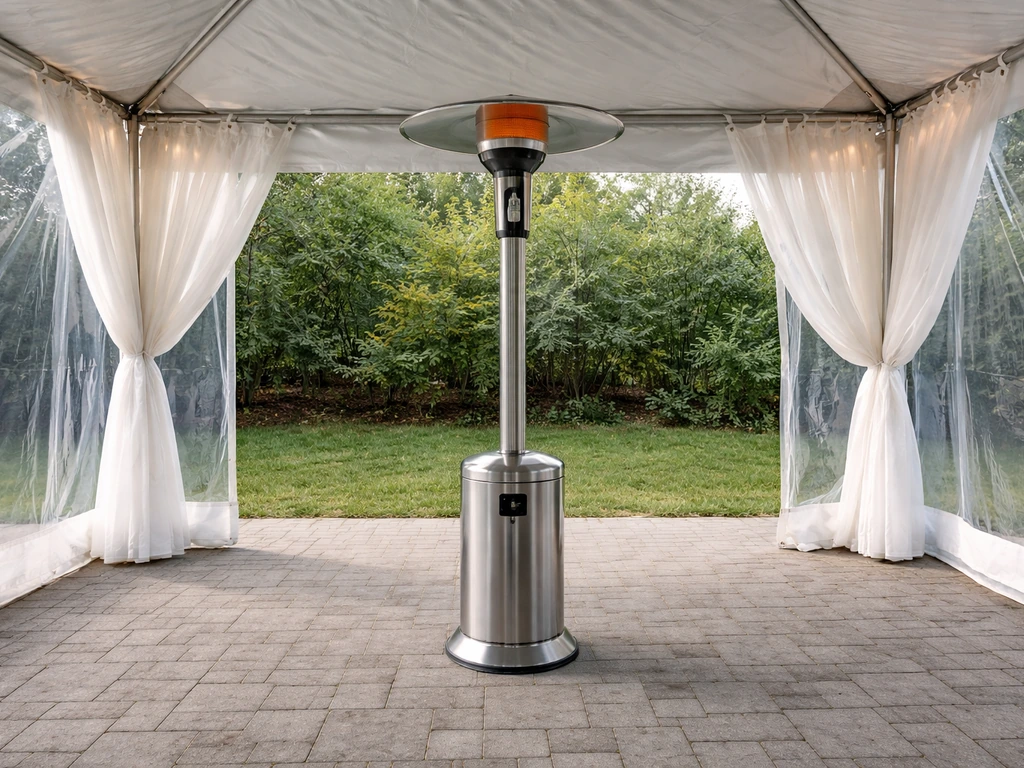
You can use a patio heater under a tent, but only under specific conditions, and most standard propane patio heaters are explicitly prohibited from exactly this kind of setup by their own manuals. The short version: if the tent is open on the sides and acts more like a canopy than an enclosed space, and you follow clearance distances and ventilation rules, some heaters can work safely. But if the tent has walls, is tightly enclosed, or if your manual says "no enclosed areas" (which most do), running a gas patio heater inside it is a genuine carbon monoxide risk, not just a vague liability disclaimer.
Can I Use a Patio Heater Under a Tent Safely?

Grant Mercer
7 Jun 2026
When it's OK and when it's not
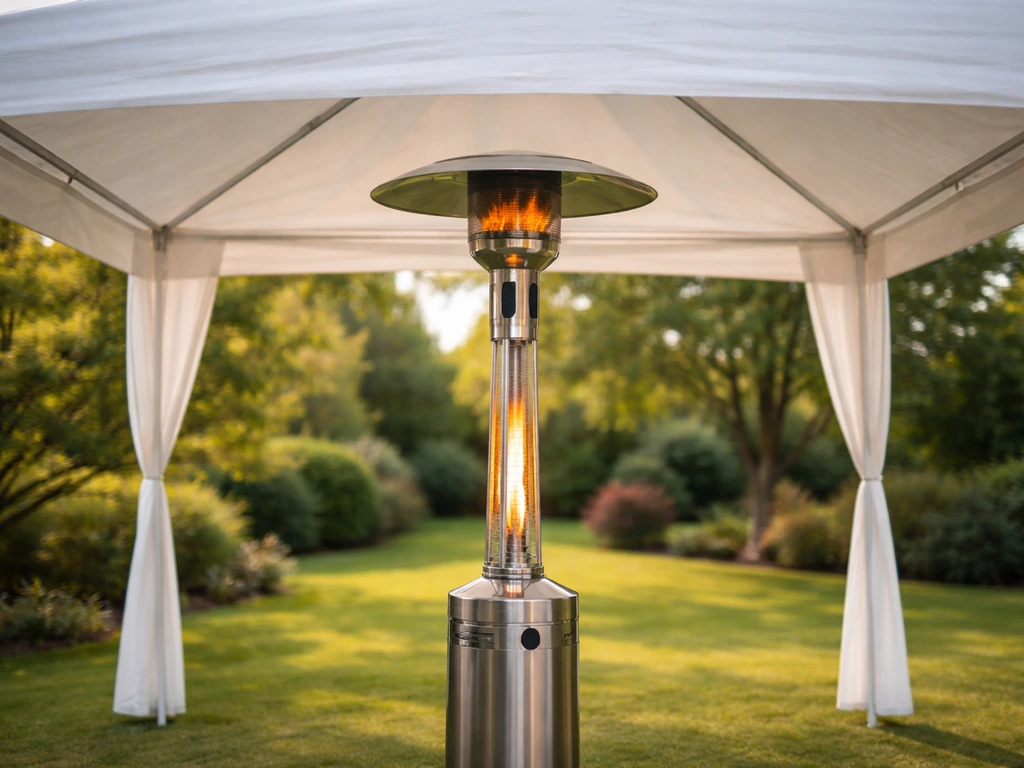
The clearest way to think about this: the more a tent acts like a room, the more dangerous a gas patio heater becomes inside it. A fully open-sided canopy on a breezy day is very different from a party tent with zippered side panels and a single small entrance. Manufacturers draw a hard line here, and so does the CPSC.
| Scenario | Gas Patio Heater OK? | Why |
|---|---|---|
| Open canopy, no side walls, good breeze | Possibly yes, with precautions | Adequate air exchange, similar to full outdoor use |
| Canopy with partial side walls (one or two sides open) | Marginal, check your manual | Reduced airflow increases CO risk; clearance to fabric is critical |
| Party tent with all walls down or mostly enclosed | No | CO can accumulate; most manuals explicitly prohibit this |
| Enclosed tent (camping style) | No | Prohibited by Mr. Heater, Dyna-Glo, and CPSC guidance |
| Electric infrared patio heater under open canopy | Generally yes | No combustion, no CO risk; still needs clearance from fabric |
The CPSC has documented deaths from carbon monoxide poisoning caused by portable heaters and lanterns used inside tents and enclosed spaces. That's not a fringe scenario. It's a well-documented hazard that the agency actively warns about.
Check your heater type and read the manual first
Before anything else, pull up your heater's manual. If you don't have the paper copy, search the model number plus "manual PDF" and you'll usually find it on Manualzz or ManualsLib. Look specifically for phrases like "enclosed area," "unvented," "tightly enclosed," or a list of prohibited locations. Don't just skim the quick-start section.
Here's what the most common brands actually say. Dyna-Glo's DGPH301BL and DGPH302SS manuals state clearly: "Do NOT use it inside a building, garage, or any other enclosed area." The DGPH101BR family uses essentially the same outdoor-only language. Mr. Heater's MH15 manual goes further and lists prohibited locations by name: "camper, tent, car or home." The word tent is right there in print. Their MH30LPPH manual similarly prohibits use in unventilated or enclosed structures.
The key thing to look for is whether your manual says "outdoor use only" as a blanket statement, or whether it specifically lists enclosed area examples. If it lists tent, camper, or enclosed structure, a party tent with side walls down falls directly into that prohibited category. Don't assume "covered patio is fine, so a tent is fine too." A covered patio is structurally open; a tented party area often is not.
Propane vs. electric: which one you have matters a lot
Electric infrared patio heaters don't burn fuel, so they produce no carbon monoxide. That changes the risk profile significantly under a tent. You still need to manage clearance from the tent fabric (more on that below), but CO accumulation is not a factor. If you're planning a tented event and want overhead or perimeter heat, an electric heater is a much more tent-compatible choice than any gas-burning model. Propane and natural gas patio heaters are the ones where ventilation and enclosed-space rules are a genuine safety issue.
Ventilation and carbon monoxide: the real risk you need to understand
Carbon monoxide is colorless and odorless. You won't smell it, and you won't see it building up. The early symptoms of CO poisoning are headache, dizziness, nausea, and confusion. In a social situation like a party under a tent, those symptoms can easily be mistaken for dehydration or alcohol. By the time people realize something is wrong, exposure may already be serious.
Even a tent that feels "open" can reduce air exchange dramatically compared to a fully outdoor setting. Wind hitting an enclosed tent gets redirected around it rather than through it. That means the CO produced by a propane burner can accumulate inside the space much faster than you'd expect. The NPS, for outdoor events using temporary tents with gas-powered heating or cooking appliances, actually requires CO monitoring equipment on site. That's not optional guidance for a government permit event. Think about what that implies for a backyard party tent with no monitoring.
If you're using any gas heater near or under a tent, at minimum you should have a battery-operated CO detector inside the tent space. It won't make an unsafe setup safe, but it gives you an early warning rather than no warning at all. And if a gas appliance fails to ignite properly, shuts off unexpectedly, or starts burning with a yellow/orange flame instead of blue, treat it as a "stop use, get fresh air" situation immediately, not a troubleshooting opportunity while still inside the tent.
Clearance distances and protecting your tent from heat damage
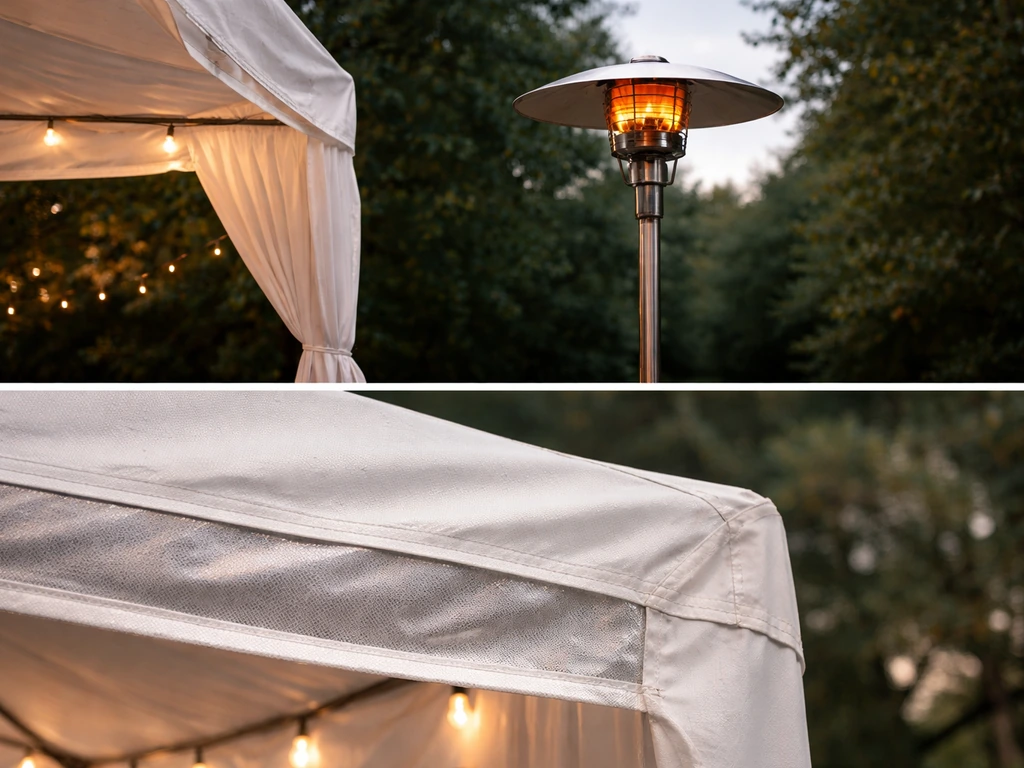
Even if ventilation is adequate, tent fabric is combustible, and most party tent materials (polyethylene, nylon, polyester) are not rated for proximity to open flame or high radiant heat. Getting clearance right is non-negotiable.
Mr. Heater's MH15 manual includes a dedicated "Minimum Clearance from Combustible Materials" section with specific distances for the front, sides, rear, and ceiling of the heater. For the Mr. Heater MH15, consult its manual's [“Minimum Clearance from Combustible Materials” section](https://manualslib.
com/manual/3660169/Mr-Heater-Mh15. html) for the required distances from combustibles. Your exact model will have its own figures, so look them up rather than guessing. As a general rule, electric patio heater manufacturers typically specify at least 3 feet from combustibles like curtains or fabric in front of the heater, with similar or greater distances for the sides and above.
For a tall mushroom-style propane heater radiating heat upward and outward, the tent roof directly overhead needs to be far enough away that it doesn't scorch or ignite.
NPS event guidance for outdoor temporary structures specifically requires portable outdoor heaters to be positioned at least 6 feet from the tent structure itself. That's a useful working minimum if your manual doesn't give you a more specific figure, but always defer to your manual's stated clearances if they're stricter.
- Look up your model's specific clearance table in the manual before placing the heater
- Keep a minimum of 3 feet from tent fabric on all sides for electric heaters; 6 feet is the practical floor for propane mushroom heaters
- Never position a patio heater directly under the peak or center of a tent roof
- Avoid placing the heater near fabric décor, tablecloths, or string lighting that can contact the heat column
- If the tent roof sags or could be pushed down by wind, that changes your clearance calculation immediately
Wind, rain, and weather effects on your burner
Here's something that gets overlooked when people use patio heaters under tents: they often do it specifically because of wind or rain, expecting the tent to protect the heater. The problem is that tent environments create unpredictable airflow. Wind funnels through tent openings, creates pressure differentials, and can produce downdrafts that blow out a burner or cause incomplete combustion. Rain driven under a tent canopy can also get into the burner head or ignitor assembly.
A mushroom-style propane heater that ignites cleanly outdoors in calm conditions may struggle to stay lit under a tent where airflow keeps shifting. You'll notice this as repeated pilot outages, the heater clicking but not lighting, or a flame that lights but then goes out within a few seconds. This is partly why using a patio heater in a marginal tent environment creates a compound risk: the heater behaves less predictably, and you're troubleshooting it in a low-ventilation space.
Troubleshooting ignition, thermocouple, and tilt switch problems in a tent setup
If your patio heater acts up under a tent, you need to understand why, because the tent environment itself is often a contributing factor, not just a coincidence.
Ignition won't catch or takes many tries
Erratic airflow from tent openings disrupts the gas-air mixture at the burner. If the ignitor clicks but the flame won't catch, first check whether a tent-side draft is blowing across the burner head. If you're outdoors but the tent is channeling wind toward the heater, repositioning the heater even a foot or two can solve it. Also check for moisture on the ignitor electrode, which happens when rain gets driven under the canopy. Dry the electrode with a clean cloth and try again. If the ignitor sparks but the gas doesn't reach or ignite, check that the propane tank valve is fully open and the regulator isn't frozen (which can happen in cold, damp conditions).
Heater lights but shuts off after a few seconds: thermocouple issues
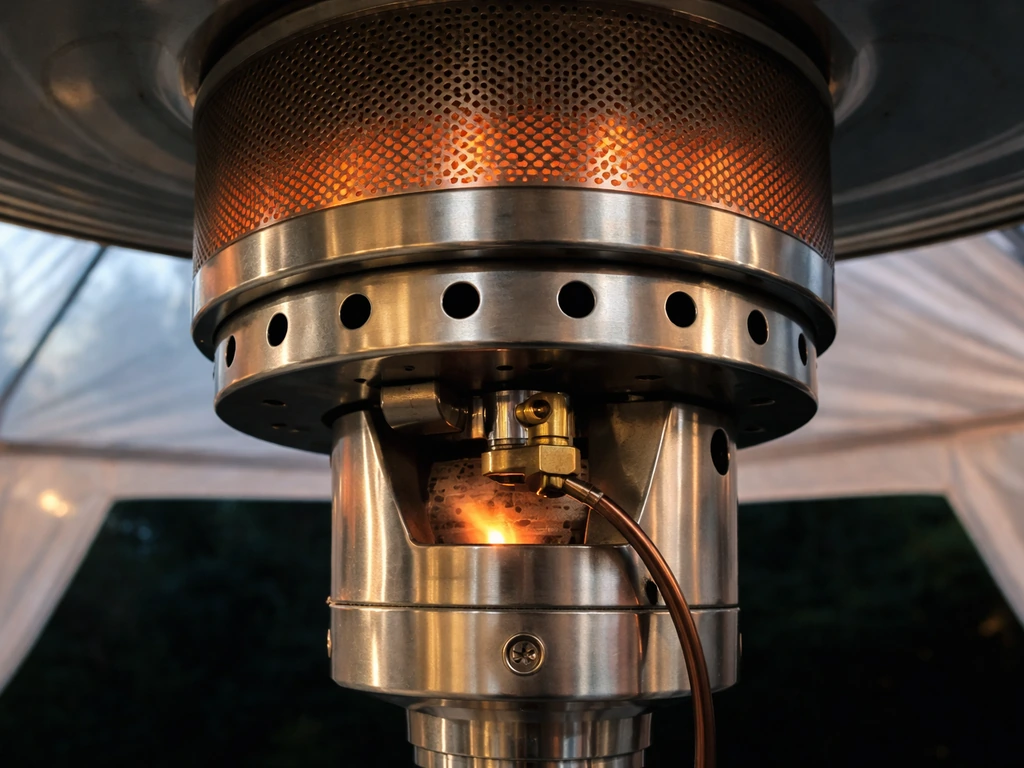
If the heater lights briefly and then cuts out, the thermocouple is the first thing to check. The thermocouple is a safety sensor that detects whether a flame is present. If it's not getting enough heat from the flame (because the flame is being blown around by tent drafts, or it's not fully lighting), it won't generate enough voltage to hold the gas valve open, and the heater shuts off. Clean the thermocouple tip with fine steel wool if it's coated with residue. Make sure the tip is positioned correctly in the flame path. If the thermocouple is old and weak, it may need replacement, which is a straightforward DIY job on most mushroom-style heaters.
Heater won't stay on due to tilt switch trips
Most freestanding propane patio heaters have a tilt switch that cuts gas flow if the heater tips beyond a certain angle. On an uneven surface under a tent (think a tarp floor, soft grass, or a wooden deck board that shifts), the heater may be slightly off-level enough to trigger the tilt switch intermittently. If your heater keeps shutting off unexpectedly and you've ruled out the thermocouple, check whether the heater is sitting perfectly level. Use a small spirit level on the base. Adjust the feet or put a flat board underneath to stabilize it. If the tilt switch itself is faulty and trips even when the heater is level, it can usually be tested with a multimeter and replaced.
One important safety note: do not bypass or disable a tilt switch to keep a heater running in a tent environment. The tilt switch exists to prevent a knocked-over heater from igniting nearby combustibles. Under a tent with fabric walls and tablecloths, that safety device is doing real work. If it's malfunctioning, fix it properly before using the heater.
How these problems connect to tent use specifically
In a tent environment, these common heater failures create a layered hazard. A heater that partially ignites but doesn't fully light can release unburned propane into a semi-enclosed space. A heater cycling on and off due to thermocouple issues produces intermittent combustion rather than clean, consistent burning. Any of these scenarios in a low-ventilation tent is worse than the same scenario outdoors. If your heater is misbehaving, get it out of the tent, troubleshoot it in the open air, and only return it to the tent once it's operating reliably and you've confirmed the space has adequate ventilation.
Your checklist for deciding today, plus safer alternatives
Before you fire up a patio heater under a tent for tonight's event, run through this checklist. If you can't answer yes to all of the applicable items, reconsider the setup or switch to an alternative.
- Check your manual: does it explicitly prohibit enclosed areas, tents, or unvented structures? If yes, stop here for propane heaters.
- Assess the tent: is it open on at least two or three sides with no walls or raised walls? If it has full side panels that can be zipped or rolled down, treat it as an enclosed space.
- Measure clearance: is there at least 6 feet of clearance between the heater and any tent wall, roof peak, or fabric element? Less than that is a fire risk with any gas heater.
- Check the surface: is the heater sitting on a stable, level surface where the tilt switch won't trip from slight ground movement?
- Verify the heater is working correctly: does it ignite cleanly on the first or second try and stay lit without cycling off? A misbehaving heater in a tent is a compound hazard.
- Do you have a CO detector? If you're using any gas-burning heat source near a tent, a battery-operated CO detector inside the tent is a minimum precaution.
- Have you told everyone in the tent what CO symptoms look and feel like: headache, dizziness, nausea, confusion? If something feels off, everyone exits immediately.
- Is the weather creating tent conditions that funnel wind into the burner area? If the tent is causing airflow problems that make the heater behave erratically, reposition or stop use.
Safer alternatives worth considering
If your tent setup doesn't clear all those checkboxes, here are practical alternatives that let you solve the warmth problem without the risk:
- Switch to an electric infrared patio heater: no combustion, no CO, and many models are rated for covered outdoor use. You still need to manage clearance from fabric, but the CO risk is eliminated entirely.
- Place propane heaters outside the tent perimeter: position them just outside the open sides to direct radiant heat inward without putting combustion inside the tent. This keeps ventilation completely open.
- Use propane fire pit tables at the perimeter rather than tall mushroom heaters under the roof, so heat stays low and away from tent fabric.
- For small enclosed tent areas, consider heated blankets, electric space heaters rated for indoor use, or simply adding a tent floor layer and dressing in layers rather than heating the space.
- If you're planning a larger event with a fully enclosed tent, look into rented propane tent heaters that are specifically designed and certified for temporary enclosed structure use, with ducted venting. These are a fundamentally different product from a standard outdoor patio heater.
The setup question for tents is closely related to questions about using patio heaters under gazebos, under solid roof structures, or in garages. If you mean using a patio heater in a garage, especially with the door open only partially, treat it like an enclosed-space ventilation question and check the manual’s prohibited locations.
If you are wondering can you use a patio heater in a garage, treat it like an enclosed-area problem and follow the manual’s restrictions closely in garages. In each case, the key variable is the same: how much air exchange is actually happening, and what does your specific heater's manual say about it.
A permanently roofed but open-sided gazebo is generally a safer context than a tented space with walls, but the same clearance and ventilation principles apply across all of them.
Bottom line: if your heater's manual says outdoor use only or prohibits enclosed areas, a party tent with walls counts. Use an electric heater, move the propane unit to the outside perimeter, or get a CO detector at a bare minimum if you proceed with a gas heater. Don't let the convenience of a tent setup override what the manufacturer and safety authorities are telling you plainly in print.
FAQ
My tent has no zippered walls, only open sides. Can I use a propane patio heater under it?
Possibly, but only if your heater’s manual explicitly allows the specific type of tent you have (or says it can be used in covered outdoor spaces that are not enclosed). If the manual uses blanket wording like “outdoor use only” or lists tent as a prohibited location, do not use it even with the sides partially open.
What if my tent is sometimes open and sometimes closed during the event?
If the tent has curtains, sidewalls, or zippered panels that can be closed, treat it like an enclosed area because you can easily lose ventilation when panels are adjusted. A canopy-like setup can be acceptable, but a “can be closed” tent usually is not covered by the safety assumptions people make.
Where should I place a CO detector if I run a gas heater near or under a tent?
Use CO detectors that are specifically rated for indoor or enclosed-space monitoring, place one inside the occupied area near breathing height, and do not rely on alarms located at the heater or outdoors. Also test the alarm before the party so you know it is working that day.
The heater won’t stay lit under the tent. Can I troubleshoot inside the tent?
Do not try to “fix” a gas heater that is failing to ignite or is repeatedly shutting off while it is still inside the tent. Move it to open air, troubleshoot there, and confirm it is burning consistently with the correct flame color before bringing it back.
If the flame looks mostly blue under the tent, is the CO risk still low?
The flame color matters, but it is not a complete indicator of CO risk. A heater can burn imperfectly due to airflow changes under tents, so assume risk based on the setup, ventilation, and manual restrictions first, then use flame inspection as an additional clue.
Would natural gas be safer than propane for a tented area?
If your heater manual prohibits enclosed areas, replacing the fuel type does not automatically make it safe. The critical factor is still whether the space is treated as enclosed and whether the manufacturer allows it.
Can I use an electric patio heater under a tent if I keep it far from the fabric?
Electric infrared heaters are generally the safer option for CO, but you still must keep tent fabric away from hot surfaces and follow the heater’s clearance requirements. In practice, the “combustible clearance” rule is often as important for electric heaters as it is for gas units.
We used the heater earlier with no issues, then the wind changed. What should we do?
A wind shift can change airflow through the tent and alter combustion, even if it was fine earlier. Recheck heater behavior and keep openings positioned the way you tested, especially before you close side panels.
If my heater is not allowed under the tent, can I place it just outside the tent opening?
Yes. If the heater is allowed only for “outdoor perimeter” setups, placing it closer to the tent boundary can reduce risk compared with placing it under the roof line, but you must still meet the clearance-to-combustibles distances in the manual.
My propane heater keeps shutting off under the tent. Could it be because it’s not level?
A common failure mode is the heater not being level, which can trigger a tilt safety switch, especially on uneven ground or soft surfaces under tents. Always confirm level with a small spirit level and ensure stable footing before each use.
Is it okay to disable the tilt switch so the heater won’t keep tripping under the tent?
Do not bypass the tilt switch or any safety shutdowns. If the safety device trips, the correct response is to fix the cause (leveling, stable base, correct installation, or replacement if it’s defective), then retest in open air before using again.
Does a tent without sidewalls still count as an enclosed area?
Yes, if the tent canopy creates a “room-like” space even without sidewalls, for example due to floor tarping, close overhead coverage, or fabric draping that reduces air exchange. When in doubt, follow the same prohibition logic as for tents with walls.
What if this is a larger party and we don’t have professional CO monitoring equipment?
For large events or where any permit or venue rules apply, treat CO monitoring as more than a recommendation. If you do not have monitoring and an emergency plan, switch to electric heating or move the gas heater fully outside.