
Technically, yes, you can run a patio heater in a garage with the door open. But whether you should depends almost entirely on the heater type, how much of the door is open, and how the space ventilates. Gas and propane patio heaters are rated for outdoor use only, and every major manufacturer, including Dyna-Glo, SunStar, and HeatStar, explicitly prohibits use inside any building or garage, even a partially open one. Electric patio heaters are a different story and are generally the safer pick for semi-enclosed spaces, though they still carry fire risks if placed wrong. The bottom line: a fully open garage door helps, but it rarely makes a gas patio heater safe enough to justify the risk.
Can You Use a Patio Heater in a Garage with the Door Open?

Grant Mercer
16 May 2026
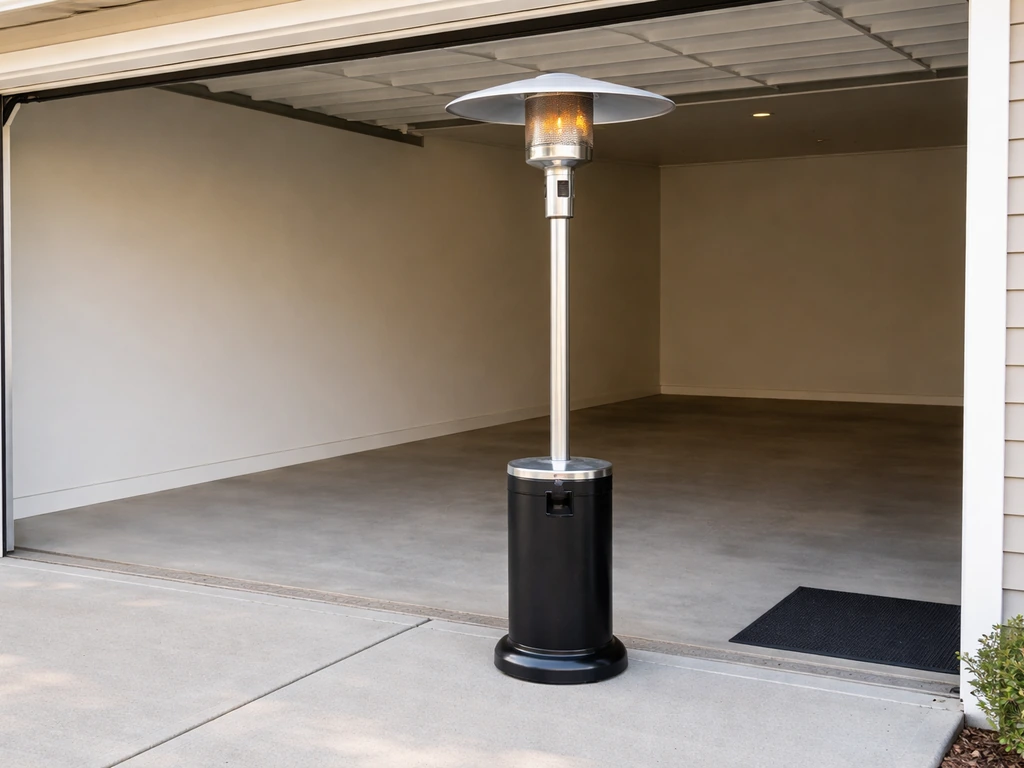
Gas vs Electric: The Answer by Heater Type
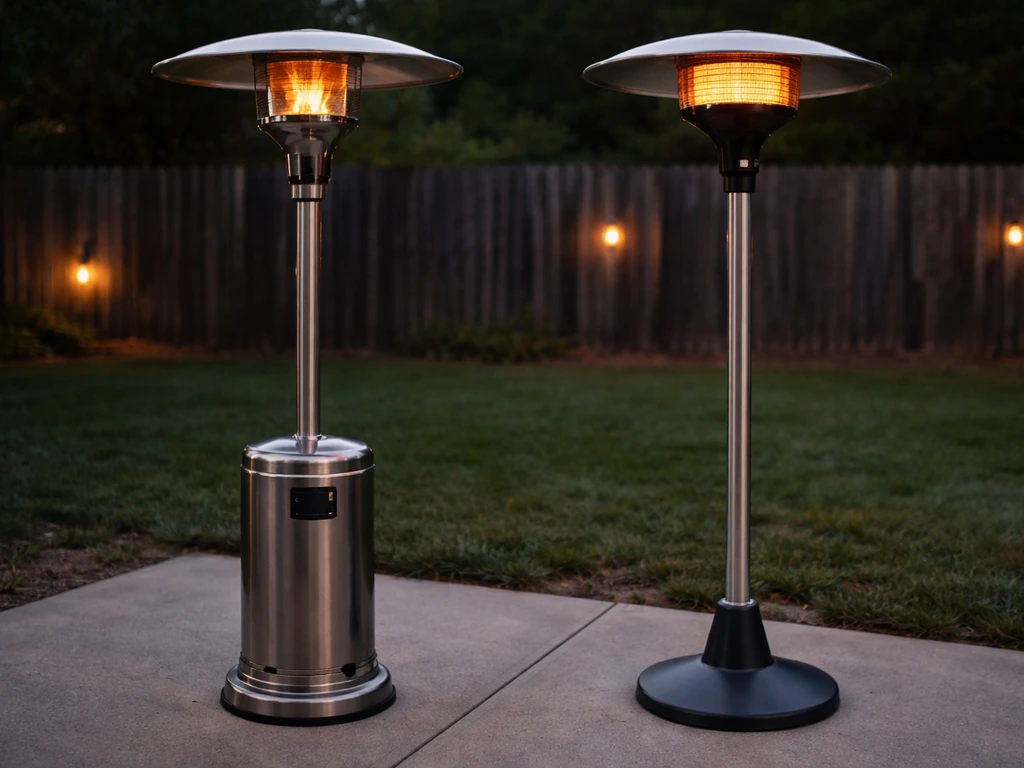
This is the most important split to understand before anything else. Gas and electric patio heaters behave completely differently when it comes to indoor risk.
| Heater Type | Garage With Door Open | Main Risk | Verdict |
|---|---|---|---|
| Propane (freestanding) | NOT recommended by manufacturers | Carbon monoxide, oxygen depletion, fire | No-go in most cases |
| Natural gas (fixed/mounted) | NOT recommended by manufacturers | Carbon monoxide, gas buildup if ignition fails | No-go |
| Electric infrared (plug-in) | Generally safer | Fire if too close to combustibles | Acceptable with caution |
| Electric quartz tube | Generally safer | Fire if placed incorrectly | Acceptable with caution |
Propane and natural gas heaters produce combustion byproducts including carbon monoxide (CO), water vapor, and nitrogen oxides as they burn. A garage, even with the door open, is a semi-enclosed space. The CPSC is direct about this: outdoor heaters can cause deadly CO buildup in minutes when used inside. That warning does not disappear just because one wall is open. Electric heaters produce no combustion gases at all, which removes the CO risk entirely. They still get hot enough to ignite nearby materials, so placement still matters.
Why This Gets Dangerous Fast: CO, Oxygen, and Fire
Carbon monoxide is the headline hazard, and it deserves to be. It is colorless, odorless, and builds up fast in spaces that seem ventilated but are not truly open-air. A standard two-car garage with the door up is still enclosed on three sides and the ceiling. Even with a breeze, dead air pockets form near walls, in corners, and along the floor where CO can concentrate. You will not smell it coming. The first signs, headache, dizziness, nausea, tend to hit before most people connect the dots.
Beyond CO, a running propane heater consumes oxygen from the surrounding air. In a typical 20x20 foot two-car garage (roughly 9,600 cubic feet with an 8-foot ceiling), oxygen levels can drop measurably faster than you would expect, especially if the heater is running at full output (most freestanding propane patio heaters run between 40,000 and 46,000 BTU). Lower oxygen also causes incomplete combustion, which actually increases CO output, creating a feedback loop.
Fire risk is the third leg of this problem. Patio heaters get extremely hot on the emitter head and the immediate surrounding area. In a garage, you have shelving, cardboard boxes, vehicle interiors, gas cans, paint, and rags all within proximity. The clearance requirements printed in most patio heater manuals assume open outdoor conditions, not a garage with stuff stacked near the walls.
Check Your Heater's Manual and Label First
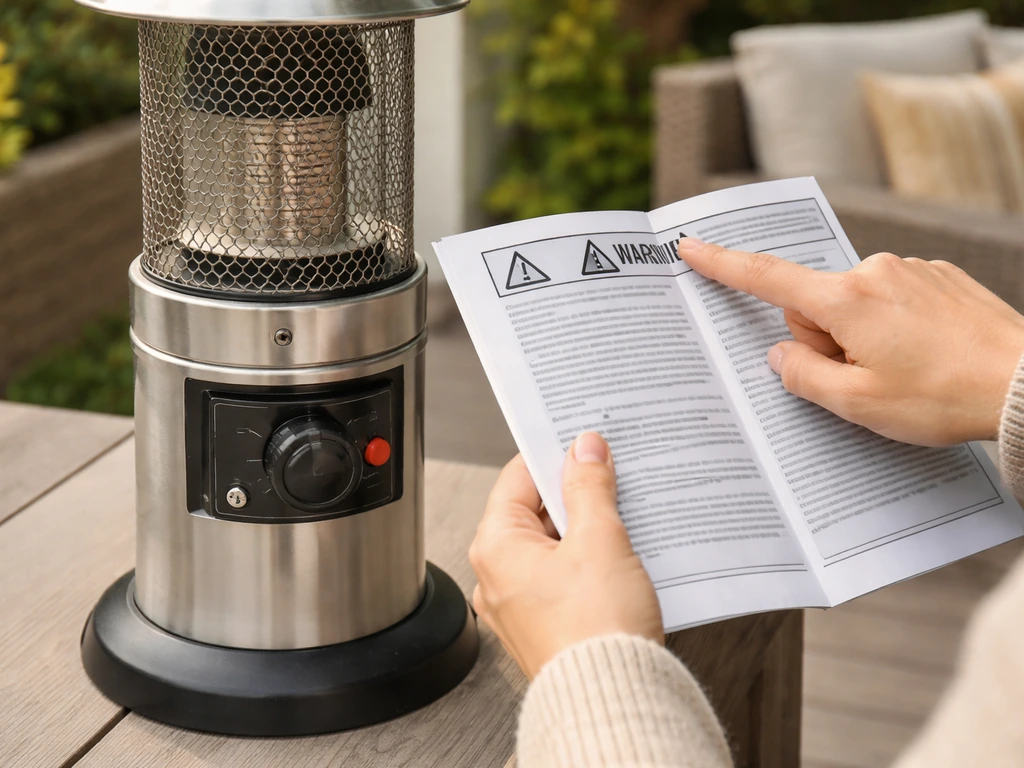
Before you do anything, pull out the owner's manual or look it up on the manufacturer's site. The language to look for is almost always in the first few pages under Danger or Warning. Dyna-Glo's manual for the DGPH102SS-1, for example, states clearly: 'DANGER, CARBON MONOXIDE HAZARD, For outdoor use only. Never use inside building, garage, or other unventilated or enclosed areas.' SunStar's PHS40 and PHJ40 installation guides say the heater is 'NOT designed, approved, or intended for indoor use or enclosed area use such as a garage, commercial building, tents.' HeatStar's HSRP37GL manual carries the same 'For Outdoor Use Only' warning. If your manual says any version of that, an open garage door does not override it.
Here is what to look for specifically when you pull the manual or read the label plate:
- Outdoor use only designation (any variation of this is a hard no for garage use)
- Minimum clearance to combustibles, typically 24 to 36 inches on all sides and above
- BTU output rating, which tells you how much combustion is happening and how much ventilation you would theoretically need
- CSA or ETL certification marking, and whether it specifies outdoor-only certification
- Any prohibition on use in 'partially enclosed' or 'semi-enclosed' spaces
If the label or manual is missing, look up the model number on Manualslib.com or the manufacturer's website. Most patio heater manuals are posted there as PDFs. If you cannot find documentation at all, treat the heater as outdoor-only and do not use it in the garage.
Ventilation Rules of Thumb When the Door Is Open
If you have an electric patio heater and want to use it in the garage with the door open, ventilation is still worth thinking through. For gas heaters, understand this section as context for why a cracked or partially open door is never enough, even if it feels breezy.
A fully open garage door (typically 7 to 8 feet tall, 8 to 16 feet wide) provides significant air exchange, but the key variable is airflow direction and continuity. A door that is open on one side of the garage without a corresponding opening on the opposite side creates poor cross-ventilation. Hot combustion gases rise and pool near the ceiling and back corners. Cracking the door halfway reduces effective ventilation by more than half because airflow dynamics are not linear. A rule of thumb used in industrial ventilation is that you need roughly 1 cubic foot per minute of fresh air per 50 BTU of combustion output for basic dilution. A 40,000 BTU heater would need approximately 800 CFM of continuous airflow just to dilute combustion products, not counting CO specifically. A parked car in the garage further disrupts airflow patterns. None of this works reliably in a home garage with one door open.
For electric heaters in a garage with the door open, the ventilation concern is simpler: you mainly need enough air movement to prevent heat from building up near flammable materials. Keep the heater at least 3 feet from anything on walls or shelving, point it away from vehicles, and make sure it is on a stable, level surface so the tilt shutoff does not engage unexpectedly.
Pre-Use Safety Checks and Quick Troubleshooting
Any time you move a patio heater, which you almost certainly did if you are bringing it into a garage, run through these checks before firing it up. A heater with a faulty component does not just fail to heat. It can fail in ways that make an already risky situation much more dangerous.
Inspect the Gas Connection and Hose
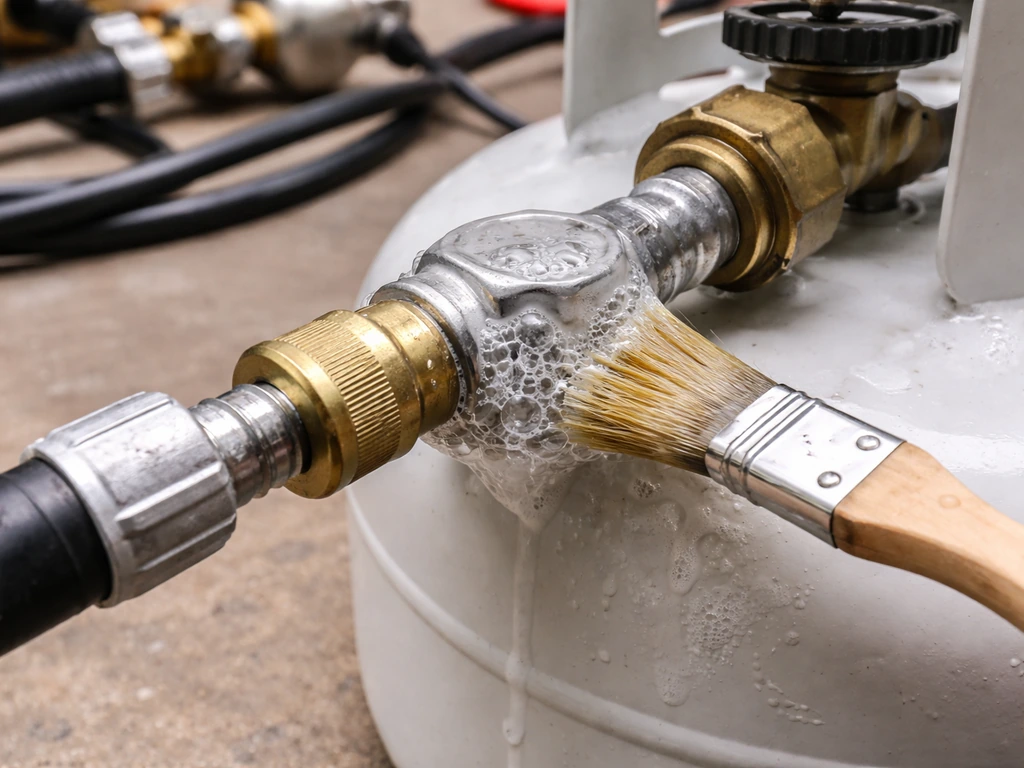
Apply soapy water to every connection: the regulator fitting at the tank, along the hose, and at the burner assembly fitting. Bubbles mean a leak. Do not use the heater if you see bubbling anywhere. Replace the hose and regulator if they are cracked, stiff, or more than 5 years old. In a garage, a small propane leak is far more dangerous than outside because the gas has nowhere to go.
Test the Ignition and Watch for Delayed Lighting
Turn the knob to the pilot or ignite position and click. The flame should light within 2 to 3 seconds. If it does not, shut the gas off immediately and wait at least 5 minutes before trying again. Gas that has been released without igniting builds up fast in a semi-enclosed space, and the next ignition attempt can set it off. If the ignition repeatedly fails, the igniter tip may be corroded, cracked, or misaligned from the pilot tube. That is a fixable issue, but fix it outside before bringing the heater anywhere near an enclosed space.
Check the Thermocouple
If your heater lights but will not stay lit after you release the control knob, the thermocouple is almost certainly the problem. The thermocouple is a safety device that senses the pilot flame and holds the gas valve open. When it fails, the valve closes and the flame goes out. A failing thermocouple is a safety issue in its own right, because it means the heater may attempt ignition without a reliable flame present. Do not use a heater with a thermocouple problem in a garage at all. The fix is usually a direct replacement thermocouple (under $15 in most cases) and is worth doing before you consider any use.
Verify the Tilt Switch
Most freestanding patio heaters include a tip-over or tilt switch that shuts off gas flow if the heater tilts past a set angle. In a garage, floors can be uneven or sloped for drainage, which can falsely trigger the tilt switch mid-use or, in rare cases of a stuck/failed switch, fail to shut off when the heater actually tips. Test it: set the heater upright on your garage floor, light it, and give it a very slight deliberate lean. The flame should die within a second or two. If it does not shut off, the tilt switch is failed-open, which is a serious hazard. Stop using the heater until the switch is replaced.
Quick Pre-Use Checklist
- Soapy water test on all gas connections: no bubbles before use
- Hose and regulator visually inspected: no cracks, kinks, or brittleness
- Igniter fires within 2 to 3 seconds: if not, diagnose igniter before use
- Heater stays lit after releasing control knob: if not, thermocouple needs replacement
- Tilt switch tested and functional: flame extinguishes when heater is tilted
- Clearance confirmed: minimum 24 to 36 inches on all sides and above to any combustible
- CO detector installed and working in the garage space (battery tested)
Safer Alternatives and What to Do Instead
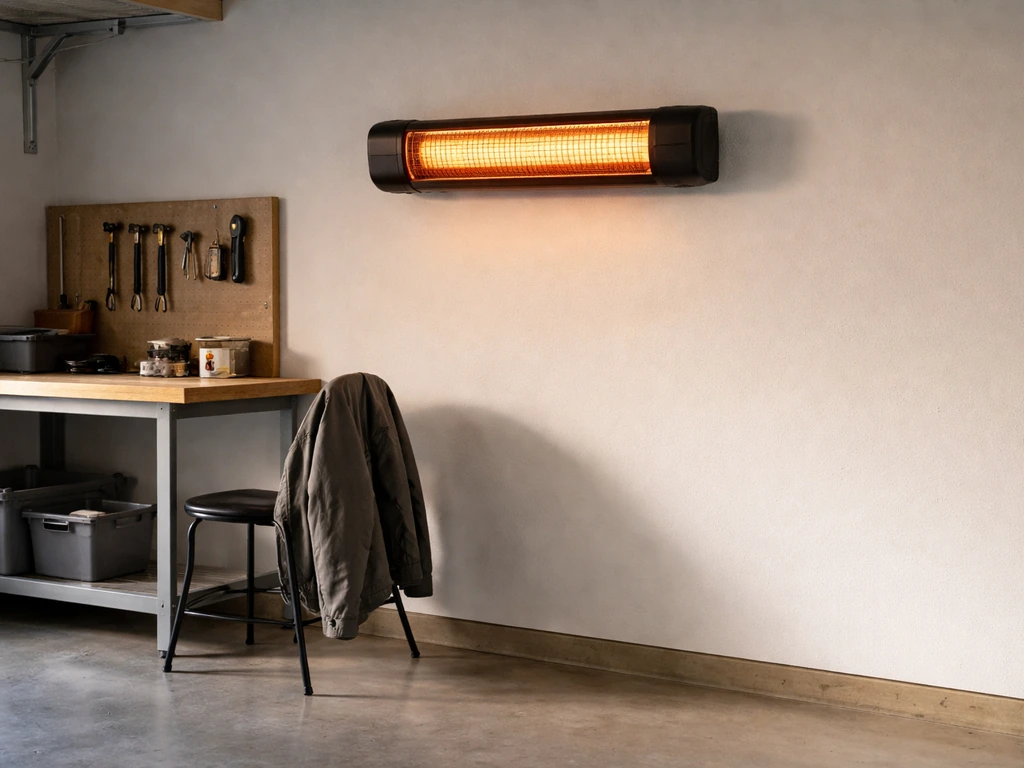
If your goal is to stay warm in the garage while you work, there are better options than running a propane patio heater with the door cracked.
The easiest swap is an electric infrared patio heater or a wall-mounted electric garage heater. Electric units produce zero combustion gases, so the CO and oxygen depletion risks disappear entirely. A 240V hardwired garage heater (brands like Dr. Infrared, Fahrenheat, or King Electric are popular DIY options) can heat a two-car garage effectively without any fuel-burning risk. If you are not set up for 240V, a 1500W plug-in electric space heater rated for indoor use will work for personal warmth in a small area.
If you are set on using your existing propane patio heater, move it fully outside the garage footprint. Even just pulling it 2 to 3 feet past the threshold into the driveway, with the door fully open, keeps combustion products from concentrating inside. You lose some warmth into the open air, but you eliminate the enclosed-space risk.
Propane forced-air heaters (often called torpedo heaters) are a separate category and some models are specifically rated for garage or indoor construction use with ventilation requirements. These are not patio heaters, but if you need serious heat in a garage, look for units with a specific indoor or garage rating and follow their ventilation requirements exactly. These are very different from a freestanding patio heater and should not be conflated.
The situation in a garage with the door open is closely related to questions about using patio heaters under covered structures. Most patio heater guidance also treats partially enclosed spots, like under a gazebo roof, as similar ventilation and fuel-burning risks patio heaters under covered structures. Using a patio heater under a roof or canopy can also create similar ventilation trade-offs, especially for gas models. Using a patio heater under a roof or inside a tent presents similar ventilation trade-offs, and the same general logic applies: electric heaters tolerate enclosure much better than gas heaters, and any rating that says outdoor-only should be treated as a hard limit regardless of how the door or opening is configured. Using a patio heater under a roof or inside a tent presents similar ventilation trade-offs, and the same general logic applies tents.
If you take one thing away: install a CO detector in your garage before you run any combustion device in it, whether that is a patio heater, a generator, or a car idling for a few minutes. CO detectors cost between $20 and $40, they work, and they have saved lives in exactly this kind of situation. It is the cheapest safety upgrade you can make today.
FAQ
If my propane patio heater manual says “outdoor use only,” can I still use it if the garage door is fully open?
Yes, but only if the unit is specifically labeled for indoor or garage use, and you still need the clearance and ventilation instructions from the manual. If your patio heater says “outdoor use only” or “not for enclosed areas,” an open door does not change the approval status.
Does a fully open garage door make a gas patio heater safe enough?
For gas heaters, “fully open” helps airflow, but it does not prevent combustion products from pooling in a three-sided space. The manual prohibition exists because you cannot rely on consistent fresh-air flow or safe dilution under real home conditions (breezes, wind direction, car blocking, and corner dead zones).
What’s wrong with leaving the garage door cracked instead of fully open?
No. A cracked door, even if it feels like there is a breeze, usually creates uneven airflow that can worsen accumulation near walls and the ceiling. Gas clearance and dilution requirements assume outdoor conditions, not semi-enclosed flow patterns.
For an electric patio heater in a garage, do I still need to think about ventilation and fire risk?
Even with an electric heater, keep it away from flammable storage and vehicle materials, and use a stable, level surface. Also avoid running cords through door gaps where they can pinch or heat up, and don’t place the heater where it can blow directly onto paper, rags, or stored chemicals.
What safety checks should I do before using any patio heater in a garage?
Yes. Check for the correct safety shutoffs before use, especially if the heater was exposed to moisture or was stored outside. In particular, verify the tilt shutoff works on a dry, level surface, and confirm the flame holds reliably (pilot and safety thermocouple) before considering any indoor use.
If I have a CO detector, can I ignore it and keep using the heater if it seems fine?
Use the CO detector as a decision tool. If it alarms, shut the heater off immediately, move everyone outside, and do not restart until the source is identified. A detector does not make an “outdoor-only” gas heater approved for garages.
Is installing a CO detector enough to make indoor garage use acceptable?
A CO detector is necessary but not sufficient. You should also prevent propane leaks, verify ignition timing, and avoid storage clutter near the emitter. CO risk, leak risk, and thermal ignition risk are different hazards with different failure modes.
What should I do if a gas patio heater won’t ignite or won’t stay lit?
If the burner does not light within a few seconds, or it lights and then shuts off when you release the control knob, treat it as a malfunction. Failed ignition or a suspected thermocouple problem should be repaired outside first, then rechecked before any further attempts in or near an enclosed space.
How can I tell if my propane heater has a leak before turning it on?
If you smell propane, see bubbles on soapy leak checks, or hear hissing, stop immediately and ventilate by opening the door and keeping ignition sources away. Do not attempt to relight, and replace parts that are cracked, stiff, or aged rather than “hoping it will work.”
Does having a car parked in the garage change the risk?
Yes, it can affect safety. A parked car can block airflow pathways and create additional dead-air pockets near the floor and corners, which makes dilution less predictable. If you attempt any indoor-adjacent use, keep the vehicle out of the garage.
Can I use a propane torpedo heater in a garage the same way I’d use a patio heater?
Not really. Forced-air “torpedo” heaters are a different appliance category with specific ventilation and combustion requirements, often intended for temporary heating during construction. Only use models that are explicitly rated for indoor or garage work, and follow their stated air supply and exhaust guidance.
If I want warmth from my propane heater, what’s the safest way to use it relative to the garage?
To reduce risk, move the heater completely outside the garage footprint with the door fully open, and keep it at least several feet away from the threshold so combustion products are not concentrating at the opening. Expect less heating inside compared with a semi-enclosed approach.
What placement rules should I follow for an electric patio heater in a garage?
If you’re using any electric patio heater, follow the distance-from-combustibles guidance on the label, and avoid placing it where it can heat stored items on shelves. For plug-in models, confirm the outlet is rated appropriately and use an extension cord only if the manufacturer specifically allows it and the cord gauge is sufficient.
Is it safe to use a patio heater under a covered porch, gazebo roof, or canopy with openings on the sides?
Treat enclosed spaces under roofs, canopies, or tents similarly. If the heater is “outdoor-only” and the area is partially enclosed, ventilation becomes unreliable, and the gas safety issues still apply.