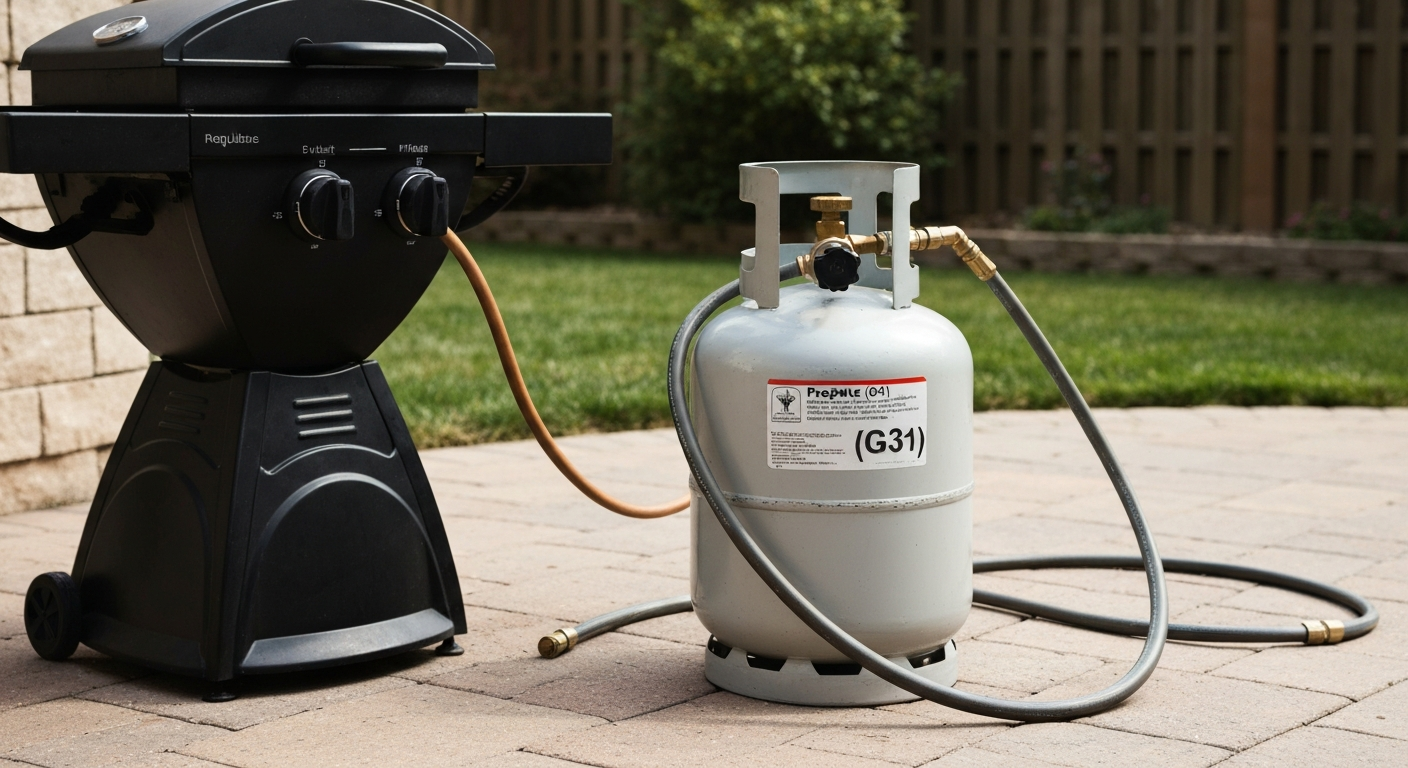
Yes, patio gas can be used on a BBQ in most cases, but only if you match the regulator outlet pressure to your grill's requirements and use a compatible connector. The gas itself (usually propane or a propane-heavy blend) burns perfectly well in a BBQ burner. The problems come from mismatched regulators, wrong connectors, and the occasional situation where someone grabs a butane-heavy canister that won't vapourise properly on a cold day. Get those three things right and you're good to go. Get them wrong and you risk a gas leak, an underperforming burner, or a voided warranty.
Can Patio Gas Be Used on BBQ? Safe Use, Regulator Checks

Grant Mercer
21 Jul 2026
TL;DR: Can You Use Patio Gas on a BBQ?
If you want a straight decision before reading further, here it is. Patio gas is almost always propane or a propane-dominant blend, and BBQs run on the same gas. The compatibility question is entirely about hardware: the regulator outlet pressure, the connector fitting, and whether your hose is rated for the pressure involved. Answer those three checks and you'll know within five minutes whether your setup will work safely.
| Check | What you need | Pass/Fail condition |
|---|---|---|
| Gas type | Propane (G31) or propane-butane blend | Fail if pure butane in cold weather below ~5°C |
| Regulator outlet pressure | Must match appliance rating (28-30 mbar for butane appliances, 37 mbar for propane appliances, 27.4 mbar/11" WC for US LP appliances) | Fail if pressures don't match |
| Connector/valve type | 27 mm clip-on (UK/EU patio cylinders), QCC Type-1 (US 20 lb cylinders), or POL on larger tanks | Fail if connector doesn't fit without a certified adapter |
| Hose condition | No cracks, kinks, or expired date stamp | Fail if hose is degraded or out of date |
| Ventilation | Outdoors or well-ventilated space only | Never use a gas BBQ indoors or in an enclosed area |
What People Mean by 'Patio Gas'
The term 'patio gas' isn't a precise chemical category. It's a retail label applied by gas suppliers to cylinders sold primarily for outdoor heaters and garden appliances. In practice it almost always refers to commercial propane (G31), though some blended cylinders contain a propane-butane mix. LPG sold for domestic/portable use is typically commercial propane (G31), butane (G30), or propane–butane mixes; see LPG fuel properties, IEA Advanced Motor Fuels (AMF) for standardized fuel composition and properties blank" rel="noopener noreferrer">LPG fuel properties — IEA Advanced Motor Fuels (AMF). A smaller number of portable patio appliances, particularly lightweight tabletop heaters and stoves, use pure butane (G30) in those small blue Campingaz-style canisters. Knowing which one you have matters more than you might think. If you want a clear comparison of what is the difference between propane and patio gas, see our dedicated guide for the key chemical and practical distinctions.
Propane has a normal boiling point of around -42. Propane's vapour pressure and physical properties are listed in supplier safety datasheets such as Propane, Safety Data Sheet (Linde Canada) blank" rel="noopener noreferrer">Propane — Safety Data Sheet (Linde Canada). 2°C, which means it turns from liquid to vapour reliably even on a freezing winter morning. Butane, by contrast, struggles below about 5°C and can stop vapourising altogether when temperatures dip near zero. If your patio gas cylinder is a propane blend, it will feed a BBQ burner in virtually any outdoor temperature the UK or northern US experiences. A butane-dominant canister is a different story. For a deeper look at the propane vs butane distinction, the article on whether patio gas is propane or butane covers this in detail.
Calorific values and burn characteristics between propane and butane are close enough that your BBQ will cook normally on either, provided the temperature is warm enough for vapourisation. The gas category designation (G30 for butane, G31 for propane) is the key identifier to look for on the cylinder label or the data plate attached to the regulator.
Cylinder and Valve Types You'll Actually Encounter
This is where a lot of people get tripped up, because 'patio gas cylinder' covers several physically different products. The connector on top of the cylinder determines which regulator you can attach, and they are not interchangeable without an appropriate adapter.
UK and European cylinders
- 27 mm clip-on (quick-release) valve: The most common fitting on small-to-medium propane patio gas cylinders in the UK (typical 5 kg and 13 kg Calor-style cylinders). A 37 mbar clip-on regulator snaps directly onto this valve. No thread, no wrench required.
- Screw-on POL or ACME-thread valves: Found on larger commercial cylinders and some refillable tanks. These require a threaded regulator connection tightened by hand or with a spanner.
- EN 417 threaded cartridge (Lindal B188): Small non-refillable camping canisters with a threaded valve. Used with compact stoves and some tabletop heaters. These are not the same as refillable patio cylinders and are not compatible with standard BBQ regulators.
- Campingaz Easy Clic / bayonet cartridges: A proprietary Campingaz format. Only compatible with Campingaz-branded appliances and regulators. Not interchangeable with 27 mm clip-on or EN 417 fittings.
North American cylinders
- QCC Type-1 (1-5/16 inch ACME right-hand nut): The standard connection on modern 20 lb propane cylinders used for BBQ grills in the US and Canada. This is what most backyard grillers are familiar with. Regulators for these use a hand-tightened ACME nut.
- POL (left-hand thread): An older fitting still found on larger tanks and some refill stations. Left-hand thread means you tighten it counter-clockwise. POL-to-QCC adapters exist but must be certified.
- Disposable 1 lb canisters: Small green Coleman-style canisters with a CGA 600 fitting. Used for camping stoves. Not suited for a full-size BBQ grill.
The practical takeaway: if your patio heater has been running from a 27 mm clip-on cylinder (UK) or a standard 20 lb QCC cylinder (US), there is a very good chance the same cylinder will physically connect to your BBQ regulator without modification, because many BBQ regulators are designed for exactly those cylinders. The issue arises when a patio heater has a different connection format, or when you are trying to reuse the patio heater's regulator on a BBQ that has different pressure requirements.
Regulator and Pressure Compatibility: This Is the Critical Check
A regulator's job is to drop the high-pressure liquid propane in the cylinder down to a stable, usable outlet pressure that your burners can work with. The outlet pressure is fixed at manufacture. It is stamped on the regulator body or printed on a label. Using a regulator set to the wrong outlet pressure is the single most common technical mistake when mixing patio and BBQ equipment, and it genuinely matters for both safety and cooking performance.
| Gas type / region | Typical appliance inlet pressure | Corresponding regulator type |
|---|---|---|
| Butane (G30) — UK/EU | 28-30 mbar | Blue clip-on or screw-on butane regulator |
| Propane (G31) — UK/EU | 37 mbar | Red or yellow clip-on propane regulator (27 mm) |
| LP gas — US/Canada (propane) | 11" WC (≈ 27.4 mbar / 0.397 psi) | QCC Type-1 single-stage regulator, UL 144 listed |
| High-pressure category (some specialist BBQs) | 50 mbar or higher | High-pressure regulator with separate hose rating |
If your BBQ manual says it needs a 37 mbar regulator and your patio heater cylinder came with a 37 mbar clip-on regulator, you can use that same cylinder with your BBQ's regulator. You are simply changing what appliance sits at the end of the hose. If the pressures don't match, running the BBQ at the wrong pressure will cause either a weak, undersized flame (too low) or an oversized, potentially dangerous flame that the appliance wasn't designed to handle (too high). Neither outcome is acceptable. Always read the pressure marking on your BBQ's regulator and cross-check it against what your BBQ manual specifies. North American readers should note that US propane appliances are calibrated for 11 inches water column (roughly 27.4 mbar), which is slightly lower than the 37 mbar European propane standard. A UK-rated 37 mbar regulator used on a US-spec BBQ will run those burners richer than designed.
In the US, LP-gas regulators sold for appliance use must be tested and listed to UL 144, and the broader handling and storage rules fall under NFPA 58. Single-stage regulators covered by those standards have defined maximum outlet settings. Buying a certified, correctly-rated replacement regulator from a hardware store or gas supplier is straightforward and cheap. For information on local restrictions and whether gas patio heaters are banned in your area, see the article on are gas patio heaters banned. It is never worth improvising.
Connector Compatibility and Adapter Options
Even if the gas type and pressure are right, you still need the physical connector between cylinder and regulator to match. Here is where adapters come in. Adapters are legitimate and widely sold, but they need to be the right ones: certified for LPG use, in good condition, and installed correctly.
Common scenarios where an adapter helps
- Your BBQ regulator has a QCC Type-1 fitting but you want to connect it to a POL valve on a larger refillable tank: use a POL-to-QCC adapter.
- You have a UK patio cylinder with a 27 mm clip-on valve but your BBQ regulator has a screw-on connection: a 27 mm clip-on to screw adapter is available from most gas suppliers.
- You want to run a small camping-style stove from an EN 417 canister but also have a larger cylinder available: dedicated adapters exist, but check appliance certification carefully.
- You are in Europe and have a Campingaz bayonet cylinder but need to connect to a standard propane regulator: this is generally not recommended because Campingaz is a proprietary system; use Campingaz-branded regulators only.
When buying an adapter, look for one that is CE-marked (UK/EU) or listed to ANSI/UL standards (US). Do not use plumbing adapters, homemade fittings, or anything that is not explicitly rated for LPG. A leaking adapter fitting at cylinder pressure is a serious hazard. Once connected, always perform a soap-solution leak test before lighting anything, which I cover in the setup steps below.
One thing worth saying plainly: the appliance manufacturer's manual will typically state that you must use the supplied regulator or a certified equivalent. Using a non-certified adapter or a regulator not specified for your BBQ will, in most cases, void the product warranty. That is the manufacturer's legal position. If you are still under warranty, check the manual before substituting any component.
Step-by-Step Safe Setup When Using a Patio Gas Supply on Your BBQ
Follow these steps in order. Don't skip the leak test. I have seen more near-misses from people who skipped the leak test than from any other single mistake.
- Read both manuals first. Check your BBQ manual for the required regulator outlet pressure (mbar or inches WC) and the specified connector type. Check the patio gas cylinder label for gas type (propane/butane/blend).
- Check the regulator you plan to use. The outlet pressure must be stamped on the regulator body. If it matches the BBQ's specification, proceed. If it doesn't, buy the correct rated regulator before continuing.
- Inspect the hose. Look for cracks, stiffness, scorching, perishing or any visible damage. Check for a date stamp or BS/EN approval marking. If the hose is more than five years old or shows any damage, replace it before proceeding.
- Turn off the cylinder valve fully. Before connecting anything, make sure the cylinder valve is closed (clockwise to close on most right-hand thread valves; counter-clockwise on POL left-hand thread valves).
- Connect the regulator to the cylinder. For a 27 mm clip-on, align the regulator collar with the valve and press down firmly until it clicks. For a QCC Type-1, thread the ACME nut clockwise and hand-tighten. For POL, thread counter-clockwise and snug with a spanner. Do not overtighten.
- Connect the hose to the BBQ inlet. Make sure all burner control knobs on the BBQ are in the OFF position before this step.
- Perform a leak test. Open the cylinder valve slowly (one full turn). Mix a small amount of washing-up liquid with water in a cup and brush or drip it over every connection point: regulator-to-cylinder joint, hose end fittings, and the BBQ inlet connection. Watch for 5-10 seconds. Any bubbles indicate a leak. Close the cylinder valve immediately if you see bubbles, disconnect, recheck the fitting, and retest. Do not proceed until there are zero bubbles.
- Open the cylinder valve fully once the leak test passes. Most regulators perform better with the valve fully open rather than partially cracked.
- Light the BBQ following the manufacturer's ignition procedure. If the BBQ has an electronic igniter, use it. If manual lighting, keep your face and body to the side of the burner, not directly above it.
- Check flame colour and shape. A healthy propane flame is mostly blue with small yellow tips at the outer edge. Consistently orange, yellow, or unstable flames can indicate a pressure mismatch, a dirty burner, or an air-gas mixture problem. If the flame looks wrong, turn everything off and recheck your regulator pressure rating.
Pre-Use Checks and Safety Checklist
Run through this checklist every single time you connect a cylinder to any gas appliance, not just when you are mixing patio and BBQ equipment. It takes about three minutes and it is the single most effective thing you can do to stay safe with gas outdoors.
- Gas type confirmed: cylinder label shows propane (G31) or a propane-dominant blend, and the temperature is above 5°C if using butane.
- Regulator outlet pressure: stamped on regulator body and matches BBQ manual specification (28-30 mbar, 37 mbar, or 11" WC depending on your appliance and region).
- Regulator condition: no visible cracks, corrosion, or deformation. Regulator diaphragm not swollen or misshapen.
- Hose condition: no cuts, abrasions, stiffness, or kinks. Date stamp within acceptable service life. Hose clamps or crimps intact at both ends.
- All BBQ burner knobs in OFF position before opening the cylinder valve.
- Leak test completed with soapy water at all connection points: zero bubbles observed over 10 seconds.
- Appliance positioned outdoors or in a well-ventilated space. Never use a gas BBQ inside a garage, tent, or any enclosed structure.
- CO alarm: if you are cooking in any semi-enclosed outdoor space (e.g., a covered pergola or canopy), a working carbon monoxide alarm nearby is a simple and worthwhile precaution. Propane combustion produces carbon monoxide if ventilation is restricted.
- No flammable materials within 1 metre of the burner area.
- Cylinder stored upright on a stable surface, not on its side.
- Know where the cylinder valve is and how to close it quickly in an emergency.
On carbon monoxide: propane burns cleanly in a well-adjusted, well-ventilated BBQ and produces very low levels of CO under normal conditions. The risk rises sharply if the burner is dirty, the air supply is restricted, or the appliance is used in an enclosed space. If you notice headaches, dizziness, or nausea while grilling in any covered or sheltered area, get everyone away from the appliance immediately and get fresh air. The article on whether gas patio heaters give off carbon monoxide covers CO risks from gas appliances in more detail.
Cooking Suitability: Heat Control, Burner Performance, and Flavor
Once you have the right regulator and a good connection, propane from a patio cylinder performs identically to propane from a cylinder sold specifically as 'BBQ gas. If you want a concise answer to whether you can cook with patio gas, see the dedicated Q&A on that question can you cook with patio gas. ' The gas is chemically the same. Propane has a higher calorific value than butane per unit volume (approximately 50.3 MJ/kg for propane vs 49.5 MJ/kg for butane), but the difference is small enough to be irrelevant in a cooking context. Your burners will reach the same temperatures, heat distribution will be the same, and heat control will respond the same way to the knob positions you're used to.
Flavor is unaffected. Propane combustion products (primarily carbon dioxide and water vapour) do not impart any detectable taste to food. The smoke and char flavors that make BBQ food taste good come from fat dripping onto hot grates or lava rocks, and from the Maillard reaction on the meat surface. Those processes are driven by heat, not by the specific gas cylinder the heat came from. Anyone telling you that 'BBQ gas' tastes better than 'patio gas' is describing a placebo effect. For a brief history of the Patio TV Dinners brand and why it faded from shelves, see what happened to patio TV dinners.
There is one practical difference worth noting: patio gas cylinders, especially the larger 13 kg refillable ones, often have a higher total gas volume than a typical 5 kg BBQ cylinder. That means you may cook many more sessions from a single patio cylinder before needing a refill. This is a minor cost advantage if you grill frequently. On the flip side, a large patio cylinder is heavier and bulkier to move and store than a small BBQ-specific cylinder, which matters if you are working in a tight patio space.
If you are comparing gas BBQ cooking to pellet grill cooking, there is a meaningful flavor difference there, because wood pellets genuinely add smoke character to food. Pellet patio heaters are a separate topic, but the broader point is that if you want authentic wood-smoke flavor, the gas source is irrelevant; you need a different cooking method entirely. The article on whether pellet patio heaters produce smoke explores that side of things.
When You Should Not Use Patio Gas on a BBQ
There are specific situations where you should not proceed, regardless of how confident you feel about the setup.
- The regulator outlet pressure does not match the BBQ's specified inlet pressure and you cannot source the correct regulator. Improvising with a mismatched regulator is not acceptable.
- The cylinder valve type requires an adapter that is not certified for LPG use. Uncertified adapters and plumbing fittings are not a safe substitute.
- The gas is pure butane and the ambient temperature is below approximately 5°C. At low temperatures butane will not vapourise adequately and the burner will either not light or will run at a fraction of rated output.
- The hose or regulator shows any visible damage, corrosion, or degradation.
- Your BBQ is designed for natural gas (NG), not LP gas. Natural gas appliances run at much lower pressures (typically 7-10 mbar) and have larger injectors. Connecting LP/propane to a natural gas BBQ without a proper conversion kit will produce an extremely large, uncontrolled flame. This is dangerous.
- You are indoors, in a garage, in a tent, or in any space without substantial open-air ventilation.
- Local regulations or your tenancy or home insurance policy prohibit the use or storage of LPG above a certain capacity at your address. Check local rules if you are unsure, particularly if you are in an apartment building or a managed property.
Cost and Refill Practicalities
In the UK, a standard 5 kg propane BBQ cylinder typically costs less per kilogram of gas than the equivalent volume in small disposable canisters, and comparable to or slightly more than a refillable 13 kg patio cylinder on a per-kilogram basis. The real cost advantage of using a patio gas cylinder for your BBQ is the larger volume: fewer trips to the gas supplier and less chance of running out mid-cook. If you already own a patio heater and keep a 13 kg patio cylinder on hand, using the same cylinder for occasional BBQ use is a perfectly sensible and economical choice, provided the hardware matches. For more on price differences and factors affecting cost, see an explanation of why is patio gas more expensive than propane.
If you are buying a cylinder purely for dual use (heater and BBQ), a 13 kg refillable propane cylinder with a 27 mm clip-on valve is the most flexible option for UK users. In the US, a standard 20 lb QCC cylinder serves both a propane patio heater and a propane BBQ grill from the same fitting with no adapter needed. The difference between the pricing of patio gas and standard propane is a separate discussion worth exploring if you are thinking about running costs over a full outdoor season.
FAQ
TL;DR — Can patio heater gas ("patio gas") be used on a BBQ?
Short answer: Yes — but only when the gas type, regulator outlet pressure and connector match the BBQ’s requirements and you follow safe setup steps. If they do not match, or you cannot fit a certified regulator/adapter that produces the correct outlet pressure, do NOT use it.
What exactly is “patio gas”? How does it differ from standard BBQ propane?
'Patio gas' is a retail name for small refillable or exchange LPG cylinders sold for patio heaters and similar appliances. Chemically it is normally propane (G31), but sometimes butane (G30) or a propane–butane mix. Propane vaporizes and performs at much lower temperatures than butane; composition affects vapor pressure, burn rate and injector sizing. Standard 20 lb BBQ cylinders in North America are also LPG (propane) but use different valves and regulator fittings.
Which pressure and regulator specs must I check before connecting patio gas to a BBQ?
1) Check appliance required outlet pressure in the BBQ manual (common values: 28–30 mbar for butane, 37 mbar for propane in EU/UK; in North America nominal LP‑gas appliance pressure ≈ 11" WC ≈ 27.4 mbar). 2) Verify the patio cylinder/regulator nominal outlet pressure — many patio cylinders come with 37 mbar clip‑on regulators for propane (EU/UK). 3) Confirm regulator type: single‑stage vs two‑stage, certified to UL‑144/NFPA‑58 (US) or applicable CE standards (EU). 4) Only use a regulator whose outlet pressure matches the BBQ’s specified inlet pressure; otherwise do not use.
What connector/fitting differences should I be aware of?
Common connector types: 1) Europe/UK small patio cylinders often use a 27 mm clip‑on valve. 2) North American 20 lb BBQ cylinders use Type‑1 (QCC / 1‑5/16" ACME) or older POL fittings on larger tanks. 3) Disposable canisters follow EN417 or Campingaz bayonet systems — these are NOT compatible with refillable patio cylinders. Use only an adapter that is designed for the two specific connectors and certified for LPG use; never force-fit or jury‑rig connections.
Step‑by‑step: Safe setup if I need an adapter or regulator change to use patio gas on my BBQ
1) Read the BBQ and patio‑heater cylinder manuals — note required inlet pressure and approved cylinder types. 2) Obtain a certified regulator that provides the correct outlet pressure for your BBQ (e.g., 37 mbar for many EU propane appliances; 11" WC ≈ 27.4 mbar for many US grills). 3) Obtain a certified hose/adapter assembly rated for LPG and the specific connector types (e.g., 27 mm clip‑on to Type‑1 adapter), preferably from a reputable supplier. 4) With cylinder valve closed, attach regulator/adapter to the cylinder per manufacturer instructions; use the correct sealing washers if specified. 5) Tighten connections by hand or with the correct tools to manufacturer torque — do NOT over‑tighten. 6) Turn on cylinder slowly and perform a soap solution leak test at all joints; never use an open flame. 7) If no leaks, follow BBQ lighting procedure and monitor flame stability and sound. 8) Supervise first cooking session and re‑check for heat/pressure anomalies. 9) If any regulator or appliance behaves oddly (hissing, yellow flames, sooting), shut off and seek professional help.
Safety and legal considerations I must know
- Carbon monoxide (CO): LPG combustion creates CO risk in poorly ventilated areas — only use outdoor/ventilated spaces per appliance manual. - Certification and code: Use only regulators, hoses, and adapters certified to relevant standards (UL‑144/NFPA‑58 in US, CE/EN standards in EU). NFPA‑58 and local codes govern storage and connections; local bans/permit rules may apply. - Warranty & insurance: Using non‑approved cylinder types, adapters or incorrect pressures often voids manufacturer warranties and may affect home insurance coverage after an incident. - Overpressure protection: Do not bypass regulator safety devices. - Temperature limits: Butane cylinders may fail to vaporize in cold weather — do not expect butane patio cylinders to feed grills reliably below their vaporization range. - If unsure, consult a certified gas technician or your gas supplier.