Most patio heaters need at least 24 to 36 inches of clearance above the heat source to any combustible surface overhead, and 24 to 36 inches of clearance on the sides to anything flammable nearby. That said, the exact number depends heavily on the type of heater you have. A tall propane mushroom-style heater in the open air has very different needs than a wall-mounted electric infrared panel under a pergola. The safest thing you can do is check your specific model's manual first, then use the ranges below as a cross-check.
How Much Clearance Does a Patio Heater Need? Measurements

Grant Mercer
15 Jun 2026
What "clearance above" actually means
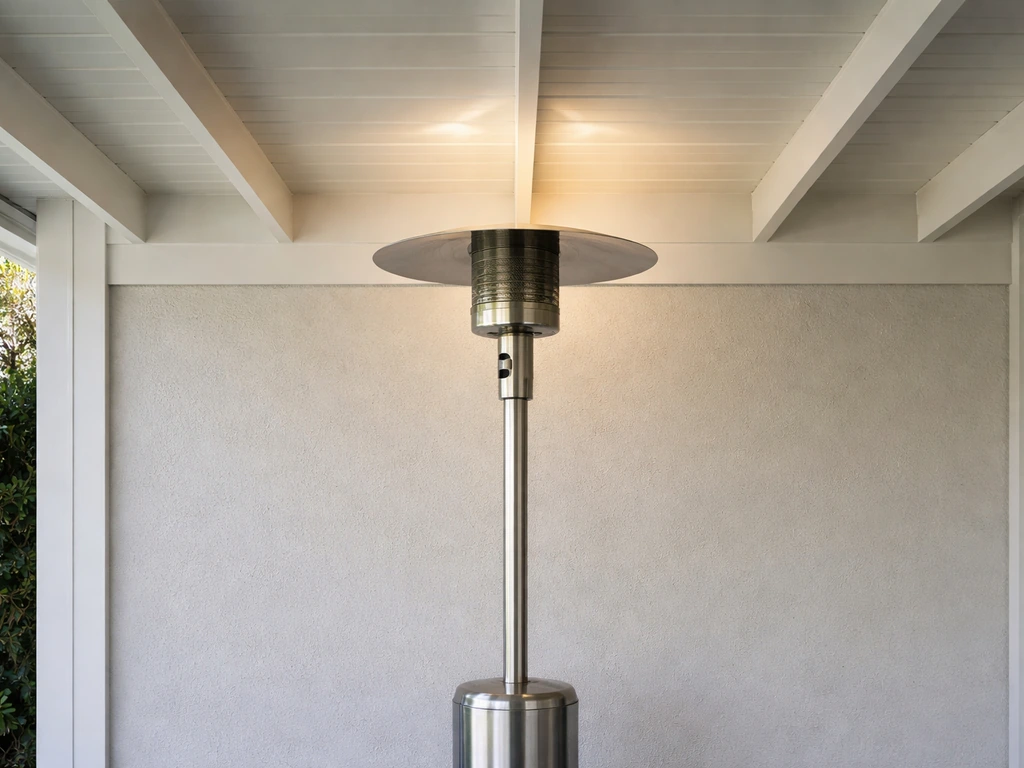
Clearance is the minimum empty air gap that must exist between a specific part of your heater and any nearby surface or object. When manufacturers say "overhead clearance" or "clearance to combustibles," they mean the straight-line distance from the hottest or highest part of the heater up to whatever is above it: a ceiling, a soffit, a pergola beam, a shade sail, a patio umbrella canopy, anything.
[Detroit Radiant Products, for example, defines clearance to combustibles in their UH Series manual as the minimum distance that must exist between the heater and any combustible item. ](https://www. gasoutdoorpatioheaters. com/wp-content/uploads/2025/11/UH-Series-Manual.
pdf) It is treated as a hard safety requirement, not a loose suggestion. Getting too close is not a minor risk: the language in that manual explicitly warns that proximity to the heater may result in explosion, fire, or property damage.
A key thing people miss is that "above" does not always mean the ceiling directly over the heater. It means the closest overhead surface in any direction, including angled soffits, sloped pergola roofs, and the underside of a retractable awning that happens to be extended. If that surface is combustible (wood, fabric, plastic), the clearance requirement is stricter than if it were non-combustible (bare concrete or steel). Always identify the material of the overhead surface before you finalize placement.
Typical overhead clearance ranges by heater type
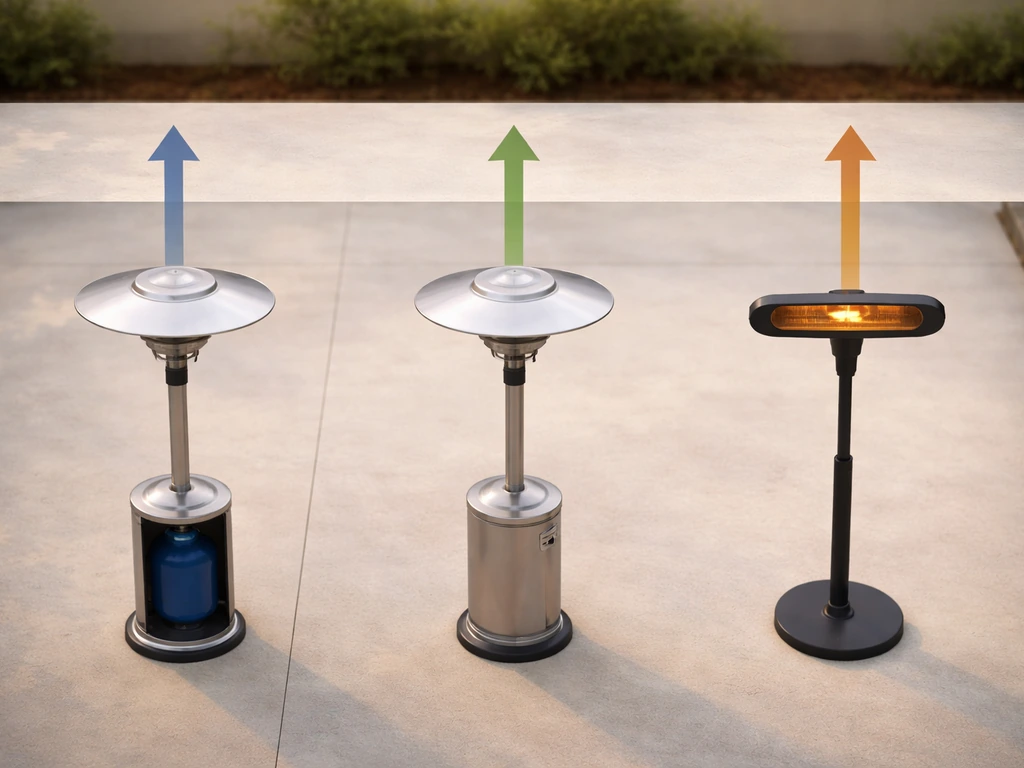
These numbers reflect common manufacturer guidance across a wide range of models. Your specific heater may require more or less, so treat these as a starting point rather than gospel.
| Heater Type | Typical Overhead Clearance | Notes |
|---|---|---|
| Propane mushroom / freestanding gas | 24–36 in. above emitter head | Most require open-air use; check if indoor/covered-space rated |
| Natural gas freestanding or post-mounted | 24–36 in. above burner head | Many require 36 in. minimum overhead to combustibles |
| Wall-mounted electric infrared | 12–24 in. above unit | Lower heat output; check for recessed or soffit restrictions |
| Ceiling-mounted / suspended infrared (gas) | 36–48 in. below mounting surface to top of unit | Follow manufacturer spec exactly; soffit/recessed installs often prohibited |
| Patio-mounted electric radiant panel | Varies; often 8–12 in. to non-combustible overhead | Patio-Pal specifies 8 in. minimum top clearance under non-combustible surfaces only |
The Patio-Pal PH 28/PH 31/PH 34 series is a useful example of how nuanced these specs get. Under a non-combustible surface, the manual allows as little as 8 inches of top clearance to prevent control overheating. But those same heaters must never be installed in a recessed ceiling or inside a soffit at all, regardless of material. Two different rules, both in the same manual, that answer two different versions of the clearance question. This is exactly why reading the manual matters and why generic advice only gets you so far.
How to measure clearance in your specific setup
Grab a tape measure, a flashlight, and if you're dealing with a tall unit, a stepladder. Here is how to do this properly for the most common real-world scenarios.
Flat ceiling or covered patio roof
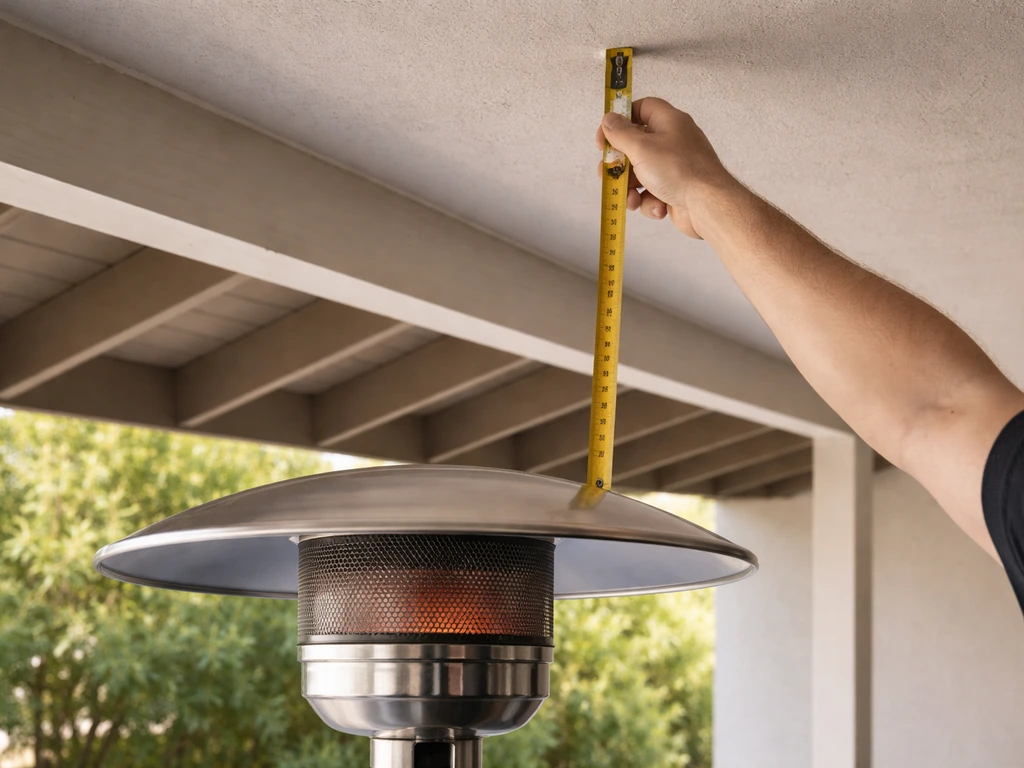
For a freestanding propane or gas heater, measure from the top of the emitter head (the mushroom dome or the reflector ring at the very top of the unit) straight up to the ceiling or roof material above it. That is your overhead clearance number. For a wall-mounted or ceiling-mounted unit, measure from the top face of the heater housing up to any overhead surface within a 2-foot horizontal radius of the unit, since heat rises and spreads. Use the shortest of those measurements as your working clearance figure.
Pergola beams and open-lattice structures
Open lattice is tricky because it feels like open air but it is not. Wood pergola beams are combustible, and heat rises through gaps and concentrates against beam undersides over time. Measure from the emitter head to the nearest beam, not just to the open sky above. If those beams are within 24 inches, move the heater or mount it lower so the clearance to the wood is met.
Patio umbrellas

A patio umbrella canopy is a combustible fabric surface that moves. When the umbrella is closed and stored, clearance may look fine. When it is open and tilted, the canopy can drop to within inches of a nearby heater. Measure clearance with the umbrella in its worst-case open position. If you cannot keep the umbrella at least 24 to 36 inches from the emitter head in every position it can reasonably end up in, keep them separated by more physical distance or use a heater type with a lower heat concentration (such as a low-wattage electric infrared panel rather than a gas heater).
Ceiling fans
Ceiling fans are both a clearance concern and a heat-distribution concern. The fan blades are often plastic or wood: combustible. The motor housing gets warm on its own and does not need additional heat stress from below. Measure from the emitter head up to the lowest point of any fan blade arc, not just to the motor housing. Also consider that a running fan can push warm air and combustion gases in unexpected directions, which may affect nearby surfaces. The safe move is to keep a gas heater at least 36 inches below any ceiling fan, and reposition a freestanding heater so it is not directly underneath.
Clearance around the sides: what to keep away from the heater
Overhead clearance gets most of the attention, but side clearance matters just as much. Most gas patio heaters specify 24 to 36 inches of horizontal clearance from any combustible surface, and at least 36 inches of clearance from any opening into a structure like a window, a door, or a dryer vent. Here is a practical rundown of what to watch for.
- Outdoor furniture cushions and throw blankets: fabric ignites easily; keep at least 36 inches from the emitter
- Wood fencing or deck railings: 24 to 36 inches minimum horizontal clearance
- Potted plants and dried vegetation: dry leaves and straw are highly combustible; keep them well back
- Curtains, shade sails, and outdoor drapes: any fabric overhead or to the side must meet the same combustible-surface clearance as a ceiling
- Windows and sliding doors: heat and combustion gases entering a structure are a carbon monoxide risk; maintain at least 36 inches from any opening
- Other gas appliances and fuel storage: never store propane tanks, lighter fluid, or similar near an operating heater
If you are setting up a heater on a wooden deck, also think about the surface below. Some high-output gas heaters radiate enough downward heat to discolor or warp decking over time, especially if the heater is placed on a decorative mat. Use a non-combustible mat or pad under a freestanding gas heater, and check the manufacturer spec for downward clearance requirements if the unit is suspended.
Checking your model's manual and handling missing paperwork
The best source for your exact clearance numbers is your heater's installation manual, not a general article (including this one). Every manufacturer is required to specify clearance to combustibles, and the numbers are usually in a table near the front of the installation section. Here is how to find that information even if you have lost the paperwork.
- Find the model number: it is almost always on a data plate or label on the back of the unit, the base, or inside the control access panel. Write it down exactly, including any letter suffixes.
- Search the manufacturer's website directly: most brands host PDF manuals in a support or downloads section. Search for your model number plus the word 'manual' or 'installation guide.'
- Use the CSAZ repository or appliance manual aggregator sites: sites that host archived appliance manuals can often surface manuals for discontinued models that no longer appear on the manufacturer's site.
- Look up the CSA or AGA certification listing: if the manual is truly unavailable, the certified clearance specifications are sometimes recorded in the appliance's listing with CSA Group or the American Gas Association.
- Contact the manufacturer directly: a model number and a phone call or support email can often get you a PDF within a day.
- Use the published clearances for a similar model in the same product line as a conservative interim guide, but do not treat this as permanent. Clearance specs can vary even between closely related models.
If you genuinely cannot find a manual and cannot get one from the manufacturer, default to the most conservative clearance figures: 36 inches overhead to any combustible surface, 36 inches on all sides to combustibles, and do not use the heater under any recessed or enclosed overhead structure until you can verify the spec. That is not a permanent fix, but it is a safe interim position.
Patio heater clearance requirements overlap closely with broader patio heater safety distance guidance, so anything you read about general safe operating distances applies here too. Following outdoor patio heater safety practices like keeping clearances and checking the manual can help reduce the risk of fire, explosion, and injuries. If you are trying to confirm your setup, pay close attention to patio heater clearance requirements for overhead and side distances as well.
For more on choosing and maintaining the right patio heater safety distance, follow the same clearance-to-combustibles logic. These clearance basics are a key part of patio heater safety, along with using the correct setup for your specific model.
Safe operation once your clearance is set
Getting the clearance right before you fire the heater up is step one. Maintaining those clearances every time you use it is just as important, because the space around a patio heater changes: chairs get pushed close, umbrellas get opened, a guest leans a blanket against the pole. Here are the habits that actually prevent incidents. Following patio fire pit safety best practices alongside heater clearance can help prevent flare-ups and nearby combustibles from igniting.
- Do a quick visual scan of the clearance zone every time before igniting: look up, look around, check that nothing has moved into the danger zone since last use
- Never move a lit heater: shut it off, let it cool, then reposition it and re-verify clearances before relighting
- Check the anti-tilt switch is functional before each use on freestanding units: a heater that tips over toward a wood deck or fabric surface is one of the most common causes of patio fires
- Do not use freestanding propane heaters under low pergolas or covered patios unless the manual explicitly approves it and you have verified the clearance numbers
- Watch for discoloration on overhead surfaces: yellowing, darkening, or paint bubbling above the heater is a sign the clearance is insufficient even if it technically meets the minimum
- Keep children and pets at least 36 inches from any operating heater: this is a safe-zone buffer, not the clearance-to-combustibles measurement
- Inspect the gas hose and regulator for cracks or wear at the start of each season: a gas leak near an ignition source removes any safety benefit that correct clearance provides
One thing worth emphasizing: clearance requirements and safe operation are part of the same system. You can have perfect overhead clearance and still create a hazard by using a faulty thermocouple that keeps the burner running longer than intended, or a blocked reflector that concentrates heat in the wrong direction. If your heater has any known issues, like a burner that stays on too long, a pilot that is hard to keep lit, or a reflector that has been bent or repositioned, address those before relying on clearance measurements alone. Clearance is a passive safeguard; a well-maintained heater is the active one.
FAQ
If I have clearance above the heater, do I still need side clearance too?
Yes. Overhead clearance only addresses what’s above, side clearance covers combustibles in the path of radiant heat, wind-driven heat, and hot surfaces on the heater body. Treat side distances as separate requirements, especially near railings, planters, outdoor rugs, and furniture backs that can shift closer.
What counts as “combustible,” for example is treated wood or plastic furniture included?
Usually yes. “Combustible” generally includes wood, fabric, plastic, wicker, vinyl, and anything that can burn or melt, even if it’s rated for outdoor use. If you’re unsure whether a surface is treated wood, composite decking, or plastic-laminate, assume it is combustible and use the more conservative clearance.
How do I measure clearance correctly if the ceiling is sloped or I have an angled pergola roof?
Measure to the closest overhead surface in any direction, not just straight above. Use a straight-line distance from the top of the emitter head or heater housing to the nearest point of the roof beam, soffit, or other overhead material that could intercept rising heat.
Does “worst case” apply to umbrellas, retractable awnings, and sails?
Yes. For any overhead or nearby cover that can move, measure with it in its most likely heating position (opened, tilted, or partially deployed). If the heater could be within the minimum distance during normal use, increase spacing or choose a heater type designed for those installations.
Can I run a heater under a recessed ceiling if my overhead clearance seems large enough?
In many models the answer is no, because some heaters cannot be installed inside a recess or enclosed overhead cavity regardless of the measured gap. Check for explicit prohibitions in your model manual, since the heat behavior in a recessed area can trap heat even when the static clearance looks acceptable.
How often should I re-check clearances after setup?
At minimum, re-check at the start of each season and any time the environment changes, like moving furniture, adding a cover, opening a pergola curtain, or raising an umbrella. Also re-check after weather events that can shift mounts or alter how covers hang and align.
What should I do if I’m missing the manual but still want to use the heater?
Use the conservative interim approach: keep overhead clearance to combustibles at 36 inches or more, keep side clearance at 36 inches on all sides, and avoid recessed or enclosed overhead structures until you verify the exact spec. If you can’t confirm clearance for your exact model, it’s safer to delay use rather than rely on generic guidance.
Does clearance change based on heater height settings or different burners/regulators?
It can. Some heaters have multiple output levels or adjustable positions that change where the hottest area sits. If your manual ties clearance requirements to operating mode or positioning, follow the specific mode that you will run, not just the default knob setting.
Are ceiling fans treated the same as other overhead combustibles?
Not exactly. Fan blades can be combustible, but the bigger nuance is the blade arc and airflow direction. Measure to the lowest point of any blade path and consider how running airflow may redirect hot gases or warm air, which can increase heating against nearby surfaces.
If the heater is on a deck, do I only worry about clearance to the ceiling and sides?
No. Downward radiant heat can still damage decking or decorative mats over time. Use a manufacturer-approved non-combustible base or mat if required, and follow any downward clearance or mounting guidance if the heater is suspended rather than placed directly on the surface.
What’s the most common clearance mistake people make?
Measuring to the wrong reference point. Clearances are based on the top of the emitter head or heater housing, then to the closest relevant surface (including angled beams and moving canopies). People often measure to the ceiling centerline or to the motor housing, which can underestimate the true closest heating point.
If my clearance is correct, what other issues can still make the heater unsafe?
Clearance is passive protection, but heater faults can override it. Address maintenance problems like a burner that stays on too long, ignition or pilot issues that lead to abnormal operation, or a damaged or misaligned reflector that concentrates heat in the wrong direction. If you suspect a malfunction, stop using the heater until it’s repaired.