Keep your fire pit at least 15 feet from any structure, combustible surface, or furniture, that is the minimum clearance under the International Fire Code, and some jurisdictions and fire departments push it to 25 feet. Never leave a burning fire pit unattended, never refuel a propane or liquid-fuel unit while the flame is lit, and always keep a charged ABC fire extinguisher within arm's reach. Those three rules alone will prevent the vast majority of patio fire pit accidents.
Patio Fire Pit Safety: Do This Today Checklist

Grant Mercer
18 Jun 2026
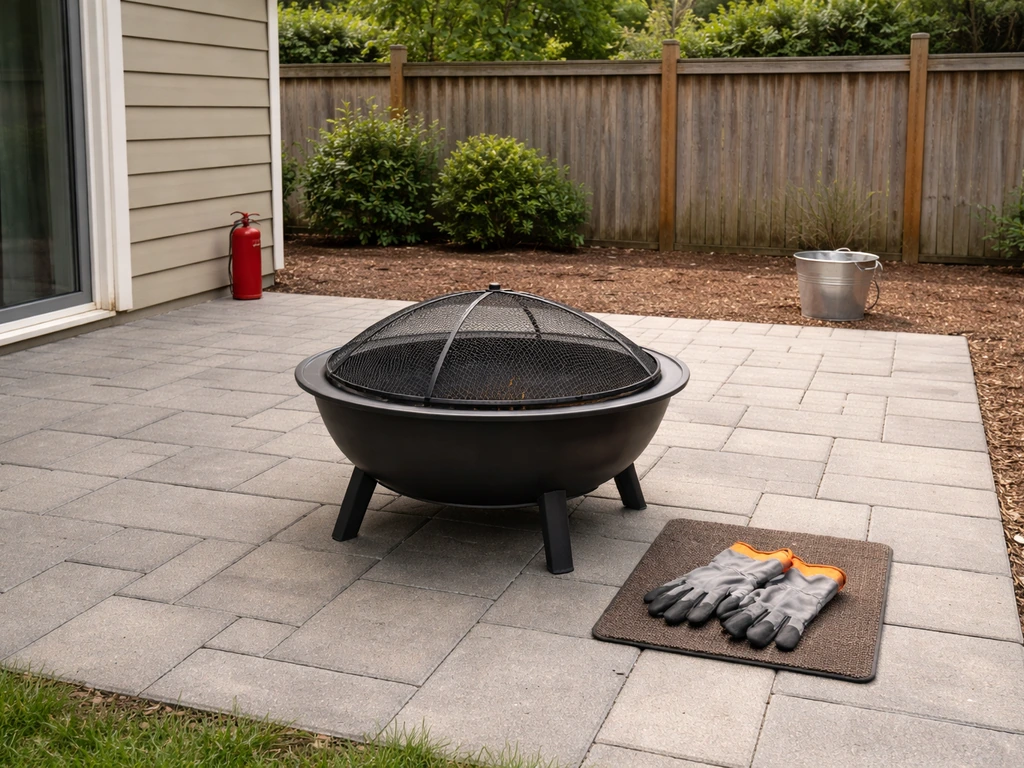
Fire pit safety basics for patios
A fire pit on your patio is genuinely enjoyable, but it introduces three real hazards: uncontrolled flame spread, radiant heat damage to nearby structures and equipment, and fuel-related emergencies (gas leaks, flare-ups, carbon monoxide). Understanding which hazard applies to your setup lets you fix the right problem instead of guessing.
The most common mistakes homeowners make are placing the fire pit too close to the house, using it under a covered patio or near overhead string lights, leaving it unattended while guests wander around it, and skipping a gas leak test on a propane or natural gas unit. Children and pets compound every one of these risks, since hot ash in a wood-burning pit stays dangerously hot for hours after the flame goes out. The American Academy of Pediatrics specifically flags residual ash heat as a burn hazard that catches caregivers off guard.
One more thing worth knowing before we get into specifics: local fire codes can be stricter than the International Fire Code baseline. The IFC sets a 15-foot portable fire pit setback, but Big Bear Fire Department in California requires 25 feet of clearance in all directions. Always check your local authority's rules, calling your city or county fire marshal takes five minutes and could save you a fine or, more importantly, a house fire.
Safe setup and placement rules
Clearance from structures and combustibles
The 15-foot rule from IFC 307.4.3 covers structures, fences, covered patios, overhanging branches, and any combustible material. That means 15 feet from your house walls, 15 feet from your wood fence, 15 feet from those string lights strung across your pergola. If your patio is too small to achieve that, move the fire pit onto the lawn. A patio heater also needs clearance from the ceiling and overhead materials, because radiant heat can damage surfaces and create a burn or fire risk if it is too close too small to achieve that. A fire pit shoved against the back wall of a 10-foot-deep patio is a fire waiting to happen.
Decks deserve special attention. A wood-burning fire pit should never sit directly on a wood deck, the radiant heat alone can char the boards beneath it, and an ember pop can ignite the surface fast. A community fire-pit safety sheet also says you should not place a fire pit [on or under a wooden deck](https://sundancemtsouth. org/documents/safe-use-of-firepits-2022.
pdf), keep it constantly attended by a responsible person, and clear combustibles within 25 feet. If you want a fire pit on a deck at all, it must be a gas or propane model explicitly approved for deck use by the manufacturer, placed on a non-combustible base that extends at least 24 inches on all sides. Even then, keep the 15-foot side clearances to rails, siding, and overhangs.
For patio heaters, the clearance requirement is also tied to local codes and the unit’s heat output, so verify the manufacturer’s guidance for safe spacing 15-foot side clearances. When in doubt, use the yard.
Surface stability and leveling
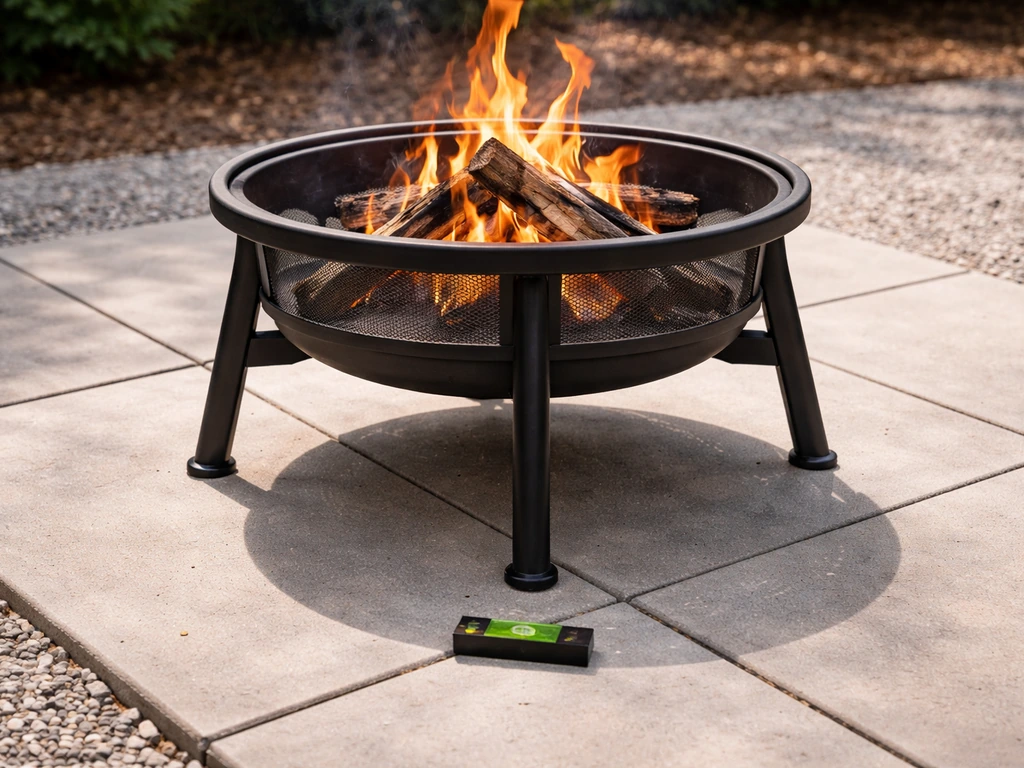
A fire pit that tips over is an emergency. Place your unit on a flat, stable, non-combustible surface, concrete pavers, flagstone, or gravel work well. Check that all four legs or feet contact the surface before lighting. For propane fire pit tables with a tank inside the base, make sure the base doors or panels close properly and the tank sits upright and secured. A leaning tank puts stress on the regulator hose connection, which is exactly the spot you do not want a slow leak developing.
Wind and airflow
Wind is the factor most people ignore until sparks start landing on the patio cushions. On breezy evenings, orient yourself and your guests so the prevailing wind blows sparks away from the house and seating area. Use a spark screen on wood-burning pits any time there is any wind at all. If gusts pick up beyond about 15 mph, extinguish the fire entirely, wind-driven embers can travel much farther than people expect. Avoid positioning the pit in a natural wind tunnel between your house and a fence or wall.
Fuel choice and handling
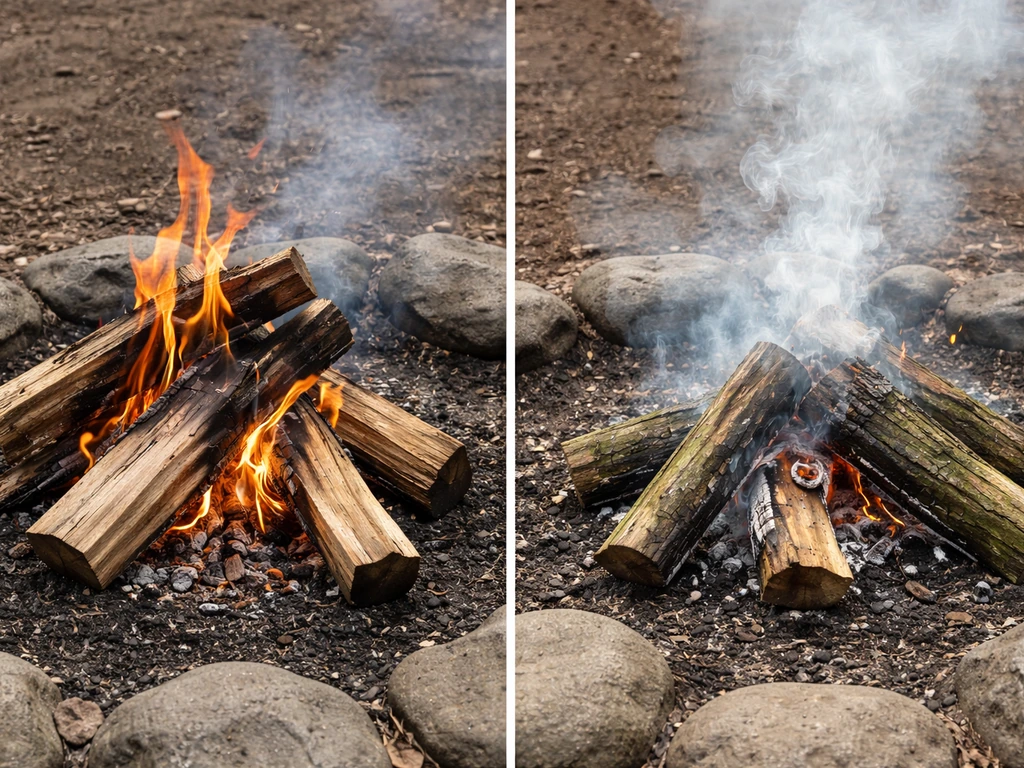
Your fuel type determines most of your specific risk profile. Here is a straight comparison of the three main options:
| Fuel Type | Main Hazard | Key Handling Rule | Clearance Notes |
|---|---|---|---|
| Wood | Embers, sparks, creosote buildup | Use dry, seasoned hardwood only; never accelerants | 25 ft recommended by some fire depts; 15 ft IFC minimum |
| Propane | Gas leak, regulator failure, flare-up on relight | Leak-test every connection before first use each season | Follow manufacturer spec; gas units often have lower heat-spread radius |
| Natural gas | Leak at fittings, valve failure, CO if used enclosed | Licensed plumber for line installation; annual valve inspection | Permanent install — follow local gas code, not just IFC fire code |
| Liquid/gel alcohol | Flame jetting during refuel; severe burn risk | CPSC recommends stopping use of non-compliant models entirely | Same 15 ft setback; treat pooled fuel as immediate emergency |
Wood-burning fire pits
Use only dry, seasoned hardwood. Wet or green wood creates excessive smoke and pops more aggressively, throwing larger embers. Never use construction lumber, pallets, or treated wood, the chemicals they release are toxic and can also cause unexpected flare-ups. Do not use gasoline, lighter fluid, or any liquid accelerant to start or revive a wood fire. A fire starter cube or a small kindling pyramid works fine and keeps you in control of the ignition.
Propane fire pits
Before connecting a new tank or reconnecting at the start of the season, do a blank" rel="noopener noreferrer">soap-and-water leak test on every threaded connection: the tank valve, the regulator fitting, and both ends of the hose. Apply soapy water with a brush, open the tank valve slowly, and watch for bubbles. Any bubbling means you have a leak, close the valve immediately, disconnect, and inspect the fitting or replace the hose. This step takes two minutes and is genuinely non-negotiable. Use only CSA or UL-certified hoses and regulators; cheap replacements from unknown sources fail at the regulator seat and are a documented cause of flare-ups.
Natural gas fire pits
Natural gas fire pits are permanently plumbed and the installation must be done by a licensed gas plumber, this is not a DIY connection job. Once installed, the annual maintenance you can do yourself includes inspecting the valve for corrosion, checking the burner ports for spider webs or debris blockage (a common cause of ignition failure), and verifying the shutoff valve turns freely. Never use a natural gas fire pit in an enclosed or partially enclosed space. Carbon monoxide from incomplete combustion is invisible and odorless, and the CPSC is explicit about how quickly CO can kill in an enclosed area.
Liquid and gel alcohol fuels, a specific warning
As of 2025, the CPSC has issued a consumer alert urging people to stop using tabletop fire pits and firepots that burn alcohol or gel fuel and do not meet voluntary safety standards. There have been two deaths and dozens of serious burn injuries linked to flame jetting, where adding more fuel to a still-hot burner causes an instant flare-up that can project flames several feet. If you own one of these units, check the CPSC's alert page for your model. If it is listed or if you cannot confirm it meets current standards, the safest move is to stop using it.
Using the fire pit safely during operation
Lighting a propane or gas fire pit correctly
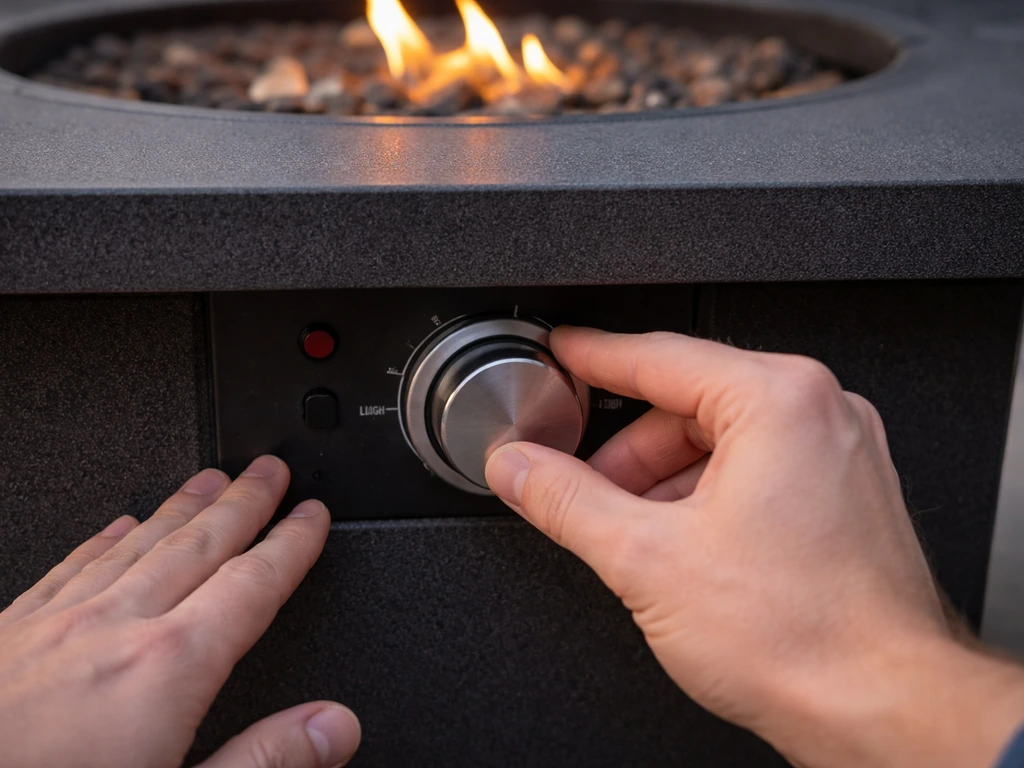
The consistent rule across almost every propane fire pit manual is: ignite first, then introduce gas flow. Turn the control knob to the LIGHT or ignite position, hold it in, press the igniter button, and keep holding the knob for the full pilot hold time, usually 10 to 30 seconds, before releasing. Releasing too early is the most common reason the flame goes out immediately after lighting. If the pit does not light within about 30 seconds, turn the knob to OFF, wait at least 5 minutes to let any accumulated gas dissipate, then try again. Do not keep clicking the igniter while unlit gas is building up around the burner.
Shutting down correctly
For propane and gas units, always turn off the gas supply valve first, then let the flame burn out naturally as residual gas clears the line. Do not try to smother a gas flame while gas is still flowing. For wood fires, stop adding fuel at least 30 minutes before you want the fire out, then douse the coals thoroughly with water, stir the ash, add more water, stir again, and check that everything is cool to the touch before leaving the area. Hot ash can reignite hours later if left smoldering.
Supervision and fire pit etiquette
A lit fire pit requires a responsible adult within arm's reach at all times, not just somewhere in the yard. The moment the fire is unattended is the moment something rolls into it or the wind shifts. Keep guests from reaching across the fire, which is a leading cause of clothing ignition. Establish a clear perimeter: keep chairs at least 3 feet back from the pit edge, move synthetic-fabric cushions well away from the fire area, and never let children or pets run near the pit unsupervised. When the evening is winding down and people start moving indoors in groups, that is exactly when unattended fires cause accidents.
Heat shields, ventilation, and protecting nearby patio heaters and equipment
If you run both a patio heater and a fire pit in the same outdoor space, which is common for shoulder-season entertaining, the two heat sources can interfere with each other in ways that cause real problems. A standing propane patio heater positioned too close to a fire pit can have its thermocouple or tilt switch affected by reflected heat, triggering a false shutoff.
More seriously, radiant heat from a wood-burning pit can damage the gas hose on a nearby heater or cause the reflector dome to warp if the clearance is too tight. Using the right clearance helps reduce the risk of patio heater safety problems when you have both heat sources running patio heaters at least 6 to 10 feet away.
Keep patio heaters at least 6 to 10 feet away from any fire pit, and make sure neither unit is positioned so its exhaust or heat plume flows across the other's gas fittings.
Heat shields and non-combustible barriers are your best tool for protecting decking, furniture, and nearby equipment. A raised fire pit on a non-combustible paver base with a radiant heat shield underneath can dramatically reduce surface temperatures at ground level. If you have a propane fire pit table, the cabinet below the burner also gets warm, make sure the vents on the cabinet are unobstructed and that you are not storing extra tanks inside a sealed enclosure during operation.
Outdoor patio heater safety also depends on keeping clearances, managing fuel, and supervising the unit so heat and sparks do not reach people or combustibles. Ventilation for the gas compartment is not optional; it is what prevents a small leak from concentrating into an ignitable mixture.
Overhead clearance matters too, and this is where patios get people into trouble. Covered patios, pergolas with fabric or wood slats, and string lights strung overhead all become fire hazards when placed above a fire pit. The smoke and heat plume from even a modest fire can discolor, dry out, and eventually ignite overhead materials.
If your patio has a solid or semi-open roof structure, a wood-burning fire pit is the wrong choice for that space, consider a low-output gas unit designed for covered outdoor use, and check the manufacturer clearance spec for overhead distances, which is typically noted in the same section as the side clearances. Patio heater clearance requirements follow similar logic, and the same spatial reasoning applies.
Emergency preparedness and what to do if something goes wrong
Equipment to have on hand before you light
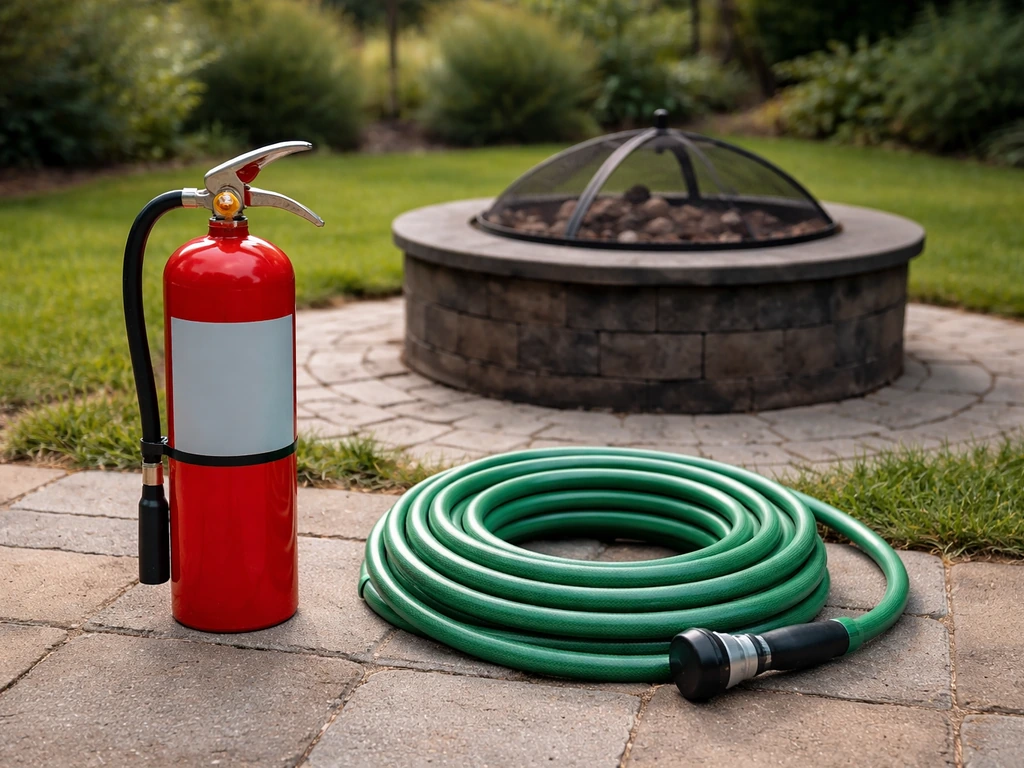
- A charged ABC (multi-purpose dry chemical) fire extinguisher rated for Class A, B, and C fires — positioned within 10 feet of the fire pit, not locked in the garage
- A garden hose connected and pressurized near the patio (for wood fires and general control)
- A metal bucket of dry sand as backup for smothering small flare-ups without water splash
- A first aid kit with burn gel or cool water access nearby
- Your local fire department's non-emergency number saved in your phone
If the fire starts spreading
If flames reach the ground, deck surface, or nearby vegetation and your extinguisher or hose cannot knock it down in the first 30 seconds, stop fighting it and call 911 immediately. Get everyone away from the structure. Do not go back inside for belongings. The NFPA's consistent guidance is that fire grows exponentially, what looks manageable for 20 seconds can become untenable in 60. Use your extinguisher on a contained flare-up or a small ground fire at the base of the pit, not on a fire that has climbed a fence or reached a wall.
If you smell gas
- Do not light or operate any ignition source — no lighter, no igniter button, no light switch
- Turn the tank valve or gas supply valve to OFF immediately
- Move everyone away from the area
- Do not go back to investigate until the smell has fully cleared — at least 10 to 15 minutes in open air
- Perform a soap-and-water leak test on all connections before attempting to relight
- If the smell is strong, persistent, or coming from a fixed natural gas line, call your gas utility's emergency line and stay out of the area
If the unit tips over
For a propane fire pit that tips, the priority is the gas supply: if you can safely reach the tank valve without putting yourself over the flames, turn it off. If you cannot reach it safely, get everyone back and call 911. Do not attempt to right a burning, tipped propane unit. For a wood-burning pit that tips, use the sand bucket or extinguisher on any burning material that spilled, then use a shovel or metal tongs to contain burning logs, never your hands. A tipped cast-iron fire pit retains heat for a long time even after the flames are out.
If someone gets burned
Cool the burn immediately with cool (not ice cold) running water for at least 10 minutes. Do not apply butter, toothpaste, or any home remedy, they trap heat and increase infection risk. For any burn larger than about 3 inches, burns on the face, hands, feet, or joints, or any burn that looks white, brown, or charred, call 911 or go to an emergency room immediately. Minor redness on a small area can be treated with a water-based burn gel and a sterile dressing, but when in doubt, get professional help.
Your patio fire pit safety checklist for today
Before your next fire, walk through this list. It takes about 15 minutes and addresses the most common hazards in order of seriousness.
- Measure actual clearance from the fire pit to the nearest structure, fence, and overhead feature — confirm it is 15 feet minimum (25 feet if you are in a high-fire-risk area or under a stricter local code)
- Confirm the fire pit is on a flat, stable, non-combustible surface with no wobble
- Move all patio cushions, synthetic rugs, fabric furniture covers, and decorative items outside the clearance zone
- For propane or gas units: perform a soap-and-water leak test on every connection before lighting
- Confirm your ABC fire extinguisher is within 10 feet, charged (gauge in the green), and not expired
- Connect your garden hose and confirm water pressure at the patio faucet
- Remove any overhead combustible materials (string lights, fabric canopies, dried vines) from directly above the fire pit
- Check that nearby patio heaters are at least 6 to 10 feet away and that their gas hoses are not in the radiant heat path of the fire pit
- Identify the gas shutoff valve location for propane or natural gas units and confirm it operates freely
- Establish a supervision rule with anyone else present: one adult stays at the fire at all times
FAQ
How do I figure out the right patio fire pit safety distance for string lights, pergolas, and the roof above it?
Use the clearance concept in two dimensions, side clearance from combustibles and overhead clearance from anything above the flame. If you cannot keep both, the safest move is to switch to a low-output gas unit rated for covered use, or relocate the fire pit to an uncovered area. Also avoid string lights directly over the pit’s centerline, even if the lights feel “cool” most of the time.
Is a heat shield or spark screen enough on its own for patio fire pit safety?
No. A spark screen helps with embers, but it does not guarantee safe spacing from radiant heat or prevent tipping and fuel-related issues. Use heat shields or non-combustible barriers only as extra protection, while still meeting the clearance and supervision rules.
What should I do if my propane fire pit ignites but the flame keeps going out?
Most failures come from releasing the knob too soon, a dirty burner, or a sensor thermocouple or thermopile issue. Shut the unit off, wait at least 5 minutes to dissipate gas, inspect the burner area for debris or blockage, then retry the lighting sequence with the knob held for the full pilot hold time. If it still won’t stay lit, stop using it until the gas components are serviced.
How can I tell whether the “soap-and-water” leak test is actually working?
You should see bubbles that consistently grow at the suspected connection when the valve is open. If you only see brief foaming or tiny surface bubbles that disappear quickly, wipe the area dry, reapply fresh soapy water, and retest. Never ignore a bubbling connection, close the valve immediately and replace the fitting or hose before relighting.
Can I use a patio fire pit on an uneven surface or pavers that are slightly loose?
You can, only if the surface is flat and stable so all feet contact firmly. Loose or rocking pavers increase tipping risk, especially in wind. If you have any wobble, level the base using properly installed non-combustible supports before lighting.
What’s the safest way to handle leftover ash after a wood-burning patio fire pit?
Treat ash like hot material for hours. If you need to dispose of it, use a metal container with a tight lid and keep it away from combustibles until the ashes are completely cool. Never put ash in a plastic trash can, and do not assume “no flames” means “safe to touch.”
If my fire pit is under a gazebo or near a wall, is it ever safe to use it there?
Only if the space is explicitly allowed by your local codes and the unit’s manufacturer installation instructions, including overhead restrictions. A typical rule is that covered patios or enclosed areas increase both radiant heat risk and, for gas units, carbon monoxide risk. When clearance cannot be met, relocate or switch to a safer, properly rated setup.
What should I do during patio fire pit safety if wind changes suddenly while guests are still outside?
Have a simple wind trigger. If gusts rise beyond about 15 mph, extinguish the fire rather than trying to manage it with positioning. Keep guests behind the perimeter, and keep the spark screen on wood-burning pits any time there is wind.
Can I use water to extinguish a propane fire pit?
Do not use water to extinguish a propane burner that is actively burning. The correct action is to turn off the gas at the supply valve if you can do so safely, then allow it to burn out naturally. Water can increase mess and splatter, and it can complicate troubleshooting if the unit needs to be inspected later.
What is the correct emergency response if embers ignite the ground or a nearby object?
If the initial flare-up is beyond what your extinguisher or hose can knock down quickly (around the first 30 seconds), stop fighting it and call 911. Move everyone away from the structure, do not return for belongings, and focus on getting people out rather than trying to salvage items.
Do children and pets need their own separate safety rules beyond the supervision rule?
Yes. Beyond having a responsible adult within arm’s reach, create a hard perimeter so pets and kids cannot roam near the edge. Keep synthetic cushions and furniture farther back than adults think is necessary, because embers can land and ignite items that seem too far away until they catch.