Yes, you can use a patio heater on a covered porch, but only if you meet three conditions: the porch is open enough on the sides to ventilate freely, your heater has enough vertical clearance from the ceiling or roof (typically 24 to 48 inches depending on the model), and the heater is working properly before you fire it up. Do patio heaters need to be covered? The short answer is you can use one on a covered porch, but only if the space is ventilated and not enclosed. If your porch is mostly enclosed or you're not sure the heater is in good shape, the risks go from manageable to serious fast.
Can Patio Heaters Be Used on a Covered Porch Safely

Grant Mercer
12 Jun 2026
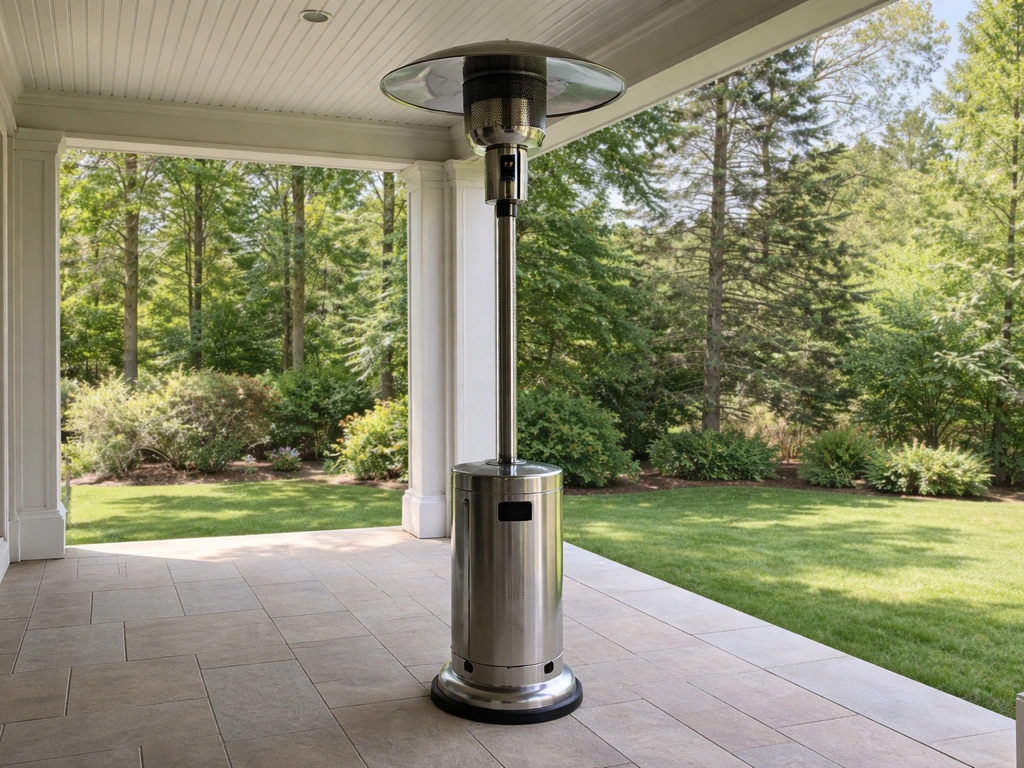
The quick yes/no safety answer
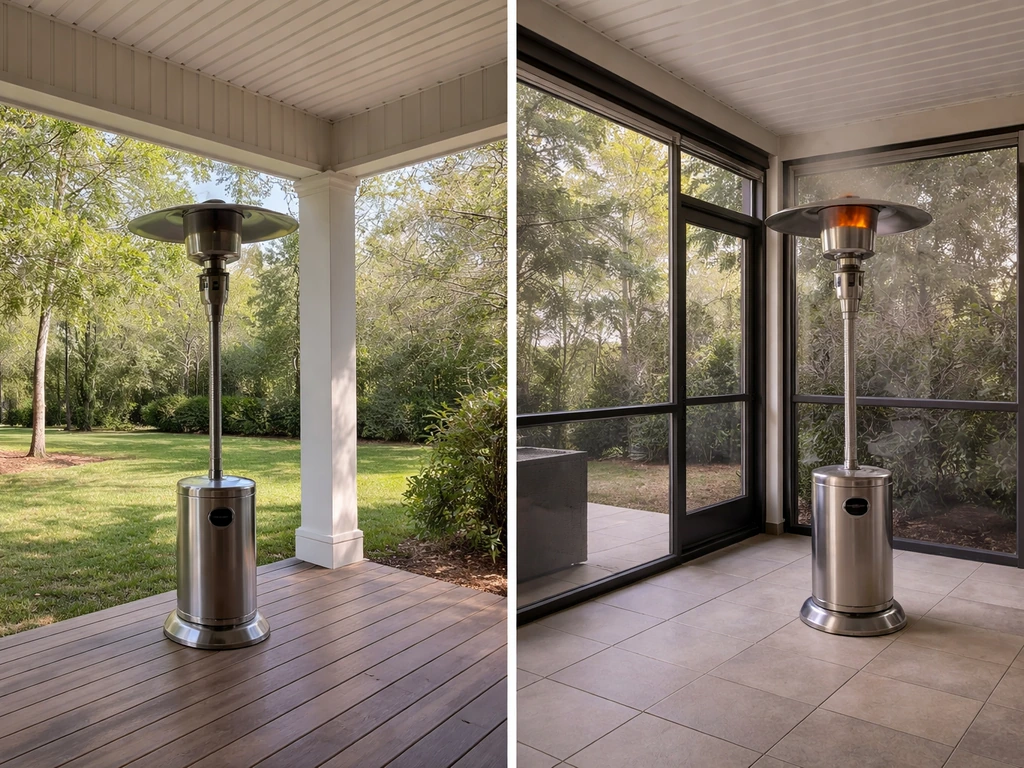
A covered porch is fine for a propane or gas patio heater as long as it isn't enclosed. The NFPA is blunt about this: propane patio heaters cannot be used in enclosed locations. OSHA echoes the same warning, specifically calling out semi-enclosed spaces with poor ventilation as high-risk environments for carbon monoxide buildup. The practical line is this: if your covered porch has open sides or is open on at least half its perimeter, you're in acceptable territory. If your porch has screens, glass panels, curtains, or walls closing off most of the sides, stop and read the ventilation section below before you do anything else.
Check your heater type and pull up the manual before anything else
Not all patio heaters are created equal, and the clearance numbers vary more than most people expect. Before you drag your heater onto the porch, you need to know what you're working with. Propane mushroom-style heaters (the tall freestanding kind) are the most common DIY setup. Electric infrared heaters mounted on walls or ceilings follow completely different rules. Natural gas heaters that are permanently plumbed are a third category with their own requirements and local code implications.
Once you know your type, look up the manual. If you don't have the paper copy, search the model number on ManualsLib or the manufacturer's site. Here's what the numbers actually look like across a few common brands:
| Brand / Model | Clearance to Top (Ceiling) | Clearance to Sides |
|---|---|---|
| Nexgrill 920-0030 | 2 feet (24 in) | 3 feet (36 in) |
| Fire Sense (standard) | 24 inches | 24–48 inches |
| Fire Sense 61436 Pro Series | 36 inches | 24 inches |
| Thermo Tiki | 36 inches | 36 inches |
| Dyna-Glo DGPH301BL-1 | Check manual for ceiling value | 36 inches |
| Bromic Platinum / Tungsten | 43.3 in (1100 mm) before deflector required | Per manual |
The takeaway here: even the most lenient spec requires at least 24 inches of clear space above the heater's heat output point. If your porch ceiling or roof overhang sits lower than that above the heater's top, you either need to reposition the heater or skip using it on that porch. Bromic specifically notes that if the clearance above the heater is less than about 43 inches, you should add a heat deflector to redirect radiant heat away from the structure. Check whether your heater has a CSA or UL listing (look for the label on the base or regulator housing). CSA/ANSI Z83.26 is the dedicated certification standard for gas-fired outdoor infrared patio heaters, and any unit that carries it has been tested to a real safety baseline. If you can't find a listing label, that's worth factoring into your risk assessment.
Ventilation and the carbon monoxide problem on a covered porch
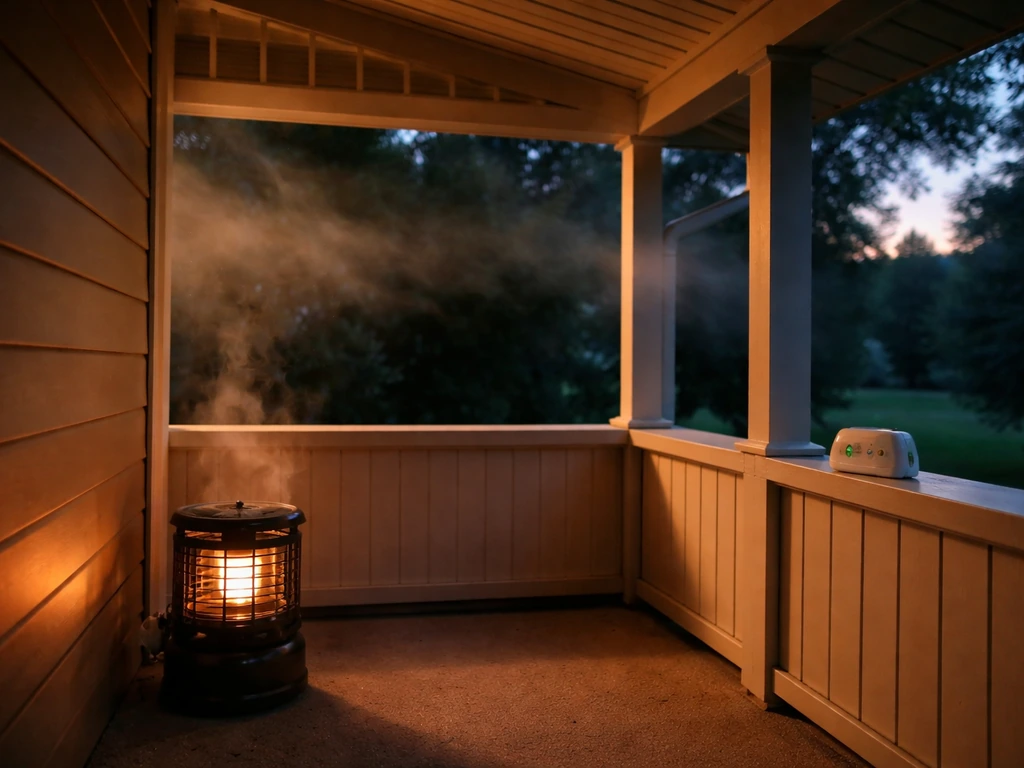
This is the part people underestimate. Propane combustion produces carbon monoxide, and CO is colorless and odorless. You won't smell it, and by the time you feel symptoms, you're already in trouble. On a wide-open patio, the gas disperses immediately. On a covered porch, especially one that's partially enclosed, it can accumulate.
The NFPA 58 code gives a practical ventilation threshold worth knowing: for any sheltered or canopied LP-gas setup, the area should not be enclosed for more than 50 percent of its perimeter. That's the minimum acceptable airflow standard. Run through this quick mental check on your porch:
- Stand in the middle of your covered porch and look at all four sides.
- Estimate what percentage of the perimeter is open (no wall, screen, window, or panel).
- If less than half the perimeter is open, the space does not meet the ventilation threshold for a propane heater.
- If you have screens, consider whether they meaningfully restrict airflow. Fine mesh screens substantially reduce ventilation; coarse lattice or open railings generally don't.
- Think about wind direction. A porch that faces into prevailing winds ventilates much better than one facing a wall or hedge.
If you have any concern about enclosure, put a battery-powered CO detector on the porch before the first use. It costs about $20 and is cheap insurance. Position it at seated height (2 to 3 feet off the floor), not up near the ceiling where it won't catch ground-level accumulation early enough to matter.
Fire safety: heat clearance from your roof, walls, and nearby materials
Propane patio heaters direct intense radiant heat upward and outward. On an open patio that heat just disappears into the air. Under a covered porch, it hits the ceiling, soffits, or overhang. Wood, vinyl siding, PVC trim, string lights, potted plant hangers, and patio curtains are all combustible. Even materials that won't ignite outright can discolor, warp, or degrade from repeated radiant heat exposure.
Use the clearance numbers from your manual as hard minimums, not suggestions. Fire Sense patio heater instructions also call for maintaining clearance from combustible materials, including a 48-inch clearance requirement (with minimums of 24 inches at the top and 24 inches at the sides) 48-inch clearance from combustible materials. If the manual says 36 inches to the top and your roof sits 30 inches above the burner, the heater doesn't belong there. Here's a practical checklist for fire hazard assessment before you position the unit:
- Measure from the top of the heater (the emitter dome on a mushroom-style unit) to the nearest overhead surface. Compare against your manual's top clearance spec.
- Look up and around for hanging plants, string lights, paper lanterns, fabric curtains, or any decoration within the side clearance radius.
- Check the wall and ceiling material. Wood, vinyl, and low-density polystyrene foam insulation panels are all combustible and need more breathing room.
- Move any propane canisters, fuel containers, or flammable liquids well away from the heater's operating zone.
- Don't position the heater directly under a ceiling fan or vent. Fans can redirect the heat column sideways toward walls or combustible surfaces.
Nexgrill's manual specifically pairs the clearance requirements with a warning to keep flammable vapors and liquids away from the operating area. That's not boilerplate. Propane is heavier than air and can pool at floor level. If there's a small propane leak from a loose fitting and a gas can nearby, you have a very bad situation. Keep the heater's zone clear of anything that burns or vaporizes.
How to position and set up your heater on the porch today
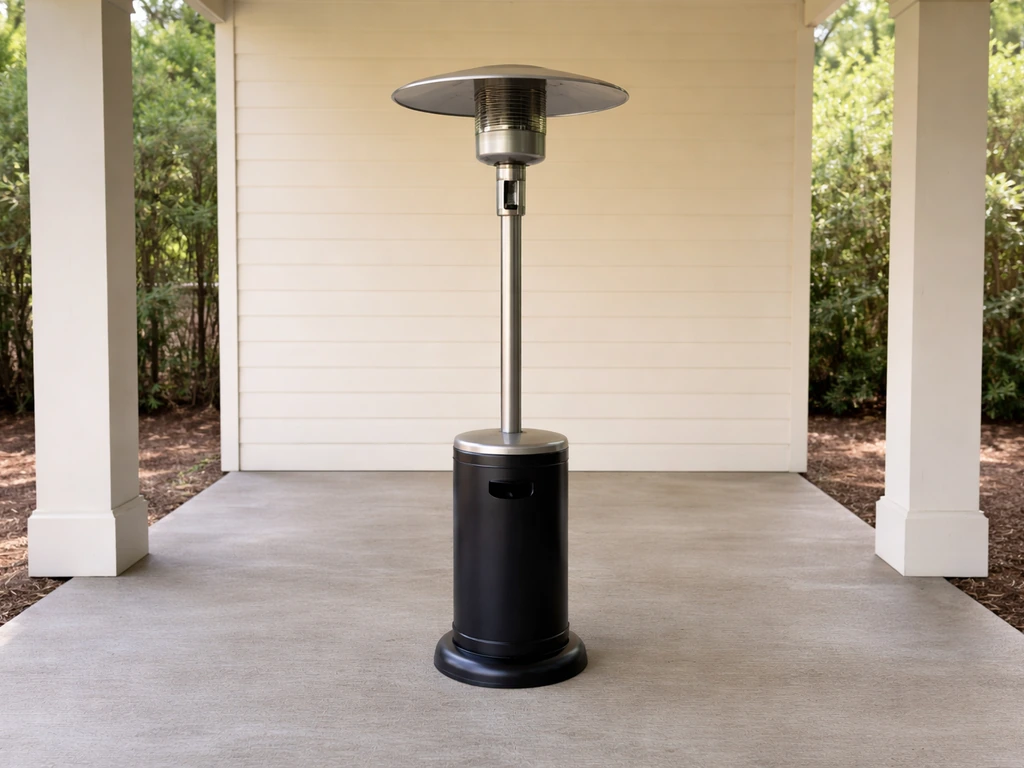
Here's the practical placement walkthrough. Do this before you connect any propane or turn anything on.
- Pick a spot on the porch that is away from walls and corners. Center placements work best for freestanding units because they maximize side clearance in all directions.
- Measure vertical clearance from the top of the heater (the emitter dome) to the ceiling, beam, or overhang directly above it. This must meet or exceed your manual's minimum. When in doubt, use 36 inches as your conservative baseline.
- Measure side clearance from the outer edge of the heater base out to any nearby wall, post, or combustible surface. Aim for at least 36 inches on all sides for most propane mushroom heaters.
- Place the heater on a flat, stable, non-combustible surface. Concrete, tile, and stone pavers are good. Composite decking is acceptable but watch for discoloration over repeated use. Wood decking is higher risk and you should place a heat-rated mat under the base.
- Make sure the heater is on level ground. These units have a tip-over safety shutoff, but a noticeably tilted heater is a hazard even before it tips all the way over.
- Connect the propane tank and check the regulator fitting for leaks using soapy water before lighting. Bubbles at the connection mean you have a leak and should not proceed.
- Do not use extension cords with electric patio heaters outdoors unless the cord is rated for outdoor use and the gauge matches the heater's amperage draw.
- Once lit, check the flame pattern. A steady blue flame with minor orange tips is normal. A yellow, flickering, or sooty flame means incomplete combustion, which produces more CO. Shut it off and troubleshoot before continuing.
What not to do
- Don't push a patio heater into a corner to 'concentrate' the warmth. It cuts your side clearance and traps heat against two walls.
- Don't hang tarps or shade sails to enclose the porch more while the heater is running. This is a CO and fire risk.
- Don't use a patio heater inside a screened enclosure that has solid walls on two or more sides.
- Don't leave the heater unattended and running under a covered porch if anyone in the space is unable to respond to a fire or CO alarm.
- Don't use the heater if the wind is blowing the flame sideways toward a combustible wall or curtain.
Pre-use safety checks and troubleshooting before you light up
Running a patio heater that isn't working correctly under a covered porch is worse than running it in the open, because any problem, whether it's a small gas leak, incomplete combustion, or a faulty shutoff, is happening in a more confined area. Because a Solo Stove is a different type of heat source than a gas or propane patio heater, you should still verify clearance and ventilation for a covered patio setup Solo Stove under a covered patio. Before using your heater under any roof, run through these checks.
- Inspect the regulator hose for cracks, kinks, or brittleness. A cracked hose on an outdoor patio is a minor inconvenience. The same hose leaking under a covered porch with low airflow is a CO and fire risk.
- Check that the tip-over safety switch is functioning. On most mushroom-style propane heaters, tilting the unit 30 degrees should cut the gas. Test by gently tilting and verifying the gas flow stops.
- Try igniting the heater with the tank valve open and the piezo or electronic igniter engaged. If the burner won't light, don't force it. Common causes are a weak piezo igniter, a fouled thermocouple, or a closed safety valve. A thermocouple failure, specifically, is one the most frequent reasons a heater won't stay lit. If the burner lights but goes out within a few seconds, the thermocouple is almost certainly not sensing the flame correctly. This is a repair to make before using the heater in an enclosed or covered area.
- If the flame goes out during normal use (which the Fire Sense manual addresses directly for wind conditions), turn off the gas valve, wait at least 5 minutes for any accumulated gas to dissipate, then attempt a relight. Never try to immediately relight a heater under a covered porch after the flame goes out without that waiting period.
- For Bromic units specifically: if the burner won't light or won't stay on, the troubleshooting guide points to loose connections or a bad thermocouple or ignitor probe. Don't bypass these safety sensors. They exist to cut gas when the flame isn't detected, and disabling them to 'make it work' turns your heater into a slow gas leak under a roof.
- Confirm the gas cylinder isn't overfilled, damaged, or stored at an angle. A 1-lb camping cylinder attached to a portable unit should be replaced if it shows rust, denting, or valve corrosion.
The bottom line on troubleshooting: a heater that has ignition problems, won't stay lit, or has a wobbly flame is telling you something is wrong. Under an open patio sky, a minor malfunction is annoying. Under a covered porch with limited airflow, it can create a CO or fire hazard. Fix the heater first, then bring it to the covered porch.
When to skip the covered porch setup and call a pro (or just move the heater)
There are situations where the honest answer is: don't do this yourself, or don't do this at all on this porch. Here's when to pump the brakes.
- Your porch is enclosed on three or four sides, even with windows or screens. That is functionally an indoor space for CO and fire risk purposes, and propane heaters are not approved for indoor use by any manufacturer or safety standard.
- You can't get the required overhead clearance without moving the heater to a different spot. If the only spot that fits is directly under a 20-inch ceiling or a wooden beam, the clearance requirement can't be met.
- Your heater has an active mechanical problem (won't stay lit, sooty flame, hissing from the regulator, or a rattling tip-over switch) and you don't know how to diagnose or fix it. A compromised heater under a covered porch is more dangerous than an open-air failure.
- You're looking at a permanently installed natural gas line or a wall-mounted gas heater under a covered structure. Those installations have local permit and inspection requirements in most jurisdictions. The 2024 International Fire Code includes safety requirements for LP-gas equipment and systems, and permanently installed setups usually require a licensed contractor and a permit. Don't DIY a permanent gas line installation under a porch roof.
- You're not sure whether the heater has ever been used before, whether it was stored correctly, or when the propane hose was last replaced. Start with a full inspection and test in an open area before moving to the covered porch.
If you're on the fence about whether your porch qualifies as 'open enough,' err on the side of caution. If you're specifically asking, can propane heaters be used under a covered patio, the key is keeping it truly well ventilated and not enclosed. You can always use the heater at the edge of the covered area where it transitions to open air, pointed inward, which keeps the heat on you and the combustion zone near the open edge. That's a practical compromise that keeps ventilation safe while still letting you enjoy the covered porch. If you want the direct answer on placement, you can use a patio heater under a covered patio as long as the space is open enough to ventilate and you follow the clearance and CO safety steps. It's worth comparing what's safe for propane heaters specifically against other heat sources you might be considering for the same space, since different appliances have different enclosure tolerances.
FAQ
Can I use a propane patio heater on a covered porch if it has screens or glass panels?
Screens and glass panels can still be acceptable if the porch remains mostly open, meaning more than half of the perimeter is unobstructed. If panels or curtains block most airflow, treat it like an enclosed space and do not use the heater, because carbon monoxide can build up without warning.
Is it safe to run a patio heater under a ceiling fan or near an overhead light fixture?
Only if the ceiling fan and fixtures are outside the heater’s clearance zone from the manual. Airflow from a fan can shift exhaust and flame behavior, and hot radiant heat can damage or discolor fixtures, so keep a buffer around the entire operating area, not just above the burner.
Do I need a carbon monoxide detector even on a covered porch that seems open?
Yes, especially for partially enclosed porches where side walls or wind barriers limit dilution. Place the detector at seated breathing height, 2 to 3 feet from the floor, and test it before each season, since many small batteries fail silently over time.
What’s the safest placement direction for a patio heater on a covered porch?
Place it so radiant heat stays toward open air, and if your porch is only “mostly” covered, position it near the transition to open space rather than in the deepest enclosed corner. Pointing inward toward people is fine, but do not aim it at curtains, plant hangers, or other hanging combustibles.
Can I use an electric patio heater under a covered porch instead of a propane one?
Often yes, but only if it is rated for outdoor use and you can keep all electrical connections and cords dry. Electric heaters still have hot surfaces and can create fire risk if they are too close to fabric, vinyl, or string lights, so use the manufacturer’s clearance requirements just like gas units.
Can I use a natural gas patio heater on a covered porch if it’s permanently installed?
It may be possible, but permanent gas installations depend on local code, approved venting or burner design, and correct clearances. If the unit is not listed for sheltered or canopied outdoor locations, do not assume the clearance rules from another model apply.
How do I know if my porch is “open enough,” beyond the 50 percent guideline?
Count unobstructed openings around the perimeter, not just how wide the doorway is. If walls, half-walls, or roofed side extensions enclose most airflow pathways, treat it as higher risk even if it feels breezy when you stand near the heater.
What should I do if the heater ignition is slow or it keeps shutting off under the porch?
Stop using it immediately, move the unit to a more open area if you need to troubleshoot, and do not relight repeatedly in the same sheltered spot. Ignition problems can indicate incomplete combustion, which increases carbon monoxide risk in a covered, partially enclosed space.
Can I leave a patio heater running unattended on a covered porch?
No. Unattended operation increases the chance that a malfunction, tip-over, or gas issue becomes a fire or CO event before you notice. If you step away, turn it off and allow full cool-down before bringing anything near the heater.
Are heat deflectors always required under a covered porch?
Not always, but you should consider one when your clearance above the heat output point is close to the lower end of the manual’s range or when heat hits structural components. Use a deflector only if the manual supports it for your exact model, since homemade shields can redirect heat into new hazards.
What should I keep away from the heater on a covered porch, besides obvious combustibles?
Also keep away propane tanks, spare cylinders, and any containers that can vent flammable vapors, because propane can pool low to the ground. Maintain a cleared “no storage” zone around the heater where liquids, aerosols, and vapor-producing items are not kept during operation.