Yes, patio heaters should be covered when stored and not in use. A good cover protects the finish, keeps debris out of burner ports and air passages, and extends the life of the unit significantly. However, you must never cover a heater while it is running or still warm, and 'covering' means something completely different from operating a heater under a covered patio or porch roof. Those are two separate questions with different rules, and getting them confused is where most of the safety problems happen.
Do Patio Heaters Need to Be Covered? Guide for Homeowners

Grant Mercer
29 Jul 2026
Quick yes/no decision checklist: cover now, cover later, or don't cover
Run through these questions before you grab a cover or start pulling out winter storage gear.
| Situation | Action | Why |
|---|---|---|
| Heater is off and fully cool (at least 1 hour) | Cover it now | Protects finish, burners, and vents from moisture and debris |
| Heater is still warm to the touch | Wait — do not cover yet | Trapped heat under a cover can warp plastic parts and create a fire risk |
| Heater is running | Never cover it | Covering during operation blocks ventilation and can cause overheating or fire |
| Short-term storage outdoors (days to weeks) | Cover with breathable outdoor cover | Prevents moisture buildup while allowing airflow |
| Long-term storage indoors (winter) | Cover heater, disconnect and remove propane cylinder outdoors | Propane cylinders must be stored outside; never bring a connected or even disconnected cylinder indoors unless code permits |
| Propane bottle heater, storing indoors | Disconnect cylinder, store cylinder outside, cover heater body indoors | NFPA 58 and most manufacturer manuals require propane cylinders to stay outdoors in well-ventilated locations |
| Electric wall or ceiling infrared heater (hardwired) | No removable cover needed; inspect for moisture ingress seasonally | Fixed units are rated for outdoor exposure; focus on inspection, not covering |
| Heater will be used under a covered patio tonight | Do not cover — operate per clearance rules instead | Operating under a roof is a separate question from storage; see sections below |
Storing vs. operating under a roof: these are two different things
Most of the confusion around covering patio heaters comes from mixing up two completely different scenarios. Covering for storage means putting a physical cover over the heater when it is off and cool, to protect it from the elements. Operating under a covered patio means running the heater underneath a roof structure, like a pergola, screened porch, or patio cover. Those two situations have almost nothing in common in terms of rules, risks, and what you need to do.
For storage: a cover is a good idea for any heater left outdoors between uses or heading into winter. It keeps rain, bird debris, spider webs, and UV exposure off the unit. The only hard rules are that the heater must be completely cool before you cover it, and any propane cylinder must be disconnected and stored separately outdoors.
For operating under a roof: this is about combustion air, carbon monoxide risk, clearances to overhead structures, and whether the space qualifies as 'outdoors' under your heater's manual and local code. Several manufacturer manuals I have worked with (including the Sunglo installation guide) actually define what counts as 'outdoors' for a gas heater. The definition typically allows use under an overhead cover with no more than two side walls, or with three side walls only if at least 30% of the horizontal perimeter stays permanently open. A screened-in porch or a patio with solid walls on three or four sides generally does not meet that definition for a combustion heater.
Safety, ventilation, and clearance rules for covered patios and porches
If you are planning to run a gas or propane heater under any kind of roof structure, ventilation is the most critical issue. Gas heaters consume oxygen and produce carbon monoxide. In a sufficiently open outdoor space this disperses harmlessly. In a semi-enclosed or enclosed space it can accumulate to dangerous levels quickly, and CO has no smell or color.
For infrared tube heaters and similar hard-plumbed natural gas units, installation manuals from manufacturers like Space-Ray and Detroit Radiant specify a minimum ventilation rate of roughly 4 CFM per 1,000 Btu/h for natural gas, or about 4.18 CFM per 1,000 Btu/h for propane. That is a real number you can use to evaluate whether a space is adequately ventilated. A 40,000 Btu/h heater needs roughly 160 CFM of fresh air exchange in that space to operate safely under a covered structure. Most open-sided pergolas with even a modest breeze will exceed that. A three-sided enclosed porch probably will not.
Clearance to combustibles is the second concern. Freestanding mushroom-style propane heaters typically require at least 36 inches of horizontal clearance from any combustible material and a minimum of 24 inches above the emitter head. Infrared heaters mounted overhead typically need at least 18 inches from the ceiling and 24 inches to the side of any combustible surface, with a minimum floor-to-heater mounting height of 84 inches (that is a 7-foot clearance below the unit). Check your specific model's label and manual for these numbers because they vary. Never assume a generic number covers your unit.
- Never run a combustion heater (gas or propane) in a fully enclosed space, garage, or screened room with no permanent openings
- A CO detector is a mandatory safety item in any semi-enclosed space where you use a gas heater
- Keep a minimum 36 inches horizontal clearance from combustibles for most freestanding propane heaters
- Allow at least 24 inches above the emitter of a freestanding heater to any overhead surface
- For overhead-mounted infrared gas heaters, maintain at least 18 inches to the ceiling above and 24 inches to any side combustible
- A 7-foot (84-inch) minimum clearance below an overhead-mounted gas infrared heater is common; verify your model's manual
- Electric infrared heaters generally have smaller clearance requirements (some ceiling-mount models require as little as 12 inches to the ceiling), making them a better fit for covered patios
Manufacturer requirements, clearances, and code: read the label and the manual
I cannot stress this enough: the label on your specific heater and the manual that came with it are legally binding from a liability and warranty standpoint, and they govern over any generic advice including what I write here. Most freestanding propane patio heaters carry a label that reads 'FOR OUTDOOR USE ONLY.' That label is there because of ANSI/CSA Z83.26, which is the safety standard that covers gas-fired outdoor infrared patio heaters. It defines appliance classes, sets limits (including capping tabletop heater input at 15,000 Btu/h), and establishes the testing and clearance criteria manufacturers use when writing their installation instructions.
At the national level, propane cylinder storage and handling falls under NFPA 58 (the LP-Gas Code), which requires that unconnected portable propane cylinders be stored outdoors in well-ventilated locations. Gas appliance installations and venting fall under NFPA 54 / ANSI Z223.1 (the National Fuel Gas Code). Electric heaters must be installed per the National Electrical Code (NEC, NFPA 70), and hardwired units should carry a UL or ETL listing for the specific application. Some jurisdictions layer local amendments on top of these national codes. Delaware's administrative code amendment 6.23.2.x requires gas patio heaters to be 'listed and used only outdoors' and limits use under overhead shelters to spaces open on all exterior sides or to installations that meet a manufacturer's or ventilation exception Delaware administrative code amendment (examples referencing patio heater outdoor use and ventilation / 6.23.2-level guidance). Delaware's administrative code, for example, includes amendments that specifically address patio heater siting and require that gas heaters used under overhead shelter be in spaces open on all exterior sides, or that they meet a manufacturer or ventilation exception.
The practical takeaway is: pull the manual for your specific model before you set up under a covered space. Look for the clearance table, the 'definition of outdoors' section if there is one, and any reference to semi-enclosed installation. If the manual does not address it, call the manufacturer's support line. If you cannot get a clear answer and the space is more enclosed than open, use an electric infrared heater instead.
Can you run a heater under a covered patio? Rules and limits
The short answer is: it depends on the heater type and how open the space is. Electric infrared heaters are the safest choice for covered patios by a wide margin. They produce no combustion gases, require no ventilation provision, and have much more forgiving overhead clearances. A ceiling- or wall-mounted electric infrared unit with an appropriate IP weather rating and a UL/ETL listing for outdoor use is a practical choice for a covered patio or pergola. Always confirm that your circuit, wiring, and any junction boxes are installed to NEC standards and that GFCI protection is in place where required.
Gas heaters (propane and natural gas) can be used under an overhead cover if the space meets the openness criteria in the manufacturer's manual and local code. For more detailed guidance on rules, clearances, and ventilation for propane units under shelter, see our guide titled 'can propane heaters be used under a covered patio'. For more details, see our guide on can patio heaters be used on a covered porch. As a rule of thumb, an open pergola or a patio cover with two open sides is generally acceptable for a freestanding propane heater, provided clearances to the roof and any combustibles are met. A pergola with lattice rather than a solid roof, for example, usually qualifies. A solid roof with walls on three or four sides likely does not, unless you can demonstrate adequate ventilation per the manufacturer's formula.
Open-fire appliances like fire pits and Solo Stoves are a different category. They produce significantly more radiant heat and airborne embers than a patio heater, and the clearance and ventilation requirements are even more restrictive. If you are comparing options for a covered porch, a radiant electric patio heater or a listed gas infrared tube heater with a professional installation is a safer choice than any open-flame appliance.
| Heater Type | OK under solid covered roof? | Key conditions |
|---|---|---|
| Electric infrared (wall/ceiling mount) | Yes, generally | Must be UL/ETL listed for outdoor use; GFCI protection required; meet overhead clearance from label |
| Freestanding propane mushroom | Conditionally | Space must be open on at least two sides; 36" horizontal + 24" overhead clearance to combustibles; CO detector recommended |
| Overhead/mounted gas infrared (tube) | Conditionally | Requires professional installation; ventilation ~4 CFM/1,000 Btu/h; 18" to ceiling, 84" below, per NFPA 54 |
| Tabletop propane (under 15,000 Btu/h) | With caution | Open space only; same openness rules apply; never use in enclosed space |
| Open-flame fire pit or Solo Stove | Not recommended | Ember and heat risks are much higher; dedicated clearance rules apply; most covered-porch use is inadvisable |
Propane bottle heaters: covering, storage, operating under a roof, and special cautions
Portable propane heaters with an attached bottle are the ones I see cause the most problems when people try to store or use them without reading the manual. Here is what you need to know, type by type.
Covering and storing a propane bottle heater
When you are done using a propane heater for the season or for an extended period, let it cool completely (minimum one hour after the last use), then disconnect the propane cylinder from the regulator. The cylinder must be stored outdoors in a well-ventilated location, never in a garage, basement, shed, or any enclosed interior space. That is NFPA 58 and every manufacturer manual I have read, including the AZ Patio Heaters HSS-A and similar models. Once the cylinder is removed, you can bring the heater body indoors for winter storage, covered with a breathable storage bag or cover to keep dust off. Do not bring the cylinder inside.
Violating this storage rule does more than create a safety hazard. AZ Patio Heaters and most other manufacturers explicitly state in their warranty language that damage caused by improper storage, including failing to disconnect the LP source or storing the cylinder improperly, can void the warranty entirely. This matters if a faulty regulator later causes a problem and you want warranty support.
Running a propane bottle heater under a covered patio
Propane heaters marked 'FOR OUTDOOR USE ONLY' mean it. You can use them under a partially covered patio that qualifies as 'outdoors' under the manufacturer's definition, but you must clear the overhead surface requirement (typically 24 inches above the emitter head) and maintain horizontal clearances to any walls, posts, or other combustibles. In practice, this means a freestanding mushroom heater on an open-sided pergola is usually fine. The same heater under a solid patio cover with a low ceiling and walls on three sides is not. For more details on whether you can use a propane fire pit under a covered patio, see our guide 'Can you use a propane fire pit under a covered patio' Can you use a propane fire pit under a covered patio?. When in doubt, install a CO detector nearby and stay alert for headaches or dizziness, which are early symptoms of CO exposure.
Inspecting the hose and regulator before use
Every spring or start-of-season, before you reconnect the propane cylinder, inspect the regulator hose for cracks, brittleness, or kinks. Apply a soapy water solution to all connections after reconnecting and watch for bubbles that indicate a gas leak. If the regulator is more than five years old or shows any sign of deterioration, replace it before using the heater. A leaking regulator on a covered patio is a serious hazard. If your heater has ignition problems, a failed thermocouple, or a tip-over switch that keeps shutting the unit down, address those issues before you run the heater in a semi-enclosed space.
Freestanding tall patio heaters: covers, anchoring, and clearances for covered patios
The classic freestanding mushroom-top propane heater (typically 7 to 8 feet tall with a 40,000 Btu/h output) is the most common type I get questions about. Here is practical guidance on all three areas.
Choosing a cover for a freestanding tall heater
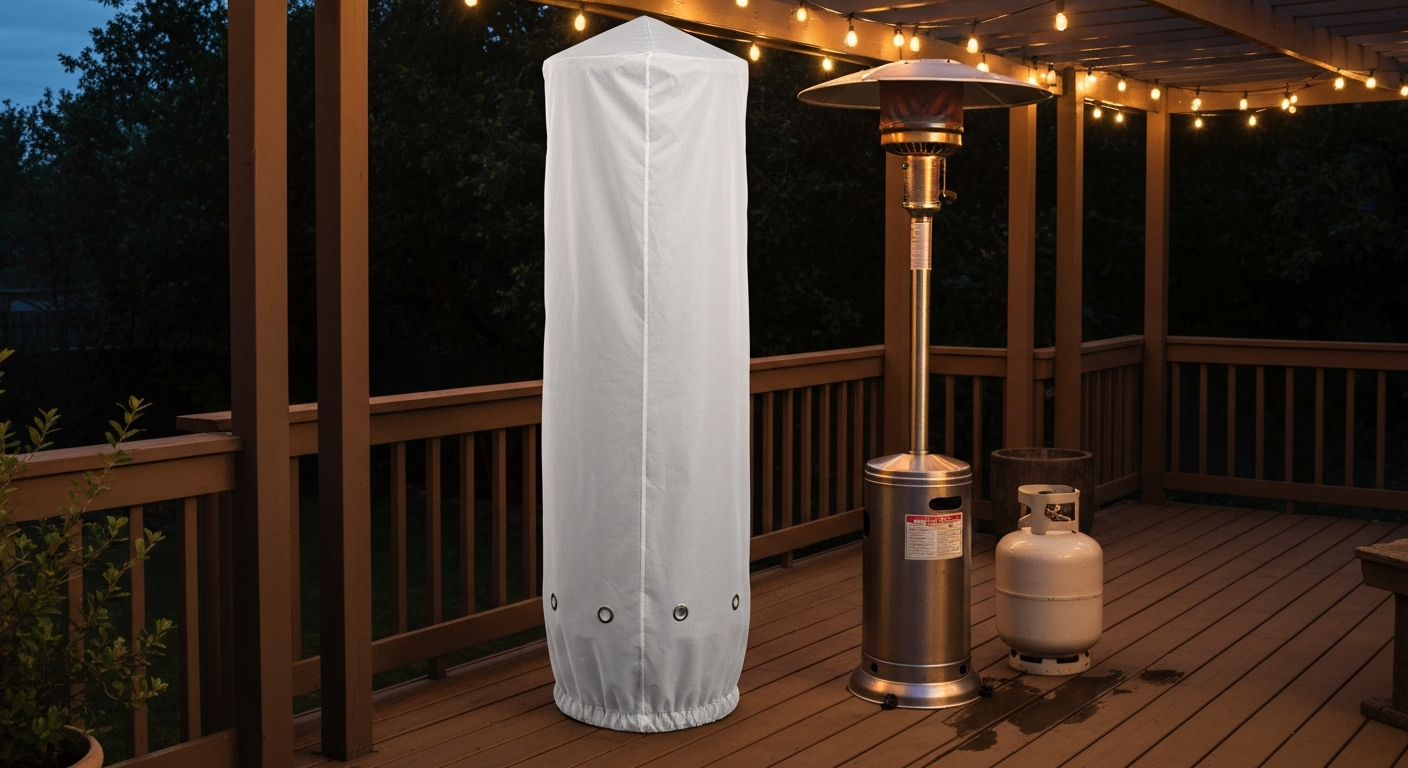
Covers for freestanding tall patio heaters are widely available and worth buying. Look for these features: a breathable fabric rather than a fully waterproof sealed cover, because trapped moisture under a non-breathable cover causes more rust than rain does. UV-resistant material is important if the heater sits in direct sun. A cover with ventilation grommets at the bottom helps prevent condensation buildup. Sizing matters: most covers designed for tall patio heaters fit heaters from 84 to 94 inches tall, but measure your unit before buying. Covers with elastic hems or tie-down cords stay on better in wind.
Always wait until the heater is completely cool (at least one hour after shutoff, and touch-test the emitter head before covering). Pull the cover down past the base and secure it. For seasonal storage with the propane cylinder removed, a breathable fabric cover indoors is ideal. For between-use outdoor storage, a weather-resistant breathable cover left on the heater outdoors is perfectly fine.
Anchoring and wind stability on a covered patio
Freestanding tall heaters are top-heavy and can tip over in wind gusts, which is exactly why they have a tip-over safety switch built in. On a covered patio, wind can funnel under the roof and destabilize the heater even more than in open areas. Fill the base with sand or water as specified by the manufacturer (most bases hold 20 to 40 lbs of sand) and position the heater away from the edges of the covered area where wind enters. Do not anchor the heater to a wall or post to prevent tipping, as this can stress the frame and create different hazards. If tip-over is a recurring problem, troubleshooting the tip-over switch itself is worthwhile, as these switches sometimes fail or get stuck in a tripped position after the heater was bumped.
Clearance guidance when using tall heaters on covered patios
Most freestanding mushroom heaters emit heat primarily from the reflector head at the top of the pole. That head typically sits between 82 and 88 inches above the ground depending on the model. Standard clearance requirements for combustibles above the emitter are approximately 24 inches. This means you need a ceiling height of at least 9 to 10 feet to safely run a tall freestanding heater under a covered patio without violating clearance requirements. Many residential patios have 8-foot ceiling heights. If your covered patio ceiling is 8 feet or lower, a freestanding tall propane heater is not suitable for that space. Consider a lower-profile tabletop unit or a wall-mounted electric infrared heater instead.
How to cover, secure, and winterize your patio heater: step by step
- Turn the heater off at the control knob and close the propane cylinder valve completely
- Allow the heater to cool for at least one hour — touch-test the emitter head and reflector before proceeding
- Disconnect the regulator from the propane cylinder; inspect the hose and fittings for cracks or wear while you have it apart
- Remove the propane cylinder and store it upright, outdoors, in a shaded and well-ventilated location away from heat sources
- Wipe down the heater body, reflector, and emitter screen with a dry cloth to remove moisture and debris
- Inspect the emitter screen for clogged ports or spider webs (a common ignition problem) and clear them with a soft brush or compressed air
- Check the thermocouple rod for corrosion or carbon buildup; clean gently with fine steel wool if needed
- If storing outdoors, place a breathable weather-resistant cover over the heater and secure it at the base
- If storing indoors for winter, bring the heater body inside covered, leave the cylinder outdoors
- In spring, reconnect the cylinder, do a leak test with soapy water on all connections, and test ignition before using in any semi-enclosed space
Seasonal inspection and maintenance checklist
Running through this checklist twice a year (before storage and before the first use of the season) will prevent the majority of common patio heater failures. Most of these issues are DIY-repairable without a service call.
| Component | What to look for | Action if issue found |
|---|---|---|
| Regulator hose | Cracks, brittleness, kinks, discoloration | Replace hose and regulator assembly; do not repair |
| Propane connections | Bubbles when soapy water applied with gas flowing | Tighten or replace fitting; do not use until resolved |
| Thermocouple | Corrosion, carbon buildup, heater won't stay lit | Clean or replace thermocouple; a common DIY fix |
| Tip-over / tilt switch | Heater shuts off without tipping, or won't reset | Inspect switch position and wiring; reset or replace |
| Emitter screen and ports | Clogs, spider webs, rust, deformed screen | Clear with compressed air or soft brush; replace screen if deformed |
| Reflector | Dents, corrosion, discoloration | Clean; replace if reflectivity significantly reduced |
| Igniter electrode | Carbon buildup, cracked ceramic, weak spark | Clean ceramic and electrode tip; adjust gap or replace |
| Base and frame | Rust, loose welds, cracked base | Light rust: clean and touch up with heat-resistant paint; structural damage: replace part or unit |
| Electric heater elements (infrared) | Visible damage to element, tripped GFCI, no heat | Check GFCI reset first; inspect element for breaks; professional help if hardwired |
Cover materials and what to buy
Not all covers are equal. A cheap non-breathable polyester tarp traps condensation against the metal body of the heater, and in humid climates you will find more rust under a poor cover than you would have if you had left the heater uncovered. Here is what to look for when buying a cover for any type of patio heater.
- Breathable fabric (solution-dyed acrylic or a polyester with micro-perforations) is better than a fully sealed waterproof tarp for outdoor storage
- UV-resistant material is important for heaters stored on south-facing patios or in high-sun climates
- Vents or ventilation grommets at the lower hem allow moisture to escape and prevent mildew
- Elastic or drawstring hems keep the cover on in wind; tie-down cords with ground stakes are worth adding in exposed locations
- Check dimensions carefully: tall freestanding heaters vary from 84 to 94 inches; tabletop heaters need smaller covers; electric wall-mount units generally do not need covers
- Covers sold specifically for patio heaters (rather than generic furniture covers) typically have better fit around the pole and base
- For tabletop or portable electric heaters, a fitted breathable bag works well for seasonal storage indoors
Electric and infrared heaters: different rules for covering and covered patios
Electric infrared heaters (wall-mount, ceiling-mount, or portable plug-in) play by different rules than combustion heaters for both storage and use under a covered patio. Because they produce no combustion gases, ventilation requirements are essentially a non-issue. The main concerns are water ingress and electrical safety. A hardwired outdoor electric infrared heater should carry a UL or ETL listing for the specific outdoor application, be installed to NEC standards with GFCI protection, and have junction boxes rated for the heat and moisture exposure. Intertek Standards Update Notices (references to UL 1278 and related electric‑heater standards) list the applicable UL/ETL standards and updates for outdoor electric infrared heaters. These are not DIY projects if the wiring is involved; hire an electrician.
For storage, hardwired wall or ceiling electric infrared heaters typically do not need a cover. They are designed to live outdoors and should be rated for weather exposure. What they do need is periodic inspection for moisture ingress, cracked element housing, and GFCI functionality. Portable plug-in electric infrared heaters should be brought indoors for winter storage; a breathable storage bag keeps dust off the element and housing.
One important note: even electric heaters carry the warning not to cover while operating. The manufacturer guidance is consistent across brands: cool down first, then cover for storage. Covering a hot electric element is a fire risk regardless of whether it is a combustion appliance.
Warnings you should take seriously
I want to be direct about a few things that are easy to dismiss until something goes wrong.
- Never cover any heater while it is operating or still hot — this applies to every type of heater: propane, natural gas, electric, and infrared
- Never bring a propane cylinder indoors, whether it is full, partially used, or empty — NFPA 58 and every manufacturer manual are clear on this
- Never assume a covered patio is adequately ventilated for a combustion heater without checking actual openness against the manufacturer's definition and the ventilation rate requirement
- Carbon monoxide poisoning does not give you warning — install a CO detector in any semi-enclosed space where you run a gas or propane heater
- A heater with a known fault (failed thermocouple, sticky tilt switch, leaking regulator) is not safe to run in a confined space — fix it first
- Do not modify clearances by raising the heater on a table or platform to gain ceiling height — this affects stability and changes the center of gravity on tip-over switches
FAQ
Short answer: Do patio heaters need to be covered?
Yes — cover patio heaters when they are OFF and cool for protection during storage or long idle periods. Never cover a heater while it’s running or still hot. Whether you must use a cover daily depends on exposure (rain, windblown debris, salt) and manufacturer guidance.
Quick decision checklist: When should I cover or store my heater?
Cover or store when: (1) the heater is turned OFF and fully cooled; (2) you won’t use it for several days or more; (3) you’re leaving it out over winter; (4) it’s exposed to driving rain, persistent moisture, or salty air. Do not cover when the unit is hot, operating, or if the cover blocks required ventilation while still connected to fuel or power.
What’s the difference between covering for storage and operating under a roof or covered patio?
Covering for storage means placing a protective cover on a cold, inactive unit to keep out water, dust, and pests. Operating under a roof addresses whether the heater may run while people are under an overhead structure. Those are separate questions: storage covers are for protection when off; running a heater under an overhead or in a semi‑enclosed area requires following manufacturer clearance, ventilation, listing (outdoor use), and local code rules.
Can I run a propane/gas patio heater on a covered patio or porch?
Maybe — only if the heater’s manual explicitly allows use under the type of cover you have and you meet its clearance, ventilation, and 'definition of outdoors' requirements. Many gas freestanding heaters are labeled 'FOR OUTDOOR USE ONLY' and require open sides (some manuals permit limited overhead cover if enough sides are open/vented). If the space is enclosed or lacks sufficient ventilation/compliance with NFPA codes, you must not run the heater there.
Can I run electric or infrared heaters under a covered patio?
Often yes — provided the heater is listed/approved for the application (UL/ETL/CSA), mounted per the manufacturer’s clearances, and installed to electrical code (NEC/NFPA 70). Electric ceiling/wall infrared models commonly have smaller required clearances and are designed for semi‑enclosed patios; follow the listing and wiring requirements exactly.
What safety and ventilation rules must I follow?
Follow manufacturer clearances to combustibles and minimum mounting heights; ensure adequate combustion and ventilation air for gas units per the manual (some tube heaters specify CFM per 1,000 Btu/hr). Abide by NFPA 58 (propane cylinder storage/handling) and NFPA 54 (fuel‑gas installation). Do not operate where carbon monoxide could accumulate (enclosed spaces). Check local codes and the Authority Having Jurisdiction (AHJ) for any additional restrictions.