Yes, you can cook with patio gas, but only if the appliance you are connecting it to is designed and certified for cooking, the regulator and fittings match the cylinder valve, and you are working outdoors with proper ventilation. The gas itself is not the problem. What matters is whether your cooker or grill is rated for the fuel type and pressure coming out of that particular cylinder, and whether you are connecting everything correctly. Using patio gas on a purpose-built camping stove or certified gas BBQ is completely normal. Connecting it to a patio heater and cooking on that is not, most heater manufacturers explicitly prohibit cooking on their appliances, and doing so voids warranties, puts you outside certification, and creates a genuine safety risk.
Can You Cook With Patio Gas? Safety, Compatibility & Tips

What people actually mean by 'patio gas'
The term 'patio gas' is a marketing label, not a chemical specification. In practice it covers three different things depending on who is selling it and what format it comes in.
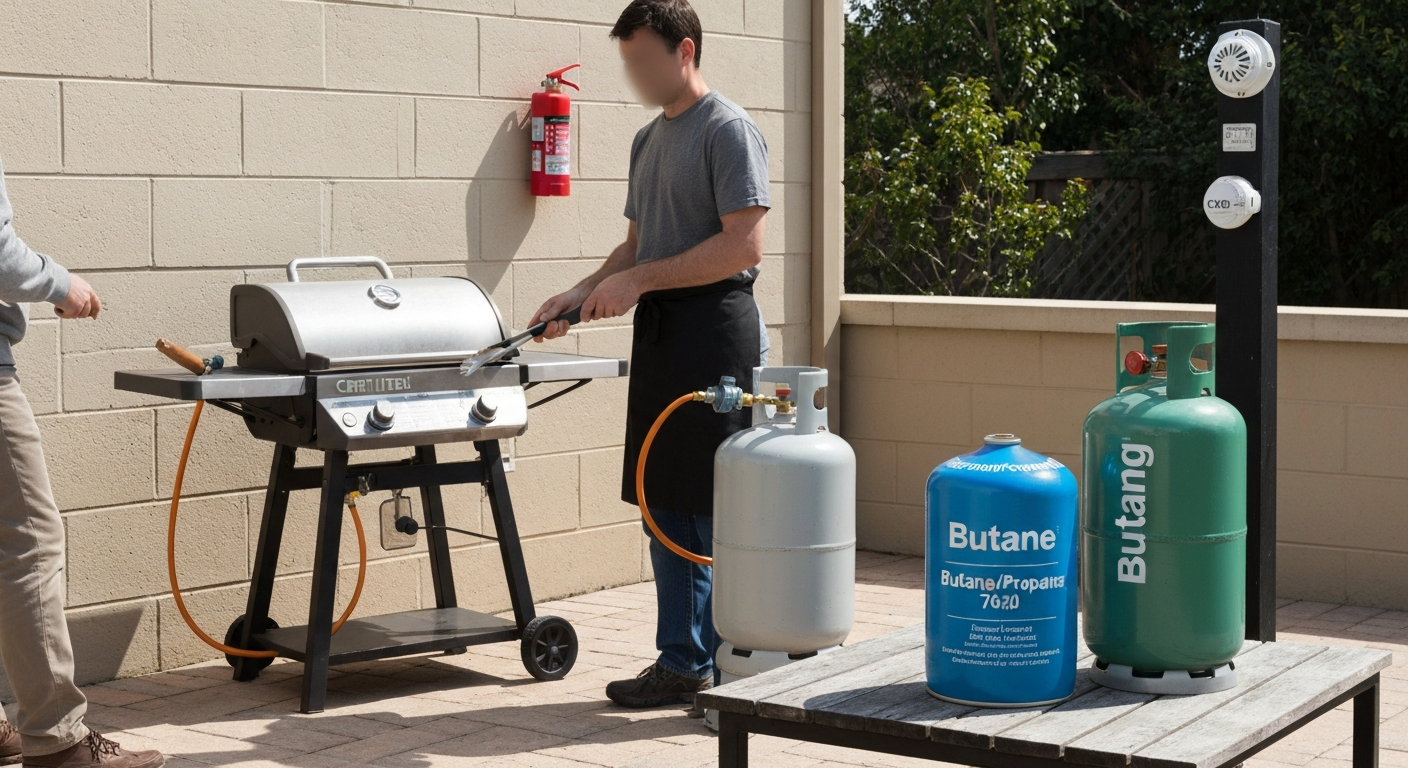
The first format is the small threaded canister, typically 100 g to 500 g, sold for camping stoves, tabletop patio burners and portable lanterns. These are non-refillable metallic cartridges built to EN 417 standard, which specifies construction, pressure limits and mandatory labelling requirements including gas composition and net fuel weight. The valve on these canisters is almost universally the 7/16 inch UNEF Lindal screw fitting. The gas inside is usually pure butane, isobutane, or a butane/propane blend in ratios like 80/20 or 70/30 (butane to propane by volume). Brands like Campingaz and Coleman label these clearly on the canister, you will see markings such as 'Butane/Propane 70/30' or simply 'Butane'.
The second format is the larger refillable cylinder, the classic 9 kg or 13 kg steel bottle you swap at a hardware store. In the UK and parts of Europe, these are often sold specifically as 'patio gas' and contain propane. Calor's orange 'Patio Gas' cylinder is a well-known example and is pure propane. These use a clip-on regulator with a specific fitting unique to that brand's cylinder, which is not the same as a standard QCC1/Type-1 thread used on North American 20 lb grill tanks.
The third format is a mid-sized refillable butane cylinder, 4.5 kg or 7 kg, which is also sometimes called patio gas in casual use, especially in the UK where blue Calor butane bottles are common. These contain pure butane and use a different regulator fitting than propane cylinders, which is an important distinction when it comes to connecting cooking appliances.
Propane vs butane vs blends: the technical differences that matter for cooking
From a pure cooking-energy standpoint, propane and butane are nearly identical. Propane delivers around 46.3 MJ/kg lower heating value; butane comes in at about 45.7 MJ/kg. That is less than a 2 percent difference, so both fuels produce effectively the same heat output at the burner. If you are just trying to boil water or sear a steak, either gas will do the job.
The real difference is vapor pressure and low-temperature performance. Propane has a boiling point of around -42°C, which means it vaporises freely down to very cold ambient temperatures. Butane boils at about -0.5°C, and isobutane at around -11.7°C. Below those points, the liquid in the canister cannot vaporise fast enough to maintain gas flow, and your burner either weakens or goes out entirely. This is why butane-dominant patio gas cartridges underperform in winter and why blends (like 80/20 or 70/30 butane/propane) exist, the propane fraction keeps vapor pressure adequate as temperature drops.
| Property | Propane | n-Butane | Isobutane | 80/20 Blend (Butane/Propane) |
|---|---|---|---|---|
| Boiling point | -42°C | -0.5°C | -11.7°C | Approx. -8 to -15°C (blended) |
| Lower heating value | ~46.3 MJ/kg | ~45.7 MJ/kg | ~45.6 MJ/kg | ~45.8 MJ/kg (approx.) |
| Vapour pressure at 20°C | ~850 kPa | ~215 kPa | ~310 kPa | ~270–400 kPa (varies by ratio) |
| Cold weather performance | Excellent | Poor below 0°C | Fair below -5°C | Better than pure butane |
| Typical cylinder type | Refillable 9/13 kg or 20 lb tank | Small cartridge or 4.5/7 kg cylinder | Small cartridge | Small EN 417 canister |
| Common regulator pressure | 11" W.C. (27 mbar) | 28–30 mbar | 28–30 mbar | 28–30 mbar |
One more thing worth noting: propane vapor pressure is significantly higher than butane's at any given temperature. This means the regulator design differs between propane and butane systems. A butane regulator is not designed to handle propane inlet pressure, and connecting a propane cylinder to a butane regulator is a serious safety issue. Always match your regulator to the gas type in the cylinder.
How patio gas stacks up against standard propane for cooking and grilling
If your patio gas cylinder contains propane, like many of the larger swap-and-go bottles sold specifically for outdoor appliances, then for cooking purposes it is functionally identical to the propane in a standard 20 lb grill tank. For a focused comparison, see what is the difference between propane and patio gas. The heat output per kilogram is the same, the combustion characteristics are the same, and the regulator outlet pressure targets the same 11 inches water column (approximately 27 mbar) that most low-pressure gas appliances, including most BBQs, are designed around. Fisher's LP‑Gas regulator equipment guide blank" rel="noopener noreferrer">lists 11 inches water column (≈27 mbar) as a common appliance outlet pressure for low‑pressure cooking appliances.
Where things diverge is in cold-weather cooking. If your 'patio gas' is a butane-dominant cartridge and you are trying to use a tabletop burner on a cold autumn evening, you may notice the flame weaken as the canister cools. This is not a fault, it is just butane's physical limitation. Swapping to a blend canister with a higher propane ratio, or warming the canister slightly (never with direct heat, just bring it indoors briefly), will restore gas flow.
From a BTU standpoint, a standard 14.1 oz (400 g) cartridge of butane/propane blend will deliver roughly the same cooking energy as an equivalent weight of standard propane. The cylinder format is smaller and easier to transport than a 20 lb tank, which is why tabletop cooking appliances designed for patio cartridges make sense for smaller setups.
Can you use patio gas on a BBQ or grill? Fittings, valves and manufacturer limits
Physically connecting patio gas to a BBQ or grill depends entirely on whether the valve fitting on the cylinder matches the regulator on your grill. For practical guidance on whether can patio gas be used on bbq, check compatibility of your cylinder, regulator and grill before attempting to connect. Most freestanding gas BBQs sold in North America are set up for a QCC1/Type-1 (ACME thread) connection on a standard 20 lb propane cylinder. That is a large handwheel fitting with a left-hand internal thread and a built-in OPD (overfill protection device). An EN 417 cartridge uses a completely different 7/16 inch UNEF Lindal screw thread. These two systems are not compatible without an approved adapter, and not all adapters are certified for cooking appliances.
UK-style 'patio gas' propane bottles (like Calor orange) use a clip-on regulator that is proprietary to that brand and incompatible with standard QCC1 or POL fittings without a specific adapter hose. POL (left-hand internal thread) fittings are found on older refillable cylinders and bulk tanks, and these need a POL-to-QCC1 adapter if you are feeding a modern grill regulator. These adapters exist and are widely sold, but you should only use ones rated for the operating pressure of your gas and certified for the application.
Manufacturer limits matter too. Your grill's documentation will specify the fuel type and inlet pressure it is designed for. Most consumer gas grills are certified for propane at 11 inches W.C. (27 mbar) appliance pressure. If your patio gas is propane, you are in the right territory. If it is butane or a blend running through a 28–30 mbar butane regulator, you are close but not identical, and some manufacturers will not warranty operation with anything other than their specified fuel and regulator combination. Check your grill manual before proceeding.
Compatibility checklist before you cook with patio gas
Before you connect a patio gas cylinder to any cooking appliance, work through each of these points. Do not skip the connector and pressure checks, most issues I have seen come from mismatched fittings or wrong regulator pressure, not the gas itself.
- Identify the gas type in your cylinder: check the label for 'butane', 'propane', or the blend ratio (e.g., 70/30 butane/propane). If it is a large refillable bottle, check the brand colour coding — orange typically means propane, blue typically means butane in the UK market.
- Check the cylinder valve type: EN 417 Lindal (small threaded canister), QCC1/Type-1 ACME (modern 20 lb propane tank), or POL left-hand thread (older refillable cylinder). These are not interchangeable without the right adapter.
- Match the regulator to the gas type: propane regulators handle higher inlet pressure than butane regulators. Never use a butane regulator on a propane cylinder.
- Verify regulator output pressure: most gas BBQs and cooking appliances are rated for 11 inches W.C. (27 mbar) for propane, or 28–30 mbar for butane/blends. Check your appliance manual and match the regulator accordingly.
- Inspect the hose: the hose connecting regulator to appliance must be rated for LP gas, show no cracking or perishing, and be secured with proper hose clips. Do not use push-fit hose without clamps on cooking applications.
- Confirm appliance certification: your cooking appliance (stove, BBQ, camp stove) must be certified for gas cooking use. Patio heaters are NOT cooking appliances — their burner assemblies, orifice sizes and safety certifications are specific to radiant heating, not food preparation.
- Check orifice/jet size compatibility: if you are switching from one gas type to another (e.g., from natural gas to propane, or propane to butane blend), verify whether your appliance requires a conversion kit. Orifice sizes are tuned to gas type and operating pressure — a propane orifice will over-fire on natural gas and may underperform on butane.
- Test for leaks before lighting: apply soapy water to all connections after assembly. Bubbles mean a leak. Do not proceed until all connections are re-tightened and re-tested with no bubbles.
- Confirm you are outdoors: LP gas cooking must be done in open or well-ventilated outdoor spaces. Even a partially enclosed patio area can accumulate carbon monoxide to dangerous levels.
Regulators, connectors and conversions: what you can and cannot safely do
The regulator is the most important component in a patio gas cooking setup and also the most commonly misunderstood. Its job is to take the high-pressure gas from the cylinder and reduce it to a safe, stable appliance pressure, typically around 27–30 mbar for consumer cooking appliances. The regulator must be selected specifically for the gas type (butane or propane), the cylinder valve fitting, and the required outlet pressure. Using the wrong regulator is not a minor inconvenience, it can result in over-pressurising the appliance, under-fuelling the burner, or in worst cases, a gas release that does not regulate down safely.
If you need to switch from a large propane cylinder to a small EN 417 patio canister to feed the same BBQ, you will need an adapter that converts from the Lindal valve to whatever fitting your regulator accepts. These adapters are sold widely, but treat them as safety-critical parts: buy branded, certified products, not cheap imports with no markings. After fitting any adapter, always perform a soap-and-water leak test before lighting.
Converting an appliance from one gas type to another, say, from natural gas to propane, or from a butane blend to pure propane, requires more than just swapping the regulator. The burner orifices (the small jets that control gas flow into the mixing tube) are sized specifically for the fuel type and pressure. Propane orifices are smaller than natural gas orifices for the same heat output. Running the wrong orifice size can produce an oversized or undersized flame, cause incomplete combustion, or in the case of natural gas orifices on LP gas, a dangerously large flame. Always use a manufacturer-approved conversion kit with the correct orifice set, and follow the conversion instructions precisely. Many manufacturers explicitly state 'do not convert to any other gas', if your appliance says this, take it literally and do not attempt the conversion.
NFPA 58 (the LP-Gas Code) requires appropriate regulator selection and, for fixed piping systems, two-stage regulation to deliver safe appliance pressures. See NFPA 58, LP‑Gas Code (handbook/excerpt) for requirements on regulator selection and two‑stage regulation, including outlet pressure limits and capacity/lock‑up behaviour NFPA 58 — LP‑Gas Code (handbook/excerpt). For portable cooking appliances on swappable cylinders, the key requirement is that the regulator is rated for the gas and the flow capacity of the connected appliance. Undersized regulators will starve the burner under load; oversized regulators may not lock up correctly at low-flow conditions. If you are unsure whether your regulator is correctly rated, the data plate on it will show the outlet pressure range and gas type, cross-reference with your appliance manual.
Safety checklist for cooking with patio gas appliances
I want to be direct here: most of the serious accidents involving patio gas during cooking come down to a small number of avoidable mistakes. Enclosed spaces, failed leak checks, and ignored manufacturer restrictions account for the majority of incidents. Work through this checklist every time you set up for outdoor cooking with gas.
- Always cook outdoors in open air: LP gas combustion produces carbon monoxide. Even a partially covered outdoor kitchen, a gazebo with side panels, or a garage with the door open can accumulate dangerous CO concentrations. The CDC and EPA are explicit that propane and LPG grills must never be used indoors, in tents, or in semi-enclosed structures.
- Install a CO detector near any area where you regularly cook with gas: battery-operated CO alarms are inexpensive and give you an audible warning before CO reaches dangerous levels. If the alarm sounds, extinguish the burner immediately and move everyone to fresh air.
- Perform a soap-and-water leak test at every connection every time you connect a new cylinder or adapter: apply the solution generously and watch for a full 30 seconds. Even slow leaks will produce bubbles. Do not use washing-up liquid that dries quickly — use a purpose-made gas leak detection solution for the best results.
- Never use a patio heater as a cooking surface: patio heater burners, reflectors and certification are specific to radiant space heating. Placing food or cookware on or near a patio heater burner creates grease drip hazards, changes the combustion geometry, can block the thermocouple or safety shutoff, and puts you outside the appliance's certified use. Most heater manuals state this prohibition explicitly.
- Keep cylinders upright and away from the cooking area: LP gas cylinders must be stored and used in the upright position unless the appliance specifically states horizontal use is safe. Keep cylinders at least one metre from any open flame or heat source, including the burner you are cooking on.
- Turn off the cylinder valve first when shutting down, not just the appliance knob: closing the cylinder valve starves the regulator and hose of gas, then let the burner consume the residual gas in the line before turning off the appliance knob. This ensures no pressurised gas sits in the hose between uses.
- Check hoses before each use: run your hand along the hose and look for cracks, perishing, kinks or pinch points. Replace any hose showing visible deterioration immediately. Hoses used outdoors in UV exposure degrade faster than indoor gas hoses — treat them as consumable safety items.
- Store cylinders away from heat sources and direct sunlight when not in use: in hot weather, LP cylinders exposed to direct sun can experience a pressure rise. Store them in a cool, shaded, well-ventilated outdoor area — not in a shed or garage where gas accumulation from a minor leak could create an explosive atmosphere.
- Follow local codes and regulations: some jurisdictions restrict LP gas appliance use in certain settings. Check local fire codes before installing a permanent outdoor cooking setup connected to a large LP cylinder, especially in multi-unit residential buildings or areas with active fire bans.
A note on patio heaters specifically: cooking is not what they are for
If you landed here because you are wondering whether you can warm food on your freestanding patio heater, the honest answer is: do not. If you are also curious about emissions from a different heater type, see: Do pellet patio heaters smoke, a short guide to their smoke and soot behaviour. If you're wondering whether gas patio heaters are banned locally, see are gas patio heaters banned for information on regional regulations and safety guidance. Patio heaters are certified to standards like ANSI Z21.103 or similar equivalents for radiant space heating only. Their burners are optimised for heating air and radiating heat outward, not for concentrating heat under a pan. More importantly, the safety systems on a patio heater, the thermocouple, the tilt switch, the ODS (oxygen depletion sensor) on some models, are calibrated for heating use. Placing cookware over the burner can interfere with these systems, potentially disabling the automatic shutoff that is supposed to protect you if the flame goes out.
There is also a practical carbon monoxide consideration. When a patio heater runs normally outdoors, combustion products disperse into open air. If you gather family around a heater and add cooking activity that creates partial obstruction of the burner or changes the airflow pattern, CO concentrations in the immediate area can increase. This is especially relevant on covered patios where ventilation is limited. If CO risk with gas appliances is something you want to understand more fully, that topic deserves its own focused look.
Why patio gas sometimes costs more and when it matters
If you have noticed that branded 'patio gas' cartridges cost more per kilogram of fuel than a bulk propane cylinder, that is not surprising. For a detailed cost breakdown, see our explainer on why is patio gas more expensive than propane covering packaging, transport and blend premiums. Small non-refillable EN 417 cartridges carry significant packaging, transport and retail margin costs relative to the actual gas inside. A 450 g canister of butane/propane blend may cost three to four times more per kilogram of gas than the same energy in a refillable propane cylinder. For occasional patio cooking this is a minor concern, but if you are cooking regularly with a portable gas stove, a refillable cylinder and a compatible regulator is noticeably cheaper to run over time.
The blend premium is also real. High-performance cartridges with a higher propane ratio for cold-weather performance command a higher price than standard butane cartridges. If you are cooking in warm weather, standard butane cartridges are cheaper and perform fine. Save the blended or propane-dominant cartridges for autumn and winter use when butane's cold-temperature limitations become relevant.
The bottom line: patio gas for cooking works, with the right setup
Cooking with patio gas is practical and safe when you pair the right gas type to a purpose-built cooking appliance with the correct regulator, the correct fittings, a leak test, and an outdoor setup with good ventilation. The gas energy content is essentially the same as standard propane, you are not giving anything up in terms of cooking performance. What you do need to be precise about is the regulator-to-gas match, the connector type, the orifice sizing if you are converting between fuels, and the manufacturer's certification of whatever appliance you are cooking on. And if your gas appliance is a patio heater rather than a stove or BBQ, cook on a different appliance. For historical context on branded outdoor meal products, see what happened to patio TV dinners. The heater is not designed for it, and the safety risks are not worth the convenience.
FAQ
Short direct answer — can you safely and legally cook with patio gas (propane, butane or blends)?
Generally: no as a default. Portable 'patio gas' appliances and cartridges are designed and certified for heating or portable cooking/stove use only when the manufacturer permits it. Many patio heaters and disposable cartridge appliances are certified only for heating (or specific tabletop cooking stoves) and explicitly prohibit cooking on the heater. Using the wrong gas, regulator, fittings or appliance for cooking can be unsafe, may violate local codes, void warranties and risk carbon monoxide (CO) or fire hazards. Check the appliance manual and local code before attempting any cooking use.
What is 'patio gas' (typical compositions and cartridge standards)?
'Patio gas' commonly means small consumer LPG supplies: butane, isobutane or butane/propane blends (examples 80/20 or 70/30). Disposable threaded canisters used for tabletop stoves and small heaters are typically EN 417 style with a 7/16" UNEF (Lindal) screw valve and are marked with composition and net weight per EN 417 standards. Full‑size LPG for grills is usually propane in refillable cylinders with Type‑1/QCC1 (ACME) or POL fittings.
Technical comparison — energy, vapor pressure and cold‑weather performance
Energy per mass: propane and butane have very similar heating values (propane slightly higher). The important difference is vapor pressure: propane has much higher vapour pressure and vaporises at much lower temperatures (boiling point ≈ −42°C) while n‑butane ≈ −0.5°C and isobutane ≈ −11.7°C. That means butane‑dominant cartridges lose pressure and performance in cool/cold weather; blends with 20–30% propane improve cold performance. (Sources: NIST thermophysical data, Engineering Toolbox.)
How do appliance pressures and burners matter for compatibility?
Appliances are designed for a target supply pressure and specific orifice sizes. Typical consumer LP grill/regulator outlet pressure is about 11" W.C. (≈27 mbar). Using a cartridge or regulator that delivers a different pressure, or using the wrong orifice, changes flame size, combustion quality and CO production. Converting an appliance between fuel types requires manufacturer‑approved conversion kits (orifice, regulator) and must follow instructions; doing otherwise is unsafe and often prohibited.
Compatibility checklist (regulators, hoses, fittings, BTU/output) — what to check before using patio gas for cooking
- Confirm appliance certification and permitted fuel in the manual (do not cook on heaters if manufacturer prohibits). - Match connector type: threaded EN417 canister vs Type‑1/QCC1 vs POL — use only approved adapters/regulator assemblies. - Regulator outlet pressure must match appliance rating (typical low‑pressure grills ~11" W.C.). - Check regulator capacity (BTU/hr) to ensure it can supply required input. - Burner orifice size must suit the gas/pressure; conversion requires approved orifice kits. - Use appropriate hose rated for LPG and correct fittings with leak‑tight connections. - Ensure appliance venting and placement per the manufacturer and local code.
Safety checklist (ventilation, CO detection, leak testing, flame testing)
- Never use liquid‑fuel or LPG cooking appliances indoors or in enclosed/semi‑enclosed areas without proper ventilation; CO can build up quickly (CDC/NIOSH guidance). - Install and test a working CO alarm in living areas per manufacturer guidance. - Leak test all connections with soapy water before use; never use flames to test for leaks. - Verify flame quality: clean blue steady flame indicates good combustion; yellow or sooty flames indicate incomplete combustion and CO risk. - Use regulator and hose rated for the gas and pressure; replace damaged components. - Follow appliance clearance and stable placement rules and keep combustibles away. - Do not modify or jury‑rig regulators, valves, or burner assemblies; use certified conversion kits if allowed.