
Most patio heaters can survive a passing rain shower, but no standard consumer propane or electric patio heater is designed to be left out in the rain long-term without a cover or shelter. Freestanding propane models from brands like Dyna-Glo, AZ Patio Heaters, and Blue Rhino all state in their owner manuals that the unit should be stored in an area sheltered from direct contact with inclement weather. Some hardwired electric and infrared heaters carry IP ratings (IPX4 or IP55) that allow exposed outdoor installation, but even those manufacturers recommend mounting under a protective roof whenever possible. The bottom line: cover it, shelter it, or bring it in when it is not in use.
Can You Leave a Patio Heater Outside in the Rain, Guide

Grant Mercer
25 Jul 2026
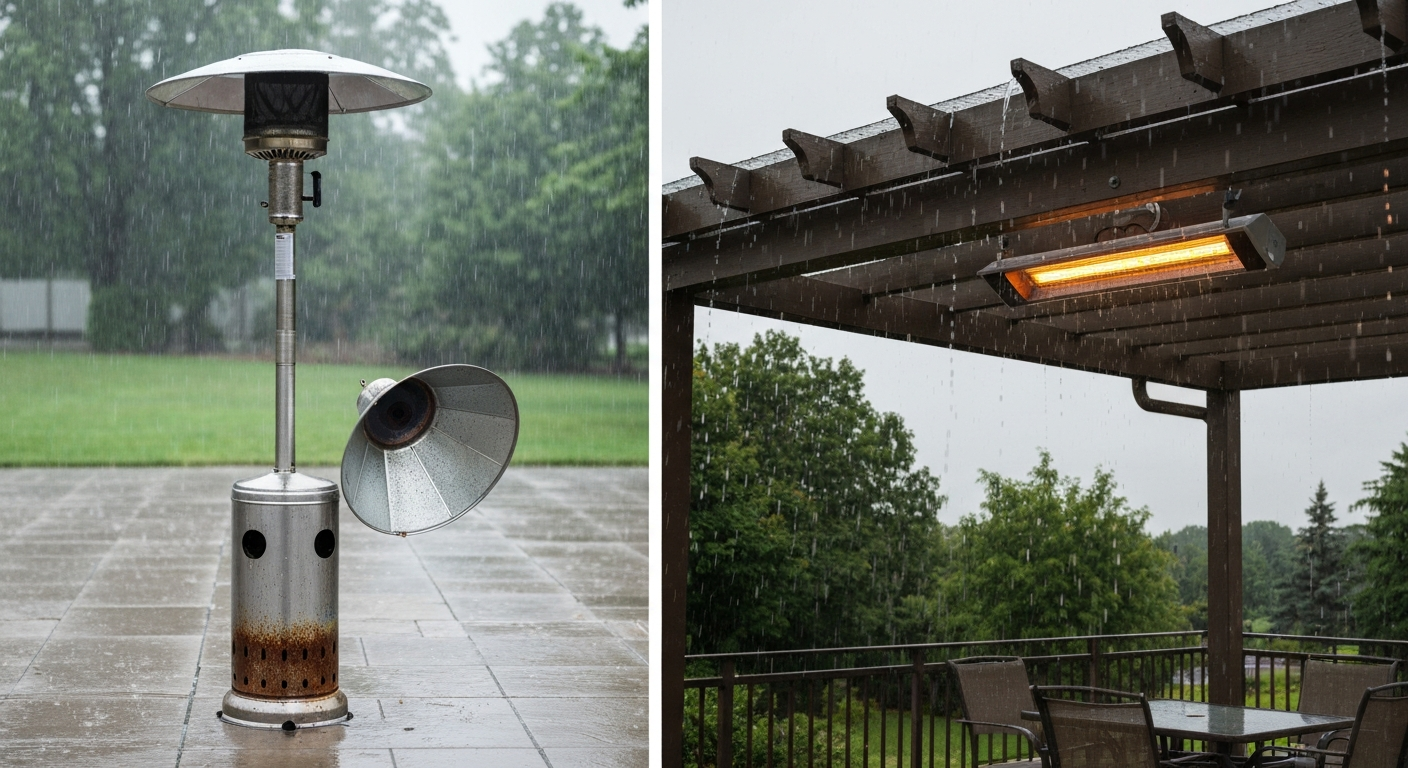
Short verdict: can you leave a patio heater in the rain?
For a freestanding propane heater, no. Getting caught in a brief shower is not a crisis, but leaving it exposed overnight or through a rainy week without a weatherproof cover is asking for corroded igniters, a waterlogged thermocouple, and a regulator that either freezes up or fails to hold pressure. For fixed natural-gas and commercial hardwired electric heaters, the answer depends entirely on the IP or NEMA rating printed on the unit or its spec sheet. If your electric heater is marked IPX4 or higher and is properly installed under code, it can handle rain splash and even light exposure. If it has no IP rating listed, treat it like the propane units: shelter it or cover it. When in doubt, check the manual first. If yours is missing, you can look it up by model on a resource like Patio Heater Manual before making any assumptions about what the unit can handle. For related questions, such as whether a patio heater can melt snow, see whether a patio heater can melt snow. For model-specific guidance, search the question "can you leave electric patio heaters outside" by model or consult the manufacturer's online manual for your exact unit.
Short-term vs long-term rain exposure: what the difference actually means
A five-minute drizzle while your heater is cooling down after a session is very different from three days of steady autumn rain with the unit sitting uncovered on the patio. Short-term exposure to light rain, while not ideal, rarely causes immediate damage on a well-maintained unit. The real damage accumulates over repeated wet-dry cycles. Water gets into the igniter housing, sits there, and the contacts oxidize. The pilot assembly gets damp, the thermocouple junction corrodes, and its millivolt output drops below the threshold needed to hold the gas valve open. The regulator diaphragm absorbs moisture and stiffens. None of these failures happen after one shower; they build up over weeks and months of casual outdoor storage without protection.
Long-term exposure also attacks the structural parts of the heater. The emitter screen on a mushroom-style propane heater traps water and rusts through. The reflector on an infrared heater oxidizes and loses efficiency. Fasteners seize. The pole on a freestanding unit corrodes at the base and becomes structurally unsafe. These are not theoretical concerns; they are the exact complaints I see most often from readers trying to get a heater running again after it spent winter on an uncovered deck.
| Exposure type | Typical risk level | What tends to fail first | Recommended action |
|---|---|---|---|
| Brief shower (under 15 min) | Low | Surface moisture on igniter contacts | Dry thoroughly before next use, no cover needed mid-session |
| Overnight rain, unit uncovered | Moderate | Igniter module, pilot assembly, thermocouple | Cover when cool; dry before relighting |
| Multi-day rain, no cover | High | Regulator diaphragm, igniter wiring, emitter screen rust | Cover and store; inspect before next use |
| Full season uncovered outdoors | Very high | All of the above plus structural corrosion, pole base rust | Full inspection; likely part replacements needed |
How rain causes specific failures inside your heater
Water does not just sit on the outside of a patio heater. It finds its way into every seam, vent, and housing opening. Understanding exactly where it causes damage helps you diagnose problems faster and decide which parts need to be inspected or replaced after a wet spell.
Igniter failure
Piezo and electronic spark igniters are the first things to stop working after rain exposure. The igniter button housing and the spark electrode tip sit close to the burner, and any moisture that gets into the wiring or onto the electrode tip can short the spark to ground instead of jumping to the burner. Corroded contacts in the igniter module are the most common moisture-related repair I walk readers through. The fix is usually cleaning the electrode tip with fine steel wool, drying the housing, and checking the wire connector for green or white corrosion. If the module itself is damaged, replacement igniters are inexpensive and a straightforward swap on most models.
Thermocouple and pilot assembly
The thermocouple generates a small millivolt signal that tells the gas valve the pilot flame is lit and it is safe to keep the valve open. Moisture contamination on the thermocouple junction or on the pilot orifice drops that millivolt output, and the gas valve interprets a low reading as 'flame out' and shuts off. If your heater lights briefly and then goes out within 30 to 90 seconds, a wet or corroded thermocouple is near the top of the suspect list. Thermocouples are one of the most commonly replaced parts on gas patio heaters for exactly this reason.
Regulator and valve corrosion
The propane regulator contains a rubber diaphragm that flexes to maintain constant outlet pressure. Moisture in the LP gas line or water that enters through the regulator vent can stiffen or crack that diaphragm, causing pressure irregularities or a complete failure to flow. Regulator guidance consistently points out that the vent must face downward to prevent water ingress, and that any blockage or corrosion of the vent screen is reason for replacement. You should never attempt to disassemble or repair a regulator yourself; if inspection shows corrosion, cracking, or a blocked vent, replace the regulator entirely.
Tilt switch problems
Most freestanding propane heaters have a tilt (tip-over) safety switch that cuts gas flow if the unit tips more than a set angle. This switch sits low on the unit and is especially vulnerable to water pooling. A waterlogged or corroded tilt switch can trigger a false 'tipped' reading even when the heater is perfectly upright, causing it to shut off or refuse to light. If your heater clicks off immediately after you let go of the control valve, and you have ruled out the thermocouple, the tilt switch is the next thing to check. Drying it out sometimes resolves the issue, but a corroded switch usually needs replacement.
Electrical shorting in electric and hardwired models
On plug-in and hardwired electric patio heaters, water that enters the element housing, junction box, or plug connection can cause immediate or delayed electrical shorts. This is not just a functional problem; it is a safety hazard. The NEC requires GFCI protection on outdoor receptacles for exactly this reason. If a plug-in electric heater has been directly rained on and then trips the GFCI or circuit breaker repeatedly, do not keep resetting it. The heater needs to be dried completely (ideally 48 to 72 hours in a warm indoor location) and inspected before being plugged in again. If it still trips after thorough drying, the element or internal wiring has been compromised and the unit should be professionally evaluated or replaced.
Manufacturer, warranty and safety considerations
Almost every major consumer patio heater brand (Dyna-Glo, AZ Patio Heaters, Blue Rhino, Fire Sense) marks their units 'For Outdoor Use Only' and then, in the same manual, instructs owners to shelter the heater from direct rain exposure when not in use. That wording matters. 'Outdoor use' means it can operate outside. It does not mean it is rated for continuous unprotected outdoor storage in wet weather. If you leave a unit uncovered in the rain and it fails, manufacturers are not obligated to cover that under warranty, because the storage instructions were not followed.
Gas patio heaters certified for the North American market are tested to CSA/ANSI Z83.26 (also listed as CSA 2.37), the consensus standard specifically covering gas-fired outdoor infrared patio heaters. That certification confirms the heater passed safety tests for normal outdoor use conditions, but it does not mean the unit passed any immersion or spray testing. For electric heaters, the relevant protection standard is IEC 60529, which defines IP ratings. IPX4 means the unit was tested against water splashing from any direction. IP55 adds protection against low-pressure water jets. These ratings are the only objective basis for knowing how much water exposure an electric heater can actually tolerate. If a heater has no IP rating listed, assume it has none.
One more point on safety: gas patio heaters must never be used or stored in an enclosed space like a garage because of carbon monoxide risk. The CPSC and OSHA both emphasize this, and it is a hard line, not a suggestion. If you are moving a propane heater inside to protect it from rain, it needs to go to a shed or covered patio with genuine ventilation, not a closed garage. For specific guidance on using a patio heater on a screened porch, including ventilation, clearance, and safety, see can you use patio heater on screened porch.
Propane portable patio heaters: rain risks, safe practices and when to cover or store
Freestanding propane mushroom heaters are the most common type I see people leaving out uncovered, and they are also the most vulnerable to rain damage because their igniter, pilot assembly, thermocouple, and tilt switch are all exposed in the lower control housing. Here is what I recommend as a practical rain protocol for any portable propane heater. Local guidance (see El Dorado County public guidance summarizing NFPA 58 OPD and cylinder storage requirements) notes small propane cylinders must have overfill‑prevention devices (OPD) and be stored upright outdoors in a secure, well‑ventilated location with the cylinder valve closed.
- Turn off the burner and allow the unit to cool completely before covering it. Covering a hot heater traps heat and moisture.
- Close the propane cylinder valve fully. Dyna-Glo and AZ Patio Heater manuals both specify disconnecting the hose and regulator assembly for extended storage.
- Store the propane cylinder separately in an upright, secure, well-ventilated outdoor location, not inside any structure. NFPA 58 is explicit about this.
- Pull a fitted, weatherproof cover over the heater. A good cover should be UV-resistant and have a bottom tie or drawstring to prevent it from blowing off.
- If you expect extended wet weather, move the heater under a covered patio, canopy, or awning rather than relying on a cover alone.
- Remove batteries from the igniter module if storing for more than a week or two. Batteries left in a damp housing corrode and can damage the igniter module.
For placement during use, situating your propane heater under a canopy, awning, or screened porch significantly reduces rain exposure while the unit is operating. Clearance requirements still apply (typically 24 to 36 inches from overhead structures depending on the model), so check your manual before positioning the heater under any overhead cover. If you are using the heater on a wood deck, that introduces its own placement considerations around heat output and clearance from deck materials.
Fixed natural-gas patio heaters: rain tolerance, installation and maintenance
Fixed natural-gas patio heaters (wall-mounted, pole-mounted, or ceiling-mounted infrared models from brands like Bromic) are generally more weather-tolerant than portable propane units because they are installed permanently and often designed around exposure to the elements. That said, 'more tolerant' does not mean 'leave it exposed to anything.' Bromic's own maintenance guidance recommends mounting fixed heaters under shelter or using a deflector accessory when the installation is directly exposed to the elements, because unprotected exposure shortens component life even on commercial-grade units.
Installation for fixed natural-gas heaters must follow the NEC and local codes. Hard-wired components, gas connections, and any junction boxes need to be rated for outdoor service. Annual inspection of the gas line connections, burner orifice, and ignition system is standard practice. The pilot assembly and thermocouple on a fixed gas heater are just as vulnerable to moisture corrosion as on a portable unit; the difference is that a fixed heater usually has better shelter by design. If your fixed heater has been exposed to sustained rain and starts exhibiting ignition or flame-retention problems, the diagnostic steps are the same as for a portable unit: check the igniter electrode, test the thermocouple millivolt output, and inspect the pilot orifice for moisture blockage.
Electric patio heaters: IP ratings, waterproofing and what 'outdoor rated' actually means
Electric patio heaters split into two very different categories when it comes to rain: those with a rated IP or NEMA enclosure designation, and those without. This distinction matters more than the label 'outdoor heater' on the box, because outdoor use does not automatically mean rain-proof.
| IP Rating | What it means for rain exposure | Suitable for direct rain? | Typical heater type |
|---|---|---|---|
| No IP rating | No tested water protection | No | Basic plug-in patio heaters; covered patio use only |
| IPX4 | Protected against water splashing from any direction | Light rain/splash only | Mid-range hardwired infrared heaters (e.g., Infratech C/CD series) |
| IP55 / IPX5 | Protected against low-pressure water jets from any direction | Yes, with proper installation | Commercial-grade strip heaters (e.g., some Heatstrip models) |
| IP65 | Dust-tight plus protected against water jets | Yes, with proper installation | High-spec commercial outdoor heaters |
Infratech specifies IPX4-rated wiring and components for their hardwired infrared heaters and describes their C/CD series as 'all-weather construction,' but still recommends installation under a protective roof whenever possible because rain and snow exposure shortens component life even on rated units. Heatstrip goes further, explicitly categorizing their products as 'Outdoor Enclosed' or 'Outdoor Exposed' and publishing IP55 ratings for models intended for direct weather exposure. The lesson here: look for the IP rating on the unit's spec sheet or rating label, not just the marketing copy.
For plug-in electric heaters without an IP rating, the NEC requires GFCI protection on any outdoor receptacle. This is not optional and it is not just a code formality; it is a real safety backstop when moisture gets into the circuit. If your outdoor outlet does not have GFCI protection, that needs to be fixed before you plug in any electric heater outside, rain or not.
Infrared and ceramic heaters: rain sensitivity and element-specific precautions
Infrared and ceramic heaters deserve their own section because the heating element itself has different moisture sensitivity depending on type. There are three common element technologies in outdoor use: quartz tube infrared, ceramic (often used with gas burners), and halogen infrared. Each has a different weak point when it comes to water.
- Quartz tube infrared elements: These are glass tubes and they are extremely sensitive to thermal shock. Water droplets hitting a hot quartz element can crack it immediately. Never operate a quartz tube infrared heater in rain. Even a light drizzle is enough to crack the element, which is an expensive replacement. If you have a quartz tube heater, it needs to be under a solid overhead cover (hard roof, not just a fabric canopy) any time it might be rained on during use.
- Ceramic elements (gas-fired): The ceramic burner media used in gas infrared patio heaters is porous and absorbs moisture. A wet ceramic element may crack under thermal stress when first lit after rain exposure. Allow the burner to dry thoroughly at low heat before running it at full output after any rain exposure.
- Halogen infrared elements: Similar thermal-shock vulnerability to quartz. Halogen elements are glass and will crack if cold water hits them while hot. The same shelter rule applies.
- Enclosed metal-sheath heating elements: These are the most rain-tolerant electric element type and are found in many commercial strip heaters. They can handle moisture better than exposed glass or ceramic elements, but still benefit from IP-rated enclosures.
The practical takeaway for infrared and ceramic heater owners is simple: if there is any chance of rain while the heater is running, it needs to be under a hard overhead cover, not just a canopy fabric that can flex and allow drips through. If you’re wondering "can you use a patio heater under an awning", the short answer is usually yes, provided the awning is a solid, non-flammable cover and you maintain the heater’s required clearance distances. This is one case where placement under a solid structure genuinely protects the heater hardware, not just your comfort.
What to do right after your heater gets rained on
If you come home to find your propane or electric patio heater has been sitting out in the rain uncovered, do not try to light or power it immediately. Here is the sequence I walk through before putting any wet heater back into service.
- For gas heaters: close the cylinder valve and disconnect the regulator hose before doing anything else. This eliminates any gas flow risk while you work.
- Move the unit to a sheltered, dry area and allow it to air-dry completely. Depending on how wet it got, this may take 24 to 48 hours. Do not use a heat gun on internal components; you can damage wiring insulation.
- Visually inspect the igniter electrode tip and wire connector for corrosion or moisture. Clean the electrode tip with fine steel wool and dry the connector with compressed air if available.
- Inspect the regulator vent (on propane models) to confirm it is facing downward and is not blocked or corroded. If the vent screen shows rust or blockage, replace the regulator.
- Check the tilt switch housing at the base of the unit. If there is visible water inside or the contacts look corroded, dry it out and test the switch continuity before reassembling.
- On electric heaters: inspect the plug, cord, and any junction box for water intrusion. If you see moisture inside a junction box or the plug housing, do not plug it in until it has been fully dried and inspected by an electrician.
- Reconnect the propane and do a leak test at all connections using soapy water before attempting to light. Bubbles mean a leak; do not proceed until the connection is tightened or the component replaced.
- Attempt a test light only after all components are dry and inspected. If the heater still fails to light or hold flame after drying, work through the igniter and thermocouple diagnostic steps.
Inspection and maintenance checklist for wet-weather patio heater care
Run through this checklist at the start and end of every outdoor heater season, and any time the unit has been exposed to extended rain without cover.
- Cover condition: inspect for tears, missing tie-downs, or pooled water on the cover surface. Replace covers that no longer seal at the bottom.
- Igniter electrode: check for corrosion, carbon buildup, or a cracked ceramic insulator. Clean or replace as needed.
- Igniter wiring and connector: look for green or white oxidation at any connector. Clean contacts or replace the wire harness if corrosion is advanced.
- Thermocouple: visually inspect for corrosion at the junction and at the connection to the gas valve. If the heater repeatedly shuts off 30 to 90 seconds after lighting, test millivolt output or replace the thermocouple.
- Tilt switch: confirm it moves freely and test continuity in both positions. Replace if corroded or stuck.
- Regulator vent: confirm it is pointing downward, unobstructed, and shows no corrosion. Replace the regulator if in doubt.
- Burner orifice: inspect for blockage from insects or debris, which is more common after wet weather when insects seek shelter. Clear with a soft brush, never a metal probe.
- Emitter screen and reflector: check for rust, holes, or warping. Replace rusted screens before using the heater.
- Propane hose: run your hand along the full length of the hose and check for cracks, stiffening, or abrasion. Replace the hose if any damage is found.
- Electric heaters only: inspect the cord and plug for cracking, check the junction box for water intrusion, and confirm GFCI protection is in place and functional.
- Infrared or ceramic elements: inspect for cracks, especially after any cold-water exposure during use. Do not operate a cracked element.
- Structural check: inspect the pole base and hardware for corrosion, and confirm all fasteners are tight and the unit is stable.
Choosing the right cover and protective setup
A good weatherproof cover is the single most cost-effective maintenance item for a patio heater. Look for covers made from heavy-duty polyester or oxford fabric with a UV-resistant coating. The cover should fit the specific profile of your heater (tapered mushroom, tower, or wall-mount), have a drawstring or tie-down at the base to prevent wind displacement, and ideally have a small vent to prevent condensation buildup inside. Cheap covers that pool water at the top or blow off in moderate wind are worse than useless because they give a false sense of protection while trapping moisture.
Beyond a cover, your best long-term weather protection is positioning. A heater stored under a covered patio, hardtop gazebo, or pergola with a solid roof stays dramatically drier than one in the open yard, even with a cover on. If you are deciding on a permanent location for a portable heater, proximity to a covered area should be a real factor in that decision. For fixed infrared heaters, Bromic and similar manufacturers offer optional deflector accessories that redirect heat and also provide a degree of weather shielding for the burner components.
When to call a professional or replace rather than repair
Most moisture-related failures on patio heaters (igniter corrosion, thermocouple replacement, tilt switch swap, regulator replacement) are straightforward DIY repairs for someone comfortable with basic hand tools and propane safety procedures. But there are situations where a professional or outright replacement is the right call.
- Any time you smell gas and cannot identify or isolate the source after a basic connection check, stop and call a gas technician.
- If the gas control valve body shows rust, cracking, or corrosion, do not attempt to disassemble it. Control valves are not user-serviceable and must be replaced by a qualified technician.
- If a hardwired electric heater continues to trip the GFCI or circuit breaker after thorough drying and visual inspection, the element or internal wiring has likely been compromised. This is a job for a licensed electrician, not a DIY repair.
- If a propane heater has been lying on its side during rain (as can happen if it tipped over in wind), liquid may have entered the valve or burner. Do not attempt to light it. Allow it to drain upright for several hours, then have it inspected before use.
- If the heater is more than 8 to 10 years old and showing widespread corrosion on structural components, the repair cost typically exceeds the value of the unit. Replacement is the practical choice.
- Any repair involving the internal gas valve, orifice manifold, or gas supply line on a fixed natural-gas heater should be performed by a licensed gas technician.
Quick rain safety do's and don'ts
| Do | Don't |
|---|---|
| Cover the heater whenever it is not in use | Leave a propane heater uncovered through multi-day rain |
| Allow the heater to cool before covering | Cover a hot heater (traps heat and moisture) |
| Disconnect and separately store the propane cylinder | Store a propane cylinder indoors or in a garage |
| Dry the unit fully before relighting after rain | Try to light a wet heater to 'burn off' the moisture |
| Use GFCI-protected outlets for all plug-in electric heaters | Plug an electric heater with no IP rating into a non-GFCI outdoor outlet |
| Mount fixed heaters under a solid roof cover when possible | Assume 'outdoor rated' means 'waterproof' without checking the IP rating |
| Inspect the regulator vent after any heavy rain exposure | Attempt to repair or disassemble a corroded gas control valve yourself |
| Store heater away from rain in a ventilated covered area | Store a gas heater in an enclosed garage (CO hazard) |
FAQ
Short answer: can you leave a patio heater outside in the rain?
Concise verdict: Only if the heater and its installation are specifically rated for direct rain exposure. Most consumer freestanding propane and many electric plug‑in/portable models are made for outdoor use but are NOT intended for continuous direct contact with rain, sleet, or snow. Some hard‑wired commercial electric and specific outdoor models carry IP/NEMA ratings (e.g., IPX4, IP55) that permit exposure—check the product manual and label.
How do recommendations differ by heater type?
Differentiated guidance: - Propane portable (freestanding): Designed for outdoor use but store sheltered when not in use; disconnect cylinder/regulator for storage; avoid direct rain and prolonged exposure. - Fixed natural gas: More robust piping and fittings but still should be installed per code and placed under a roof or canopy when possible; exposed installations require weatherproof components. - Electric plug‑in / portable: Vulnerable — only use in rain if the unit and plug/receptacle are rated for wet locations and the cord/receptacle are GFCI protected. - Hard‑wired electric / infrared (commercial): Some models are rated for exposed outdoor use (IP ratings); follow manufacturer installation (clearances and wiring per NEC). - Infrared/ceramic elements: The emitter assembly can tolerate heat but the electrical/ignition components and control electronics are vulnerable to water—shelter or buy an exposed‑rated model.
What's the difference between short‑term and long‑term rain exposure?
Short‑term (splashing, brief showers): Usually fine for units labeled 'outdoor' if sheltered or designed to resist weather; wipe dry after. Long‑term (continuous exposure, sitting in rain, repeated storms): Accelerates corrosion, fouls igniters/thermocouples, may clog regulator vents, short electronics, and degrades seals—this can lead to failure or unsafe operation. Manufacturers typically recommend shelter or removing/covering the heater when not in use for extended periods.
How does rain cause specific failures?
Failure modes from water: - Ignition (piezo/electronic spark): Moisture corrodes contacts and wiring, preventing spark. - Regulator/valve: Corrosion or debris blocks vent/diaphragm; vent orientation can trap water causing malfunction. - Thermocouple/flame sensor: Corrosion or wetness reduces millivolt output and fails to sense flame. - Tilt/freeze/overturn switches: Water can cause sticky or non‑functional safety switches. - Electrical shorting: Wet connectors, junction boxes, or control boards can short or burn out. - Exterior corrosion: Fasteners, burners, and reflector panels corrode, affecting performance and safety.
Immediate steps if your patio heater got rained on
Step‑by‑step immediate actions: 1) Turn unit off and close propane cylinder valve (or isolate power). 2) For propane: disconnect bottle/regulator and move it to a ventilated outdoor location upright. 3) For electric: disconnect power at outlet or breaker and avoid restoring until dry. 4) Let the heater dry fully—air dry 24–72 hours in warm, dry location; remove panels/batteries if possible. 5) Inspect for water in control box, connectors, or burners (see inspection checklist). 6) Do not attempt ignition until dry and inspected. 7) If you smell gas after reconnecting or see corrosion/damage, stop and call a qualified technician.
Inspection checklist after rain exposure
Practical checklist: - Visual: look for standing water, rust, loose or corroded fittings, damaged wiring, wet control boxes. - Ignition: dry and visually inspect igniter tip, wiring, and battery compartments. - Thermocouple/flame sensor: check for corrosion, soot, or discolouration. - Regulator & hose: inspect for rust, cracks, or water in the vent; ensure vent faces downward and is clear. - Electrical: check cord, plug, junction box, and GFCI (test). - Safety switches: test tilt and any mechanical cutoffs after fully dry. - Burners and ports: clear debris, spider webs, or blockages. - Functional test (when dry): perform a monitored start‑up outdoors with a gas leak check and watch flame stability. Link to Patio Heater Manual ignition, thermocouple, tilt switch, regulator, and assembly/maintenance guides for details.