For most patios, you need roughly 20 BTU per square foot. A 200 sq ft patio needs about 4,000 BTU at minimum, but a standard freestanding propane patio heater puts out 40,000 to 48,000 BTU because outdoor heat bleeds away fast. The real question isn't just your patio's square footage: it's how exposed, windy, or cold your space gets, and what type of heater you're placing there. That combination tells you the BTU range that will actually keep people warm versus the one that just looks good on a product listing.
How Many BTU for a Patio Heater: Calculate Your Best Match
Grant Mercer
24 May 2026
BTU basics for patio heaters
BTU stands for British Thermal Unit. It's a unit of energy, specifically the amount of heat needed to raise one pound of water by one degree Fahrenheit. When a patio heater lists 48,000 BTU, that number tells you how much heat energy the burner can produce per hour at its maximum setting. WoodlandDirect’s propane patio heater information notes that BTUs indicate how much heat a gas appliance will provide, so higher BTU ratings mean higher heat output BTUs tell you how much heat a gas appliance will provide. Higher BTU means more heat output, which means more warming power over a larger area or in colder conditions.
One important distinction: BTU is an energy measurement, not a temperature setting. A heater dialed to half output is burning at half its rated BTU, not half its temperature. This matters when you're standing in front of a radiant patio heater on a cold night and wondering why it feels weak at low settings. You're literally running at reduced energy output. Most freestanding propane heaters have a variable dial that can cut output from 48,000 BTU down to around 10,000 BTU, which is useful for mild nights but useless on a cold, windy patio.
One more thing to know: propane patio heaters are rated in BTU input (fuel consumed), and electric models are rated in watts. If you're comparing an electric infrared heater to a propane one, remember that 1 watt equals about 3.41 BTU per hour. So a 1,500-watt electric heater is producing roughly 5,100 BTU/hr, which is much lower than a 40,000 BTU propane unit. That's why electric tabletop heaters are personal warmers, not patio heaters in the traditional sense.
How to calculate the BTU you actually need
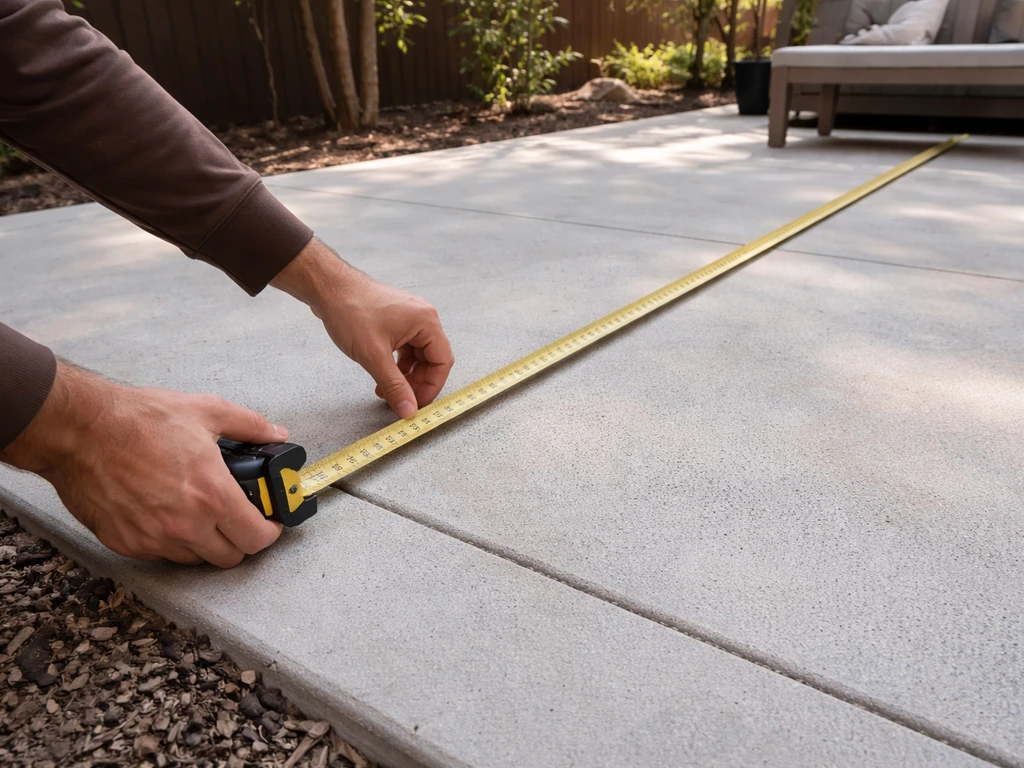
Start with the 20 BTU per square foot rule. Measure the length and width of the area you want to heat, multiply them together for square footage, then multiply by 20. A 10 x 15 ft patio (150 sq ft) comes out to 3,000 BTU as a baseline. A 20 x 25 ft covered patio (500 sq ft) comes to 10,000 BTU. Those numbers assume mild weather and a somewhat sheltered space. In the real world, you'll almost always need to adjust upward.
Here's how to adjust for your actual conditions. Cold climates and cold seasons push you toward more BTU because the temperature gap between outside air and your comfort target is wider. Wind is the other big factor: moving air strips heat off your skin and off the heater itself.
Patio Enhancement Group links the need for higher BTUs per square foot in colder, wind-exposed outdoor conditions to increased sustained wind velocity Wind is the other big factor: moving air strips heat off your skin and off the heater itself. .
An exposed, breezy patio can cut effective coverage by 30 to 50 percent. SunStar's sizing guidelines show this clearly: a heater in a breezy exposed location covers an 8 x 8 ft zone, while the same heater in a moderately protected spot covers 10 x 10 ft. That's a 56 percent difference in coverage area from the same unit.
So the practical calculation looks like this: take your baseline BTU from the square footage formula, then apply a multiplier based on your exposure. For a well-sheltered covered patio in a mild climate, stay close to the baseline. For an open patio in a colder region with any wind, plan for 1.5 to 2 times the baseline number. This is why most outdoor patios end up needing a 40,000 to 48,000 BTU freestanding heater even for relatively modest spaces.
| Patio Size (sq ft) | Baseline BTU (x20) | Sheltered Estimate | Exposed/Windy Estimate |
|---|---|---|---|
| 100 | 2,000 | 10,000–15,000 | 20,000–30,000 |
| 200 | 4,000 | 15,000–25,000 | 30,000–40,000 |
| 300 | 6,000 | 25,000–35,000 | 40,000–48,000 |
| 400 | 8,000 | 35,000–45,000 | 48,000+ (or 2 heaters) |
| 500+ | 10,000+ | 40,000–48,000 (or 2 heaters) | Multiple heaters required |
If your patio is larger than about 300 to 400 sq ft and you're in a cold or exposed setting, a single heater won't cut it regardless of BTU. You're looking at multiple units. To answer how many patio heaters do i need, first estimate your total square footage and then divide by the coverage area your heater is rated for under similar wind and temperature conditions.
Lowe's guidance suggests one heater per 1,500 to 2,000 sq ft for covered spaces, which sounds like a lot but assumes mild conditions and covered protection. To answer how many patio heaters you need, use the heater-per-area guidance for your covered or open space and then adjust for wind and temperature. For real-world open-air use, plan for one heater per 100 to 200 sq ft of the zone you actually want to keep warm.
If you are trying to keep costs down instead of buying, you can also compare this BTU sizing approach with how much to rent a patio heater for your space and weather conditions.
Choosing the right BTU range by heater type and setup
The type of heater you're buying matters as much as the BTU number. A 48,000 BTU freestanding mushroom-style propane heater and a 48,000 BTU directional infrared heater behave very differently in real use. Here's a practical breakdown by heater type.
Tabletop propane heaters
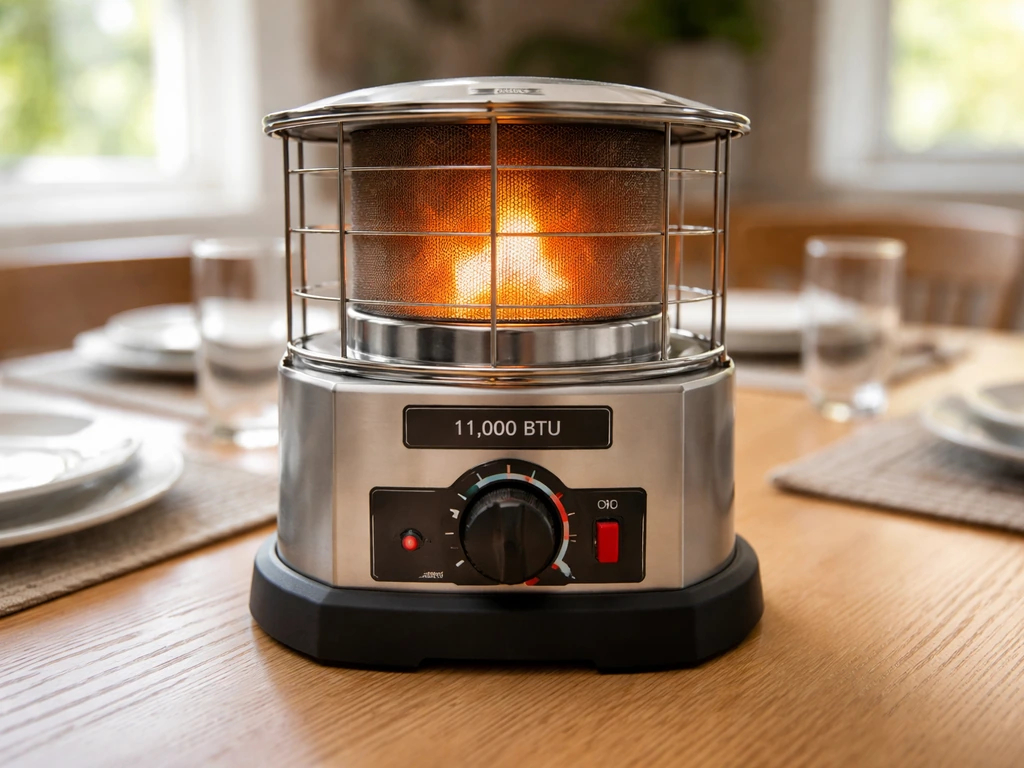
These are compact, low-output units designed for personal warmth at a table, not area heating. The Hiland tabletop propane heater, for example, puts out 11,000 BTU and covers about 15 sq ft. That's a personal comfort zone, not a patio solution. If you're shopping tabletop, expect 10,000 to 15,000 BTU max, and plan for it to warm the people seated immediately around it, not the whole patio. They're great for a small bistro table setup in mild weather.
Freestanding propane heaters (mushroom or pyramid style)
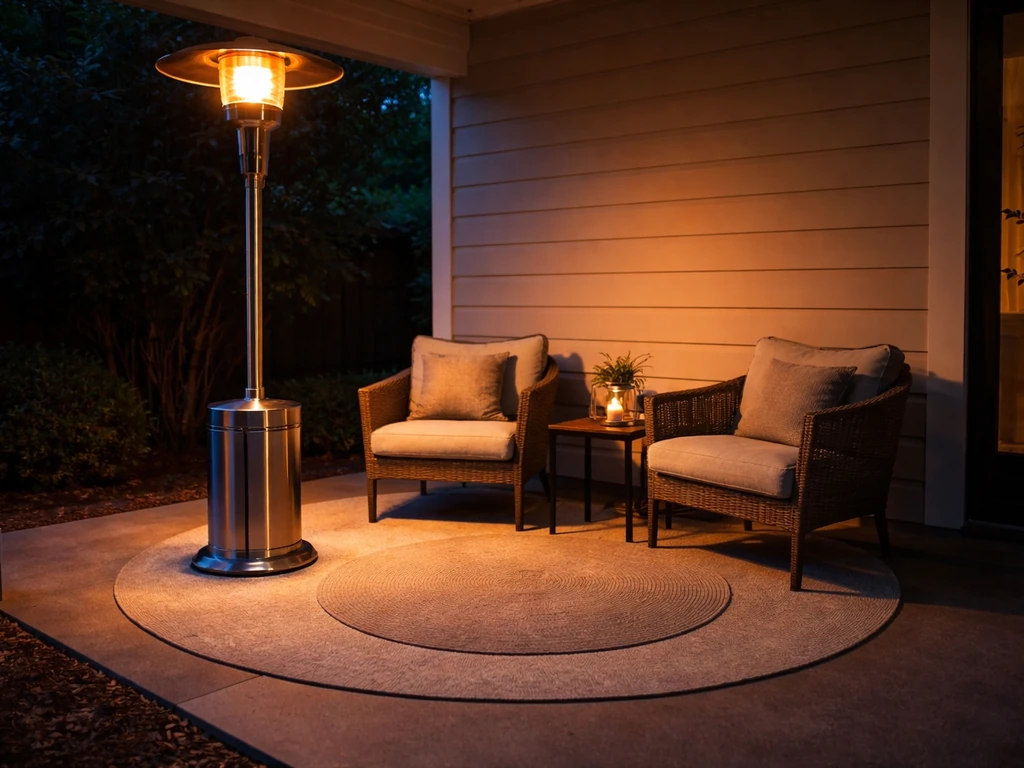
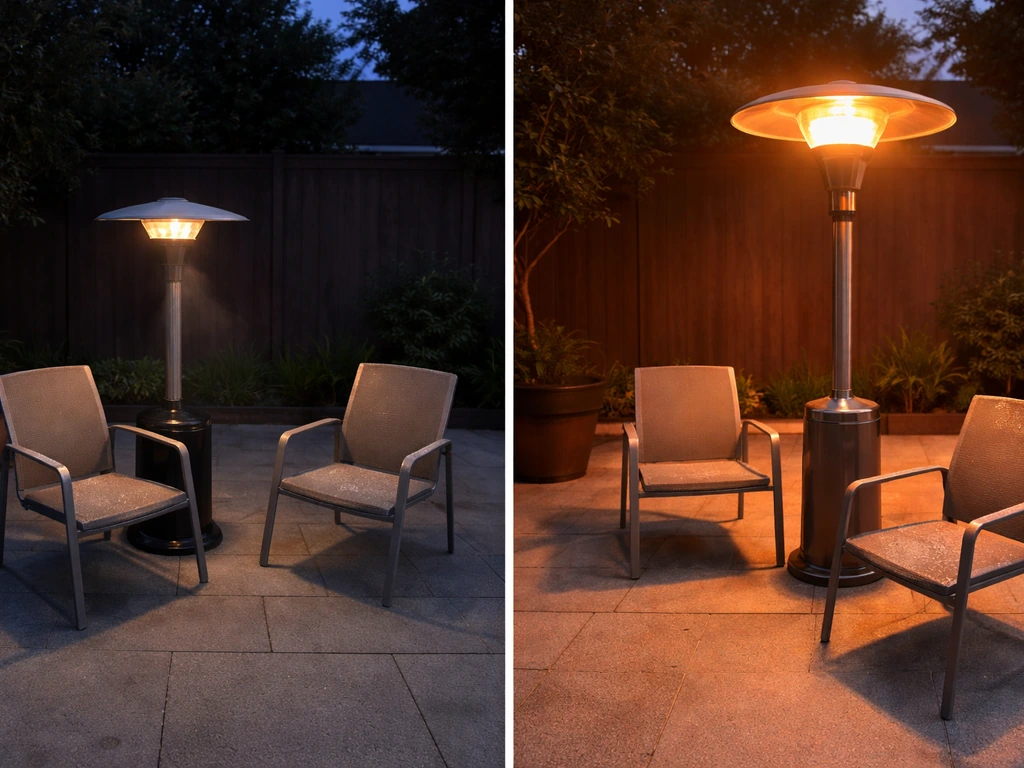
This is the most common category for residential patios. Most models fall in the 40,000 to 48,000 BTU range. At 48,000 BTU, a freestanding heater typically heats an area about 18 feet in diameter (roughly 250 sq ft of circular coverage). Hampton Bay, East Oak, and most major brands all advertise similar coverage for their 48,000 BTU units. For a typical 10 x 10 to 15 x 15 ft patio, one 48,000 BTU freestanding heater is the standard recommendation. For anything larger, plan for two.
Electric infrared heaters (wall-mount or overhead)
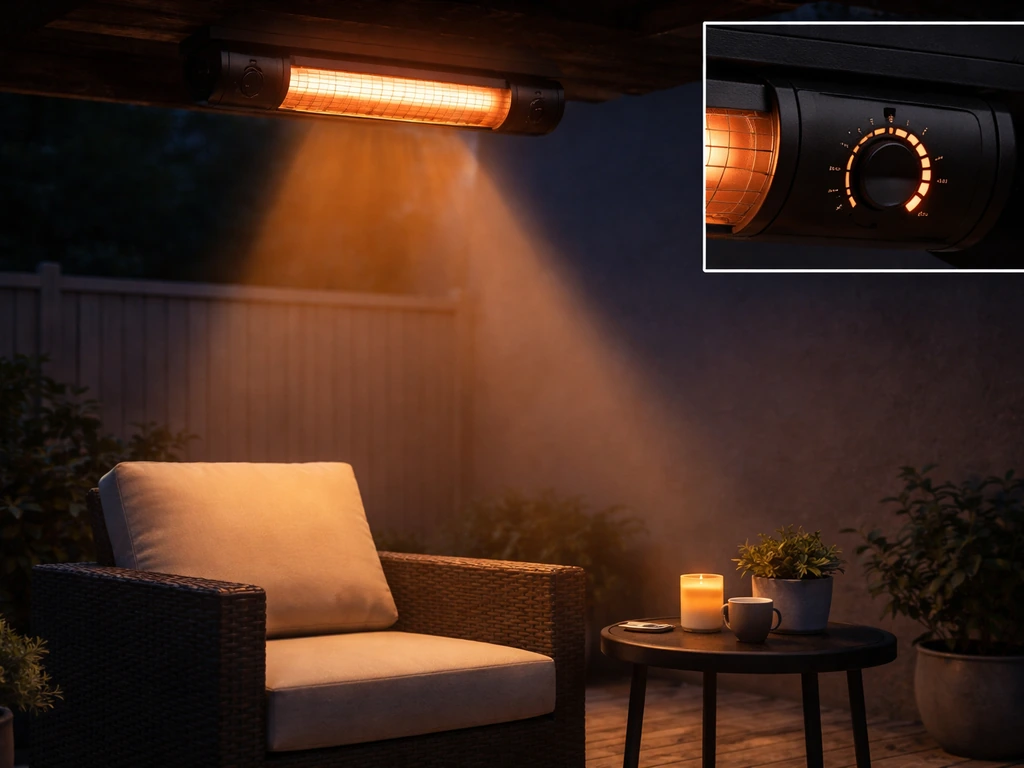
Electric infrared models typically run 1,500 to 3,000 watts, which translates to roughly 5,000 to 10,000 BTU per hour. Their advantage isn't raw BTU output: it's directional, radiant heat that warms people directly rather than heating the air around them. Coverage is usually 100 to 200 sq ft per unit, but because the heat is targeted, they can feel warmer than their BTU numbers suggest. Wall-mount or overhead placement dramatically affects coverage, and mounting height and angle matter a lot. SunStar's guidelines recommend a mounting height of 6 to 8 feet and a 30 to 60 degree downward angle for optimal radiant coverage.
| Heater Type | Typical BTU Range | Coverage Area | Best Use Case |
|---|---|---|---|
| Tabletop propane | 10,000–15,000 BTU | ~15 sq ft (personal zone) | Small bistro table, mild weather |
| Freestanding propane (mushroom/pyramid) | 40,000–48,000 BTU | ~200–250 sq ft (18 ft diameter) | Standard residential patio |
| Electric infrared (wall/overhead) | 5,000–10,000 BTU (1,500–3,000W) | 100–200 sq ft per unit | Covered patios, targeted warmth |
| Commercial propane/radiant | 50,000+ BTU | 250+ sq ft | Large open patios, cold climates |
Reading manufacturer specs correctly
This is where a lot of buyers get tripped up. The BTU number on the box and the coverage area claim are not always based on the same assumptions, and sometimes the same model will show wildly different coverage numbers depending on who's selling it. The Mr. Heater F270765, for example, appears in one listing as covering 215 sq ft and in another reference as 1,200 sq ft. Those aren't the same number because they're measuring different things under different assumptions.
The BTU rating is almost always the maximum input rating at full power. The coverage area is an estimate based on the manufacturer's assumption about wind, ambient temperature, and desired warmth. A heater rated at 48,000 BTU with an 18-foot diameter claim is assuming relatively calm air and mild outdoor temperatures. If your patio is colder or windier than those assumptions, that same heater will feel underpowered.
When you're reading a spec sheet or product listing, look for these specifics: the maximum BTU output, the fuel type (LP propane only vs. natural gas), the regulator type included, and the actual coverage assumption the manufacturer used. The regulator matters more than most people realize. Using the wrong regulator or an aftermarket one can change the gas pressure and drop the actual output below the rated BTU, meaning the heater can't reach its labeled performance. The manual will tell you which regulator and hose assembly to use, and you should follow it exactly.
One more spec to check: some heaters label their coverage area as a radius (e.g., 9 feet), while others use diameter (18 feet) or a square footage number. Make sure you know which one you're reading. An 18-foot diameter gives you about 254 sq ft of circular coverage. A 10-foot radius gives you 314 sq ft. These aren't the same, and mixing them up can lead to buying a heater that barely covers half of what you expected.
Common mistakes that lead to underheating or overheating
Underheating is by far the more common problem. Here are the mistakes I see most often:
- Buying by price instead of BTU: A 30,000 BTU heater costs less but leaves everyone shivering on a cool night. The 40,000 to 48,000 BTU range exists for a reason.
- Ignoring wind: An open, exposed patio will strip heat away continuously. If you have any regular wind at your location, assume your effective coverage drops by at least 30 percent. SunStar's guidelines show this clearly with their breezy vs. sheltered coverage zones.
- Placing the heater in the wrong spot: A freestanding heater jammed into a corner loses half its radiant coverage. It should be centered in the space you want to heat, or at least positioned so the heat reaches the seating area directly.
- Relying on one heater for too large an area: The average effective coverage of a 48,000 BTU heater is around 100 to 215 sq ft depending on conditions. If you're trying to heat 400 sq ft with one unit, it won't work well regardless of BTU rating.
- Using the wrong fuel or regulator: Running an LP heater with a natural gas regulator (or vice versa) means you're not getting the rated BTU output. Always use the included regulator and the correct fuel type.
- Flame blowing out in wind: This isn't just annoying, it's a sign the heater is in a location where it can't perform. Wind kills the burner flame on propane heaters. If yours keeps blowing out, the solution is a windbreak or a repositioned heater, not a new thermocouple.
Overheating is less common but does happen, usually when someone buys a large commercial-grade heater (50,000+ BTU) for a small covered porch. In a tight, enclosed space, a high-output propane heater can overheat the area and, more importantly, create a carbon monoxide hazard. Propane heaters are designed for outdoor use with open ventilation. If your 'patio' is really a semi-enclosed sunroom or three-season room, an electric infrared heater is the safer and more appropriate choice. Propane heaters require ventilation, and their manuals are explicit about this.
Quick steps to pick your BTU target today
Here's the practical process to nail down the right BTU before you buy anything.
- Measure your patio: Get the length and width in feet. Multiply them for square footage. This is your starting number.
- Multiply by 20 for your baseline BTU: A 150 sq ft patio needs a baseline of 3,000 BTU. A 300 sq ft patio needs 6,000 BTU.
- Adjust for exposure: If your patio is covered and sheltered, multiply the baseline by 2 to 3. If it's open and regularly windy, multiply by 4 to 6. Most real patios end up in the 30,000 to 48,000 BTU range for a freestanding unit.
- Match to heater type: If you're buying a freestanding propane heater for a standard residential patio, 40,000 to 48,000 BTU is the right range for most situations. For a tabletop unit at a bistro table, 10,000 to 15,000 BTU works. For a wall-mount electric, plan for one 1,500 to 3,000-watt unit per 100 to 150 sq ft.
- Read the spec sheet carefully: Find the maximum BTU, confirm the fuel type (LP vs. natural gas), and note what coverage assumption the manufacturer used. Don't trust a coverage claim without knowing what conditions it assumes.
- Check clearances before you place it: The manual for most 48,000 BTU propane heaters requires at least 3 feet of clearance from flammables on all sides and above. Verify your placement allows for this before you buy a fixed-mount unit.
- Consider a windbreak if your patio is exposed: A simple fence panel or privacy screen behind the heater can dramatically improve effective coverage and prevent flame-out issues.
- Verify the regulator and fuel compatibility: The included regulator must match your fuel source. Don't swap or substitute. If you're not sure, the manufacturer's manual is the authority, not the product listing.
One final note on safety: propane patio heaters are outdoor appliances only. Never use them in garages, tents, or enclosed spaces, even partially enclosed ones. If you're buying for a covered patio, make sure it's genuinely open on at least two sides for airflow. If you're not sure how many heaters you'll need for a larger event or a bigger space, that's a separate sizing question worth working through based on your specific layout and guest count.
Propane consumption is another practical factor to plan around once you've settled on BTU range: a 48,000 BTU heater running at full output burns roughly 1 pound of propane per hour, so a standard 20-pound tank gives you about 10 hours of run time at max. For most patio heaters, knowing the fuel burn rate helps you estimate how long a propane tank will last propane consumption. If you dial it back to 60 percent output, that number climbs significantly. It's worth keeping in mind when you're budgeting for an evening outdoors or a longer event.
FAQ
If the box says my patio heater covers X square feet, should I trust that number for my home?
Start by treating the heater’s BTU as maximum input (energy burned per hour), then verify the product’s stated coverage assumptions. If the listing does not specify wind exposure, mounting height, and target comfort level, plan as if it is an open, breezy patio (use 1.5 to 2 times your square-foot baseline) because most real-world performance runs below ideal lab conditions.
How do I convert the coverage claim (radius vs diameter) when figuring out how many BTUs I need?
Check whether your listing reports coverage as diameter, radius, or total square footage. Example: 18 feet diameter is about 254 sq ft (pi x r²), while a 10-foot radius is about 314 sq ft. Mixing these up can make you buy a heater that only covers roughly half of what you expected.
Does turning down a propane patio heater make it run at a lower BTU output or just change the temperature feel?
If you are using a propane heater at reduced settings, you are also reducing BTU input. Half the dial output usually means roughly half the BTU, so a heater that “feels fine” on low during mild weather may feel weak in cold wind because the fuel burn rate drops accordingly.
What’s the biggest mistake people make when they choose BTUs for a windy patio?
Yes. For open-air use, people often get the best comfort by placing directional infrared heaters where radiant heat can “see” the seating area, and by limiting direct exposure to wind. If you must face wind, raising BTU or adding a second unit usually improves comfort more reliably than simply raising the thermostat on electric units.
Can I size an electric infrared patio heater the same way as propane BTU heaters?
Electric patio heaters are limited by wattage and household power supply, so a “small” patio in cold weather may still require a layout with multiple smaller units. Also confirm voltage and amperage requirements (some models need dedicated circuits), because underpowered installation can prevent the heater from reaching its rated output.
Is propane still a good option if my “patio” is covered but partly enclosed?
If your patio is mostly enclosed (for example, three-season room, sunroom, or a space with only one open side), propane may be inappropriate due to ventilation needs. In these semi-enclosed cases, many people switch to electric infrared for safer operation and more controllable output, and they size based on the seating zone rather than treating it like a fully open patio.
What should I do if my patio seating area is not centered under the heater?
If the heater must warm guests who are spread across the space, one large “mushroom” unit may not deliver even heat. A better approach is zoning, place units so their coverage overlaps the seating area, and size by the zone you actually want warm (not the whole patio footprint).
How do I size BTUs for a party when guests are moving around the patio?
When you buy for a larger event, estimate your warmable zone and then divide total area by the heater’s stated coverage under similar exposure. If you do not have realistic coverage assumptions, use the one heater per 100 to 200 sq ft open-air planning range and then add one extra unit if you expect gusty wind.
Once I pick the BTU, how long will a propane tank last at that setting?
Use propane consumption to plan runtime. At full output, a 48,000 BTU heater burns about 1 pound of propane per hour, so a 20-pound tank is roughly 10 hours at max. At 60% output, you should expect meaningfully longer runtime, but you will also need to account for reduced heating.
Why do the same patio heater models list very different coverage areas in different stores?
If the manufacturer coverage numbers vary wildly between listings, assume the most conservative measurement conditions that match your use case (windy, colder, larger target comfort). Also check whether the different listings are measuring at different heights, with different mounting angles, or using different heat targets, because that can change coverage without changing BTU.