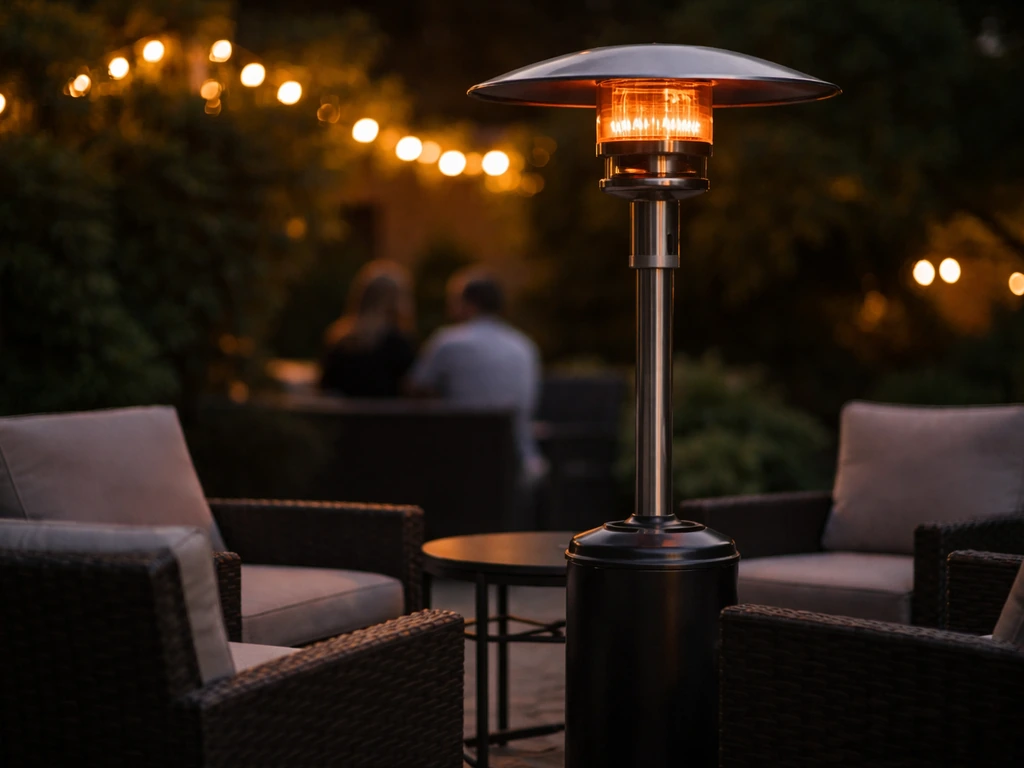
Yes, 48,000 BTU is a solid output for a patio heater and sits right in the sweet spot for most residential outdoor spaces. A single 48,000 BTU propane tower heater can realistically keep people comfortable within about a 9 to 15-foot radius under decent conditions. But whether it's actually "good" for your specific patio depends on how open your space is, how far your seating sits from the heater, and whether wind is a factor. The BTU number tells you how much fuel energy goes into the burner, not how much warmth lands on the people sitting around it.
Is 48,000 BTU Good for a Patio Heater? Sizing Guide
Grant Mercer
8 Jun 2026
BTU basics and how patio heater heat actually spreads
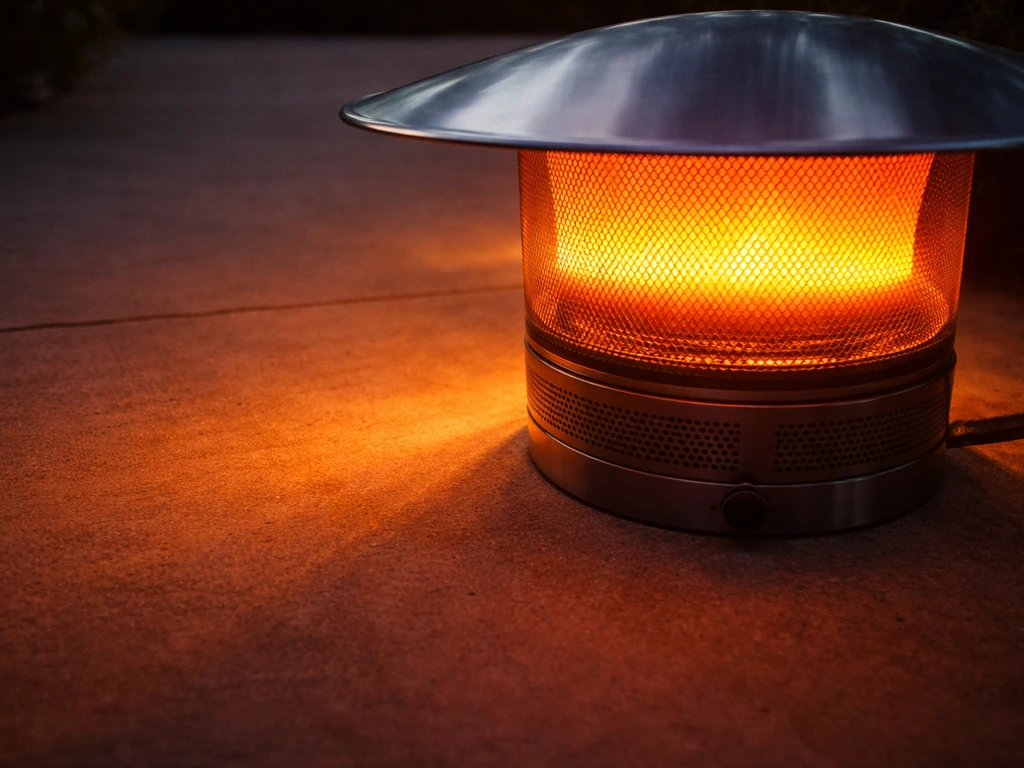
BTU stands for British Thermal Unit, and blank" rel="noopener noreferrer">on any gas appliance it measures the energy content of the fuel being burned, not a guaranteed comfort radius. When you see "48,000 BTU" on a patio heater box, that's the input rating. What actually reaches your guests is radiant heat, which travels in straight lines like sunlight and warms people and surfaces directly in its path rather than heating the surrounding air. This is a critical distinction for outdoor use, because outdoor air is essentially infinite and constantly moving. You can't "heat" your backyard the way you'd heat a living room.
Most freestanding and mounted patio heaters produce radiant infrared heat. That means comfort is about geometry as much as it is about BTU. A heater pointed at the back of someone's chair is doing almost nothing for them. One aimed directly at the seating zone, at the right height and angle, will make a noticeable difference even at a lower BTU rating. Coverage claims on product listings, like "250 sq ft" or "9-foot radius," are generated under controlled, low-wind test conditions. Real open-air performance will typically be lower.
Choosing the right BTU by patio size and layout
A 48,000 BTU heater is generally marketed with a blank" rel="noopener noreferrer">stated heat radius of around 9 to 15 feet depending on the model, which translates to roughly 100 to 250 square feet. That's enough for a single dining table grouping or a tightly clustered seating arrangement, but not enough to warm a sprawling 500-square-foot open deck uniformly. If you still wonder what size patio heater do i need, start by matching BTUs to your patio’s layout and then adjust for wind and seating distance. If your space is larger, you'd need multiple units positioned to create overlapping heat zones rather than expecting one heater to cover everything. For a wedding, you may need multiple patio heaters to cover the seating areas comfortably rather than relying on a single unit multiple units. If you are wondering how many patio heaters do i need, focus on your total covered square footage and whether you need overlapping heat zones.
Layout matters almost as much as square footage. Radiant heaters create zones, not uniform warmth. A long rectangular patio with seating on both sides is a very different challenge from a circular grouping around a fire pit. For linear arrangements, a single mounted radiant heater aimed along the seating line works well. For circular or square groupings, a central tower heater like most 48,000 BTU propane models is a natural fit. Infratech installation guides, for example, use an 11 x 11-foot coverage cell as a basic planning unit, which tells you that even high-quality commercial systems are designed to be layered across a space rather than deployed as a single cure-all.
| Patio Size | Layout Type | 48,000 BTU Fit | Recommendation |
|---|---|---|---|
| Under 150 sq ft | Compact deck, single table | Excellent | One unit is plenty, may feel too intense close up |
| 150–250 sq ft | Standard patio, centered seating | Good | One unit covers the zone well under moderate conditions |
| 250–400 sq ft | Open deck, multiple seating areas | Fair | One unit covers one zone; consider two heaters |
| 400+ sq ft | Large open patio or entertaining space | Insufficient alone | Two or more units needed for even coverage |
Safety and performance limits of over- or under-sized heaters
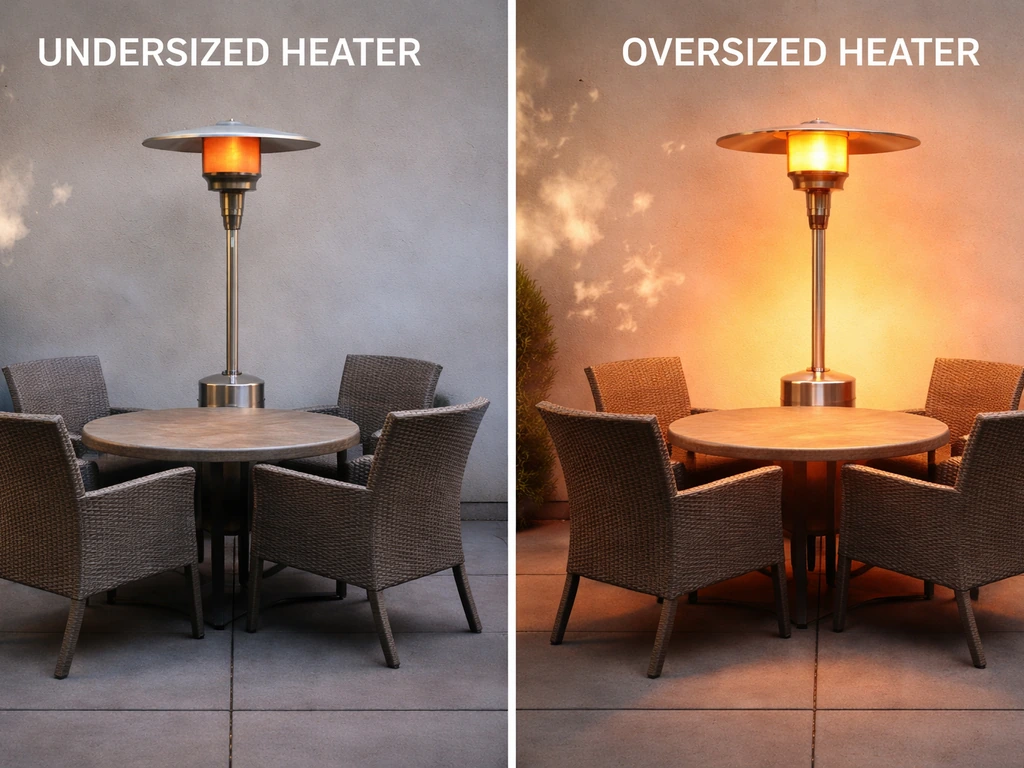
Undersizing is the more common mistake. A heater that's too small for the space will run at full output constantly and still leave people on the outer edges cold. You'll crank it up, guests will drag their chairs closer, and someone ends up uncomfortably close to an open flame. For propane patio heaters, NFPA guidelines and most manufacturer instructions specify minimum separation distances from people and combustible materials, typically at least 2 to 3 feet of clearance from any side. Closing that gap because the heater isn't keeping up is a real safety concern, not just a comfort issue.
Oversizing has its own problems. A heater that's too powerful for a small, enclosed, or semi-enclosed patio can raise radiant intensity to an uncomfortable level, create uneven hot spots, and waste fuel. More importantly, using a large gas heater in a space that's too enclosed raises carbon monoxide and oxygen-depletion risks. Patio heaters are listed for outdoor use only, and that's not a suggestion. If your patio has three solid walls and a roof, a 48,000 BTU gas heater may not be appropriate regardless of how cold it is.
Gas types and real-world efficiency
Most 48,000 BTU patio heaters you'll find at home improvement stores run on propane from a standard 20-lb tank. Some models are designed for natural gas and require a permanent gas line connection. The BTU rating refers to input energy for both, but you can't swap fuel types without a conversion kit designed for that specific model, and even then you need to verify the burner orifice and regulator are matched to the fuel. A propane burner run on natural gas (or vice versa) without proper conversion will deliver incorrect output and potentially unsafe combustion.
For propane models, actual radiant heat delivery depends on burner design, reflector quality, and emitter material. Gas patio heaters deliver radiant heat less efficiently than purpose-built electric infrared heaters, which some manufacturers claim convert over 90% of input energy to radiant output. A standard propane tower heater loses a portion of its BTU energy to convection and exhaust. That's not a reason to avoid propane heaters, they're extremely popular and practical, but it does mean the stated BTU is an input figure, not a "delivered warmth" guarantee. If you're concerned about propane consumption, that topic is worth looking at separately before you commit to a model. For a quick estimate of propane use, focus on the heater's BTU input and the burn rate that corresponds to that input how much propane does a patio heater use.
How to size for wind, cover, and seating distance
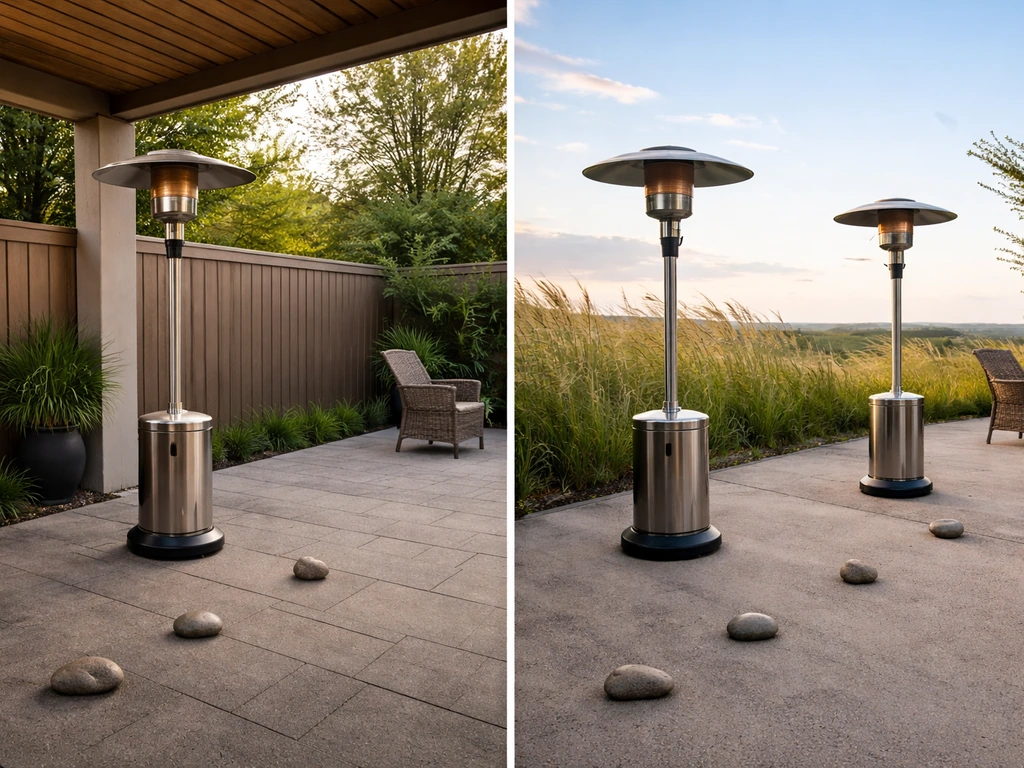
Wind is the biggest variable that product listings ignore. Manufacturers like Sunglo explicitly note on their spec sheets that "heat coverage varies depending on wind," which is a polite way of saying that even a well-rated heater can feel underpowered on a breezy evening. Wind disrupts the radiant column coming off a standing heater and cools people on the outer edge of the coverage zone faster than the heater can compensate.
- Fully open, exposed patio with regular wind: bump your BTU needs up by at least 20–30% or plan for two heaters instead of one
- Partially covered patio (pergola, awning, one or two solid walls): 48,000 BTU works well for up to 200–250 sq ft of seating area
- Fully covered or three-sided enclosure: 48,000 BTU propane may be excessive and unsafe; consider a lower-output electric infrared or verify ventilation is adequate
- Seating within 6–8 feet of the heater: one 48,000 BTU unit is comfortable for 4–6 people in calm conditions
- Seating at 10–15 feet: warmth is noticeable but borderline; wind will make this feel inadequate
Mounting height and angle matter too, especially for wall-mounted or ceiling-mounted radiant heaters. Infratech installation manuals emphasize that aiming the heater at a downward angle toward occupied zones, rather than straight down, distributes warmth more effectively across the seating area. For freestanding tower heaters, keeping the heater at the center of the group at the manufacturer-specified height, typically around 7 to 8 feet for most 48,000 BTU models, is important. Positioning it against a wall or in a corner reduces coverage dramatically because half the radiant output goes into a surface instead of toward people.
Common signs your heater is too small or too big
Signs it's too small
- Guests consistently migrate closer to the heater throughout the evening
- The heater runs at full output and the area still feels cold beyond 6 feet
- You find yourself needing the heater on warmer nights than expected
- Cold pockets appear on one side of the seating area (usually the windward side)
Signs it may be too large or poorly placed
- People closest to the heater feel uncomfortably hot or back their chairs away
- Noticeably uneven warmth: one seat is too warm, others are cold
- The heater runs on low settings most of the time and still feels intense
- You're burning through a propane tank unusually fast with few guests
Troubleshooting when performance is disappointing after purchase
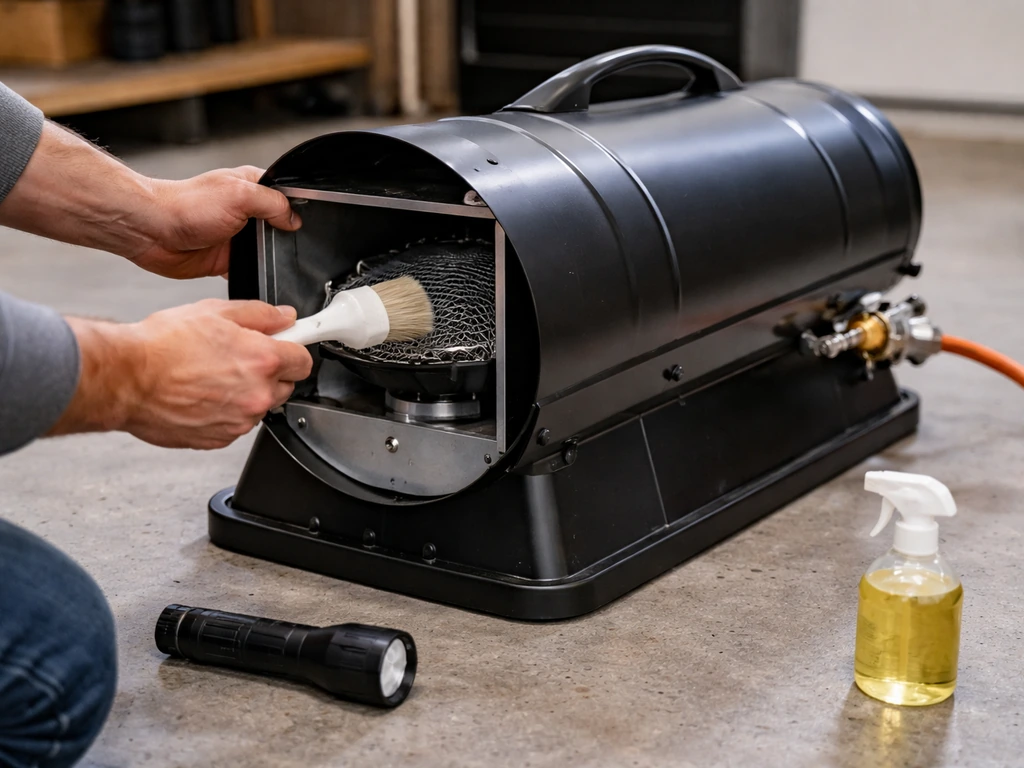
If you've bought a 48,000 BTU heater and it's not delivering the warmth you expected, sizing isn't always the problem. Before assuming you need a bigger unit, run through the basics. First, verify the heater is positioned correctly at the recommended height and centered in the seating zone. Second, check that the regulator and propane hose are rated for the heater's BTU demand. An undersized or faulty regulator will starve the burner of gas and drop output significantly even when the tank is full. Third, inspect the flame. A healthy flame on most propane patio heaters is blue with orange tips. A weak, yellow, or flickering flame indicates a gas supply or combustion issue, not a BTU shortfall.
If the heater keeps shutting off during use, especially on windy nights, the safety system is likely doing its job. Wind can cool the thermocouple or pilot sensing element, which causes the gas valve to close as a safety response. This is a placement and wind-exposure issue, not a malfunction. In that scenario, adding a wind guard or repositioning the heater relative to the prevailing wind direction often fixes it. If the thermocouple itself has failed or is misaligned from the pilot flame, that's a straightforward DIY repair involving removing and replacing a low-cost part. Don't just override the safety system to get more heat.
Quick buying checklist for 48,000 BTU patio heaters
Before you finalize a purchase, use this checklist to verify the specs match your actual setup. Two heaters both rated at 48,000 BTU can claim wildly different coverage areas (anywhere from 100 to 250+ sq ft), so the number alone doesn't tell the whole story.
- Check the stated heat radius, not just BTU: look for a model listing a radius of at least 9 feet if you need to cover a standard 6-person patio grouping
- Verify fuel type compatibility: confirm whether the model runs on standard 20-lb propane or requires a natural gas line, and check if conversion kits are available
- Confirm regulator included and its BTU rating: the included regulator must be rated for 48,000 BTU minimum; budget units sometimes include undersized regulators that throttle output
- Look for a tip-over safety shutoff and a thermocouple-based flame failure device: these are non-negotiable safety features on any gas patio heater
- Check the operating height and match it to your patio ceiling clearance or intended placement height
- Read wind-related disclaimers in the spec sheet: if the manufacturer notes coverage varies with wind and your patio is exposed, factor that into your expectations
- Compare coverage claims skeptically: if one 48,000 BTU heater claims 100 sq ft and another claims 250 sq ft, the reflector design, emitter quality, and geometry are very different between the two
- Plan for multiple units if your space exceeds 250 sq ft or has multiple distinct seating zones: two 48,000 BTU units placed strategically will outperform one 96,000 BTU unit in terms of even coverage
The bottom line is that 48,000 BTU is a perfectly capable output for most residential patio heaters, and for the average backyard setup it will do the job well. If you're comparing rental options instead of buying, the price to rent a patio heater can vary a lot by BTU size and duration 48,000 BTU. The question is whether you're setting it up in a way that lets it deliver that output where people actually sit. Get the placement right, keep the gas supply healthy, and understand where its real limits are in wind, and a 48,000 BTU heater will serve you well for years.
FAQ
Is 48,000 BTU enough if my patio is wide open?
If your seating is farther than the manufacturer’s stated radius, 48,000 BTU often won’t feel strong enough. A practical approach is to treat the 9 to 15 foot claim as a comfort range in low wind, then add margin by using multiple heaters or moving the heater closer to the seating zone. Also, make sure the heater height matches the model spec, since being too high spreads radiation past people.
Can I use a 48,000 BTU gas heater on a covered patio or gazebo?
Yes, but only if the roof or walls are truly semi-enclosed and have enough venting. For fully enclosed spaces, a propane heater can increase carbon monoxide and oxygen depletion risk, even when BTU seems “right.” If your patio has three solid walls and a roof, it’s generally safer to use heaters specifically rated for that enclosure, or switch to a purpose-built outdoor setup with appropriate clearances and ventilation.
Can I convert a 48,000 BTU propane patio heater to natural gas (or the other way around)?
No, not by BTU alone. Propane and natural gas versions are not interchangeable without the exact conversion parts for that specific model, because burner orifice and regulator settings must match the fuel. If you swap fuels incorrectly, the heater may underperform, soot up, or burn inefficiently.
Why does my 48,000 BTU heater feel weak even though the rating matches?
Check fuel delivery first. If the heater is starving, it can look like it’s “undersized” even when BTU is correct, especially in cold weather or with a small, undersized hose/regulator combo. Also confirm the tank is new enough and has no valve issues, then inspect the flame color, a healthy propane flame is typically blue with orange tips.
My heater keeps turning off in wind, is that a sign it’s underpowered?
If it’s shutting off during windy nights, the safety system is usually responding to pilot sensing problems caused by wind cooling. Before repairs, try repositioning it so the prevailing breeze does not strike the pilot area directly, or use a properly designed wind guard. If it still fails, a misaligned or failed thermocouple is often the culprit and is usually a replaceable part.
How should I place a 48,000 BTU heater on a long rectangle patio?
It can, because radiant heaters make “hot zones” rather than evenly warmed air. For a long patio, a single tower heater centered on the seating line may still leave the far end cool. The better choice is often either multiple heaters spaced to overlap coverage cells, or a linear mounted radiant heater aimed along where people sit.
Does putting the heater near a wall or corner reduce its usable coverage?
For freestanding tower heaters, placing it against a wall or in a corner usually reduces effective coverage because a significant portion of radiation hits the surface instead of reaching people. If you must place it near a wall, reposition it so the beam aims toward the seating area, and do not assume the full radius still applies.
What are the signs my 48,000 BTU patio heater is too strong for my space?
Yes, and it’s a common overheating mistake for smaller or partially enclosed areas. If guests feel intense heat right next to the unit but cold farther away, you may need repositioning or a lower-output solution instead of turning it up. Also, ensure you’re not violating minimum clearance requirements from people and combustibles.
How do mounting height and aiming change comfort with a 48,000 BTU infrared heater?
Look beyond the stated “square feet” and check the mounting and aiming. For radiant infrared heaters, the goal is to aim the emitter toward the occupied zone at the model’s recommended angle and height, then center the heater in relation to the seating. A wrong angle can cut comfort dramatically even with the correct BTU rating.
How can I estimate how much propane a 48,000 BTU heater will use for my typical patio time?
If propane consumption is your concern, focus on runtime expectations, not just comfort radius. Compare heaters by input BTU and the corresponding burn rate listed in the specs, then estimate how many hours you want to run and whether tank capacity supports that. This helps you avoid buying a “bigger” heater that costs more to operate without meaningfully improving comfort.