Most full-size freestanding propane patio heaters burn between 1.5 and 2.5 pounds of propane per hour at full output, which works out to roughly 8 to 13 hours of runtime from a standard 20-pound tank. A common 40,000 BTU/hr heater lands right around 1.75 lb/hr, while a larger 47,000 BTU/hr unit burns closer to 1.77 lb/hr as listed in its manual. Tabletop models rated around 10,000 to 11,000 BTU/hr use far less, sometimes under 0.5 lb/hr. The exact number for your heater is either printed right on the spec label or easy to calculate from the BTU rating using a simple conversion.
How Much Propane Does a Patio Heater Use? Easy Guide

Grant Mercer
17 May 2026
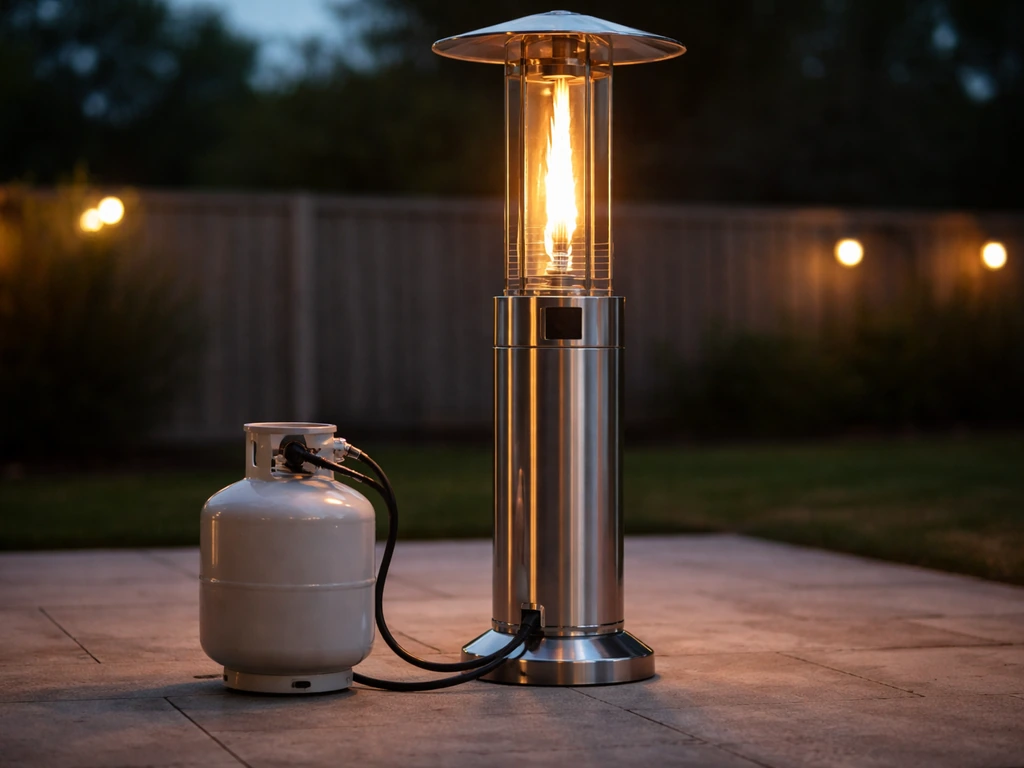
Burn rate vs. runtime: what 'fuel use' actually means
When people ask how much propane a patio heater uses, they usually mean one of two things: how fast it burns through fuel (the burn rate, measured in pounds or gallons per hour), or how long a tank will last (runtime, measured in hours). These are two sides of the same coin, but it helps to keep them straight.
Burn rate is the number you'll find in a good owner's manual, expressed as 'Heater Gas Consumption: X Lbs per hour.' Some manuals skip this and only list the BTU/hr input rating, which you can convert to lb/hr yourself (more on that below). Runtime is just your available propane weight divided by the burn rate. If your heater burns 1.77 lb/hr and your 20-pound tank has 18 pounds of usable propane, you get about 10 hours of heat.
Both numbers change depending on your heat setting. At full blast you hit the maximum burn rate. Turn the dial down to medium and you might cut fuel use by 30 to 50 percent, stretching runtime significantly. That's worth keeping in mind when you're planning for a long evening or a wedding rental situation. If you are wondering how many patio heaters you need for a wedding, start by matching the expected runtime to your available tank sizes and heat settings planning for a long evening or a wedding rental situation.
Find your heater's actual specs before you calculate anything
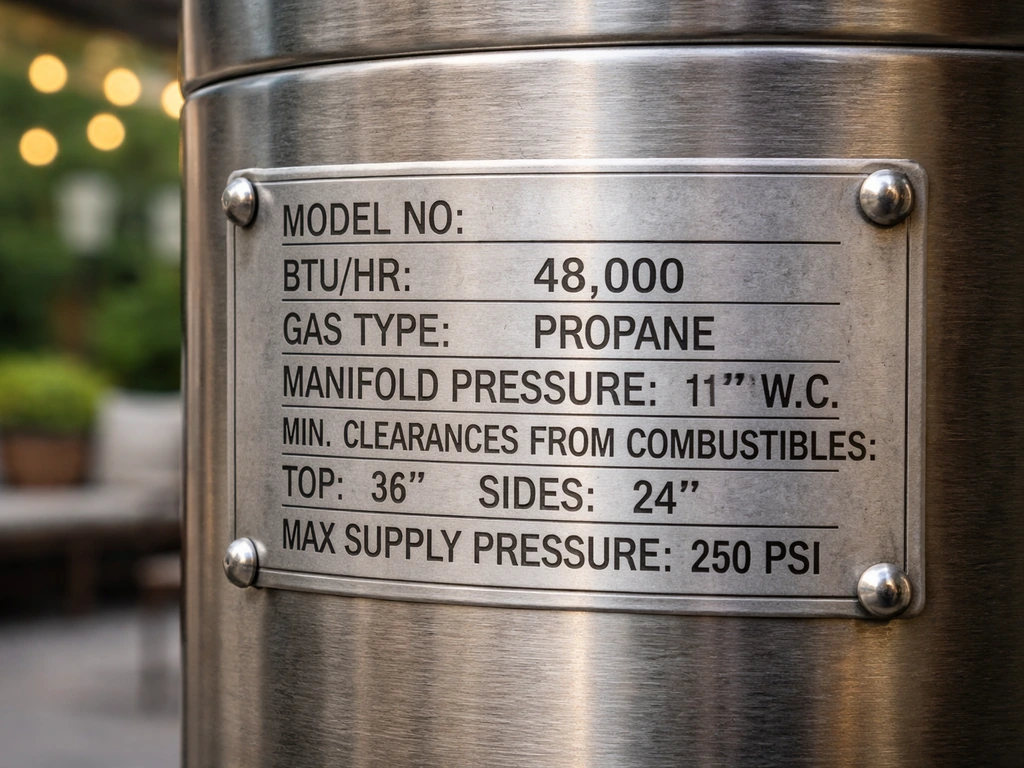
Before doing any math, grab the real numbers for your specific heater. For the Mi-T-M MH-0042-PM11, the product listing gives a fuel consumption of 2.3 lb per hour, which provides an additional cross-check for burn rate. Look in three places: the data plate or spec label riveted to the heater body (usually on the base or the burner housing), the owner's manual, and the manufacturer's product page or spec sheet. You're looking for four things.
- Heat input rating in BTU/hr (this is your main conversion starting point if no burn rate is listed)
- Fuel type: liquid propane (LP) only, or natural gas (NG). These are not interchangeable. Many manuals state explicitly that using the wrong gas type is dangerous and voids the warranty.
- Gas consumption in lb/hr or gal/hr if the manufacturer lists it directly. Some manuals, like those for the Mi-T-M MH-0042-PM11, list 'Fuel Consumption: 2.3 lb./hr' right in the spec table.
- Regulator outlet pressure, usually listed as 'Manifold Pressure' or 'Setting Pressure' in inches of water column (in. W.C.). For LP patio heaters, this is almost always 11.0 in. W.C. If your regulator isn't delivering the right pressure, your actual burn rate won't match the manual.
If your heater doesn't have a readable data plate, search the model number online and look for the PDF manual. The technical data table is usually near the back. If you can only find the BTU rating, that's enough to work with.
How to estimate propane consumption step by step
Here's the conversion method I use when a manual doesn't list fuel consumption directly. It works for any LP patio heater.
- Find your heater's BTU/hr input rating. Example: 40,000 BTU/hr.
- Use the propane energy density: 1 gallon of liquid propane contains approximately 91,500 BTU. Divide BTU/hr by 91,500 to get gallons per hour. For 40,000 BTU/hr: 40,000 ÷ 91,500 = 0.437 gallons per hour.
- Convert gallons per hour to pounds per hour using propane's weight of about 4.24 lb per gallon. Multiply gal/hr by 4.24. For our example: 0.437 × 4.24 = 1.85 lb/hr.
- Double-check: a 47,000 BTU/hr heater listed at 1.77 lb/hr in its manual works out to 47,000 ÷ 91,500 = 0.514 gal/hr × 4.24 = 2.18 lb/hr by this formula. The manual figure is slightly lower because manufacturers test at rated conditions and real combustion efficiency varies. Use the manual number when you have it; use the formula as a reasonable estimate otherwise.
- To get runtime, divide your available propane by the burn rate. A 20 lb tank typically holds about 18 to 19 lb of usable propane after accounting for the tare weight of the cylinder and the 80% fill safety rule. So: 18 lb ÷ 1.85 lb/hr ≈ 9.7 hours.
Typical consumption ranges by heater size and setting
Patio heaters vary a lot by size and output class. If you're wondering whether an about-48,000 BTU patio heater is a good fit, check its BTU rating and then estimate propane use using the same burn-rate versus runtime approach is 48000 btu good for patio heater. Here's a realistic overview of what to expect based on manufacturer specs and common BTU ratings.
| Heater Type / BTU Rating | Approx. Burn Rate (lb/hr) | Approx. Burn Rate (gal/hr) | Runtime from 20 lb Tank (full output) |
|---|---|---|---|
| Small tabletop, ~10,000 BTU/hr | ~0.46 lb/hr | ~0.11 gal/hr | ~39 hours |
| Mid-size tabletop, ~24,000 BTU/hr | ~1.1 lb/hr | ~0.26 gal/hr | ~16 hours |
| Standard freestanding, ~40,000 BTU/hr | ~1.75–1.85 lb/hr | ~0.41–0.44 gal/hr | ~9–10 hours |
| Large freestanding, ~47,000 BTU/hr | ~1.77–2.1 lb/hr | ~0.42–0.50 gal/hr | ~8–10 hours |
| High-output commercial, ~50,000+ BTU/hr | ~2.3+ lb/hr | ~0.54+ gal/hr | ~7–8 hours |
These are full-output numbers. Running at medium or low cuts fuel use substantially, so real-world runtime is often longer than the table suggests. A 40,000 BTU heater set to medium might burn closer to 1.0 to 1.2 lb/hr, pushing runtime past 15 hours on a single 20-pound tank.
Runtime from common tank sizes
Once you know your burn rate in lb/hr, calculating runtime for any tank is straightforward. Use the usable propane weight, not the tank's nominal rating. A nominally 20-pound tank actually holds around 20 pounds of propane when full, but you'll rarely get a perfect fill, and tanks have tare weight stamped on them. Tank dimensions and capacity estimates can vary by manufacturer, so confirm cylinder details before estimating runtime. Most refilled tanks deliver 17 to 19 lb of propane in practice. For a 100-pound tank, usable propane is roughly 80 to 96 lb depending on fill level.
| Tank Size | Approx. Usable Propane (lb) | Approx. Usable Volume (gal) | Runtime at 1.77 lb/hr (47k BTU heater) | Runtime at 1.85 lb/hr (40k BTU heater) | Runtime at 2.3 lb/hr (50k+ BTU heater) |
|---|---|---|---|---|---|
| 20 lb cylinder | 17–19 lb | ~4.5 gal | 9.6–10.7 hrs | 9.2–10.3 hrs | 7.4–8.3 hrs |
| 30 lb cylinder | 26–28 lb | ~6.6 gal | 14.7–15.8 hrs | 14.1–15.1 hrs | 11.3–12.2 hrs |
| 100 lb cylinder | 80–96 lb | ~22–24 gal | 45–54 hrs | 43–52 hrs | 34.8–41.7 hrs |
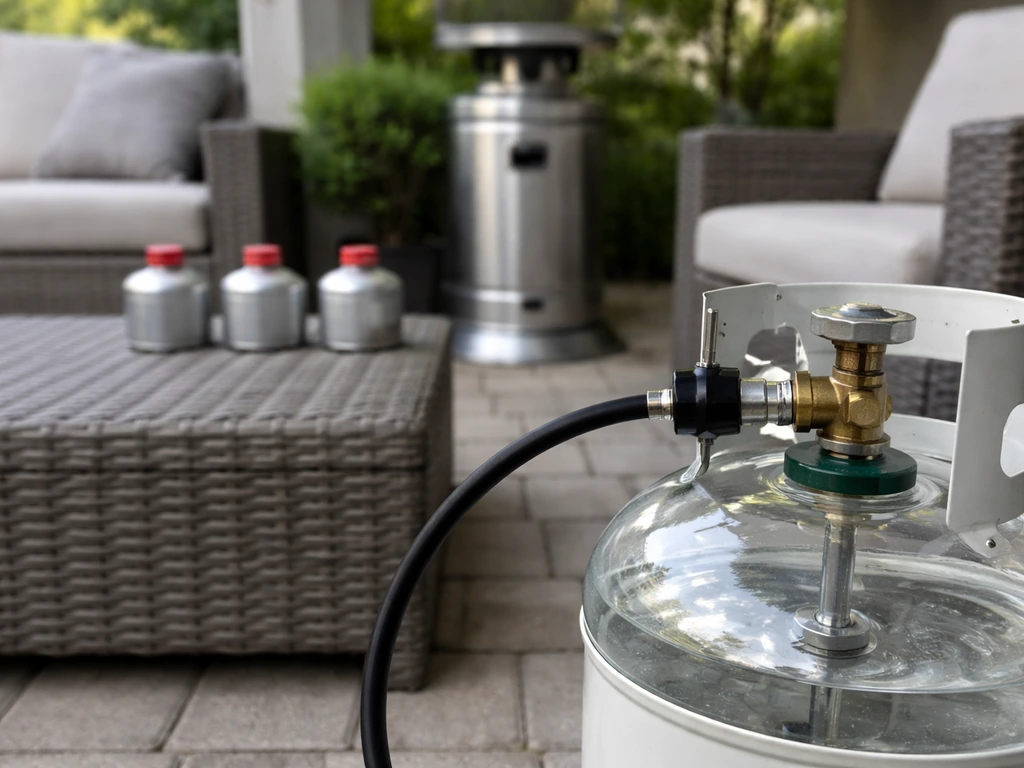
One thing to keep in mind: a 20-pound cylinder is the standard pairing for most residential freestanding heaters. Many manuals (like the Model 235000 spec sheet) actually specify 'Nominal 20 lb / 5 Gallon' as the required cylinder size. If you're scaling up to a 100-pound tank for an event or a permanent installation, confirm your regulator is rated for that cylinder and that it still delivers 11.0 in. W.C. output pressure. The math works the same, but the setup needs to match.
The simplest real-world check: weigh your tank
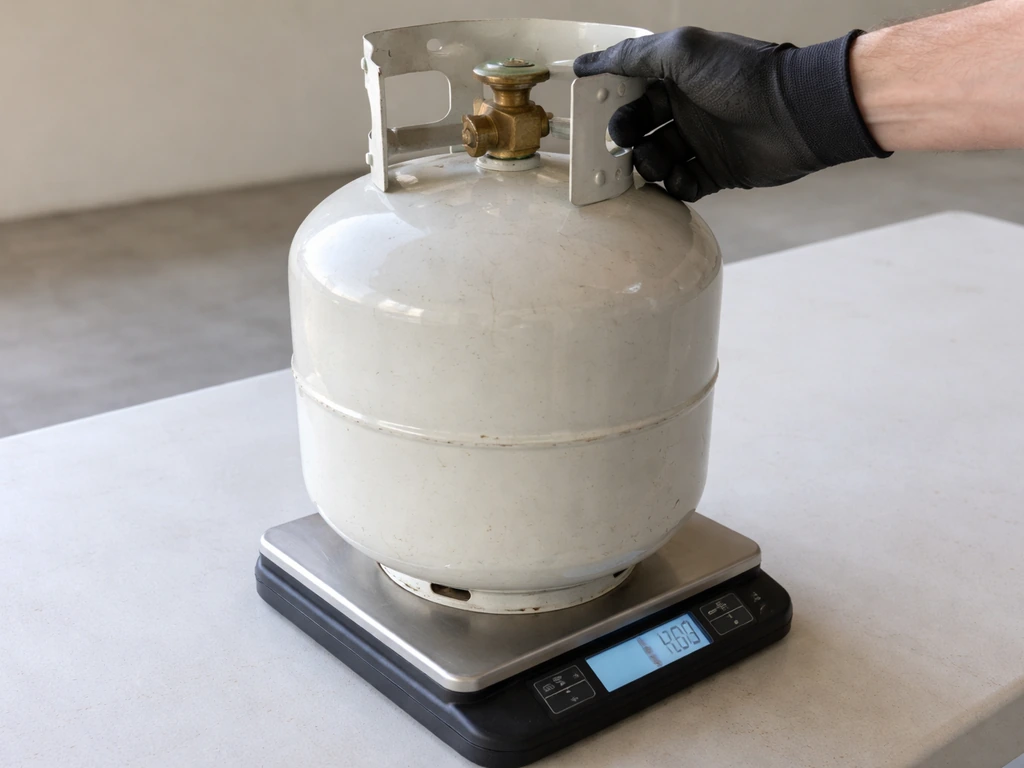
Calculations are great, but nothing beats a direct measurement. Here's a quick method I've used plenty of times to verify what a heater is actually burning.
- Find the tare weight (TW) stamped on the collar of your propane cylinder. This is the empty weight of the tank itself.
- Weigh the full tank on a standard bathroom or postal scale. Subtract the tare weight to get your starting propane weight in pounds.
- Run the heater at a consistent setting for exactly 1 hour, then weigh the tank again. Subtract to get your actual hourly burn rate.
- Compare this to your manual's listed consumption or your calculated estimate. If they're significantly different (more than 10 to 15 percent off), that's a signal something isn't right with the gas supply, regulator, or burner.
This is also the most reliable way to monitor propane levels between uses. A full 20 lb tank plus its typical tare weight of 17 to 18 lb will read 37 to 38 lb on the scale. When it drops to within a few pounds of the tare weight, you're nearly out.
What changes your fuel use (and what wastes it)
The burn rate in your manual assumes the heater is running correctly under rated conditions. Several real-world factors push that number up or down.
Factors that increase consumption
- Wind: even a light breeze pulls heat away from the radiant element and the surrounding space, making the area feel colder and prompting you to turn the dial up. Windscreens or a sheltered placement help.
- Cold ambient temperatures: propane vaporizes less efficiently at low temps, and vapor pressure in the tank drops. Below about 20°F, a 20-pound tank may struggle to supply adequate vapor, effectively reducing output and causing the flame to drop or stutter.
- Running at maximum output continuously: full-blast operation maximizes burn rate. Stepping down to medium heat during warmer parts of the evening cuts consumption significantly.
- Incorrect regulator pressure: if someone has swapped the regulator for one set to a different output pressure, the orifice will flow more or less propane than intended, throwing off both output and consumption.
Factors that waste fuel without adding heat
- Dirty or blocked burner: carbon buildup and debris on the burner head cause incomplete combustion. You're burning propane but getting less usable heat out of it. Clean the burner ports with a soft brush and compressed air at the start of each season.
- Clogged air intake: the venturi tube or air shutter on the burner mixes air with propane. If it's blocked by spider webs, insect nests, or debris (common after storage), combustion is inefficient and you may see yellow or orange flame instead of blue.
- Gas leaks: even a small leak around a hose fitting or valve is wasted propane and a serious safety hazard. If you smell gas, shut everything off immediately and do not relight until you've found and fixed the leak. Check connections with soapy water solution before each use.
- Wrong fuel type or orifice: LP and natural gas require different orifice sizes and regulators. Using an NG orifice on propane (or vice versa) will massively skew consumption and create a dangerous flame condition. Most LP patio heater manuals specifically state the heater is for liquid propane only and that conversion is hazardous.
Quick safety checks before every use
Beyond fuel consumption accuracy, a few maintenance checks protect you and make sure your consumption numbers stay predictable. Inspect the hose for cracks or abrasion before attaching the tank. Verify the regulator seats fully on the tank valve before opening it. Test for leaks with soapy water any time you reconnect the cylinder. And confirm your heater's tilt safety switch is functional: if the unit tips over, the switch should cut gas flow automatically. A faulty tilt switch won't affect consumption directly, but it's a safety component that should work every time.
If your heater is consuming far more fuel than the manual suggests and the flame looks right, verify the regulator is the correct type for LP at 11 in. W.C. output pressure. A worn diaphragm inside an old regulator can allow pressure to creep up, pushing more gas through the orifice than designed. Regulators are inexpensive and worth replacing every few seasons if the heater is used regularly.
Putting it all together
For most homeowners running a standard 40,000 to 47,000 BTU freestanding heater on a 20-pound tank: expect roughly 8 to 11 hours of full-output runtime, or 12 to 15 hours at a medium setting. This also helps you decide what size patio heater you need for your space and the length of time you want it to run what size patio heater do i need.
To estimate how much to rent a patio heater, focus on the heater’s BTU output and typical runtime so you can plan how long you need it. If you're planning a space and wondering how many patio heaters do i need, you can use the BTU output and the number of hours you want them to run to size the setup.
Check your manual for the exact lb/hr figure, or calculate it from your BTU rating using 91,500 BTU per gallon and 4. 24 lb per gallon. Weigh your tank before and after a one-hour run to confirm your real-world burn rate. For wedding setups, you can use that real-world burn rate to estimate how many patio heaters you need for the total heating time a one-hour run. For a quick estimate, use your heater’s burn rate and the total time you need heat, then multiply how many units it will take how many patio heaters you need.
And if the numbers seem off, look at the regulator, the burner, and the air intake before assuming anything more complicated is wrong. Those three things account for the majority of abnormal consumption issues I've seen.
FAQ
If my patio heater manual only lists BTU/hr, how do I estimate how much propane it uses?
Use the BTU/hr on the data plate to estimate lb/hr only when you have no “gas consumption” figure. Then apply the tank runtime using usable propane weight, not the tank’s nominal rating (for a 20 lb cylinder, plan on roughly 17 to 19 lb usable, depending on fill).
Why does my patio heater seem to use more propane than the stated lb/hr?
Do not assume full output math matches every situation. High wind, cold temperatures, blocked air intake, or a dirty burner can make the heater run harder to maintain heat, so measured burn rate may be higher than the spec sheet.
How can I tell whether a burn-rate problem is actually fuel consumption or just poor burning (flame issues)?
If the flame is weak, orange, sooty, or won’t stay steady at the same control setting, consumption can be unpredictable. In that case, check that the orifice and burner are clean and that the regulator is delivering the correct LP pressure before trusting any runtime estimate.
What’s the best way to estimate propane use for a wedding or long evening where conditions vary?
When you want to plan for an event, measure for at least one full hour at the exact setting you will use (low, medium, or high), then weigh the tank before and after. That gives you a real lb/hr number you can scale to the total hours.
Does turning the patio heater from high to medium always cut propane use by the same amount?
Medium and low settings are not standardized across brands. Use the manual if it provides multiple consumption rates, otherwise do a quick weigh test at your intended dial position because the cut in fuel use can differ a lot by heater design.
Is there a better way than using a tank gauge to know when I’m getting low?
For refill planning, track tank weight trends. If your scale is accurate, weighing “full to near-empty” directly is better than relying on the gauge, since patio heaters can have less reliable visual level indicators.
Can I run a freestanding patio heater on a larger propane tank like 100 lb, and will the math still work?
Use the right cylinder size for the heater and confirm compatibility. For 100 lb tanks on freestanding models, make sure your regulator is rated for that cylinder and still provides the correct output pressure, otherwise consumption and safety can be wrong.
What should I check first if propane use is suddenly higher than usual after a tank change?
Check for a regulator and connection mismatch before replacing parts. A wrong regulator type or an incorrectly seated regulator can cause abnormal gas flow, and that will change consumption without necessarily changing how “normal” the flame looks to an untrained observer.
How do I calculate propane use when I have two or more patio heaters running at once?
If you have multiple heaters, total propane use is not just “more time.” Multiply each heater’s lb/hr at the setting you will use, then compare against how many usable pounds you have across tanks to prevent running out mid-event.
Can I use these propane consumption estimates for any patio heater, including converted units?
Verify you are using LP patio heater assumptions. If a unit is configured for a different gas type or an incorrect conversion/regulator setup, the lb/hr estimate and runtime will not match real usage.