Yes, gas-powered patio heaters do give off carbon monoxide. Propane, natural gas, butane, and wood or pellet-burning models all produce CO as a byproduct of combustion. The key factor is whether that CO has somewhere to go. In a genuinely open outdoor space with good airflow, it disperses quickly and stays well below dangerous levels. The moment you add a roof, walls, a tent, a screened porch, or a low awning, CO can build up fast enough to cause poisoning. Electric and infrared heaters are the one exception: because they produce no combustion at all, they release zero carbon monoxide.
Do Patio Heaters Give Off Carbon Monoxide? Safety Guide

Grant Mercer
26 Jul 2026
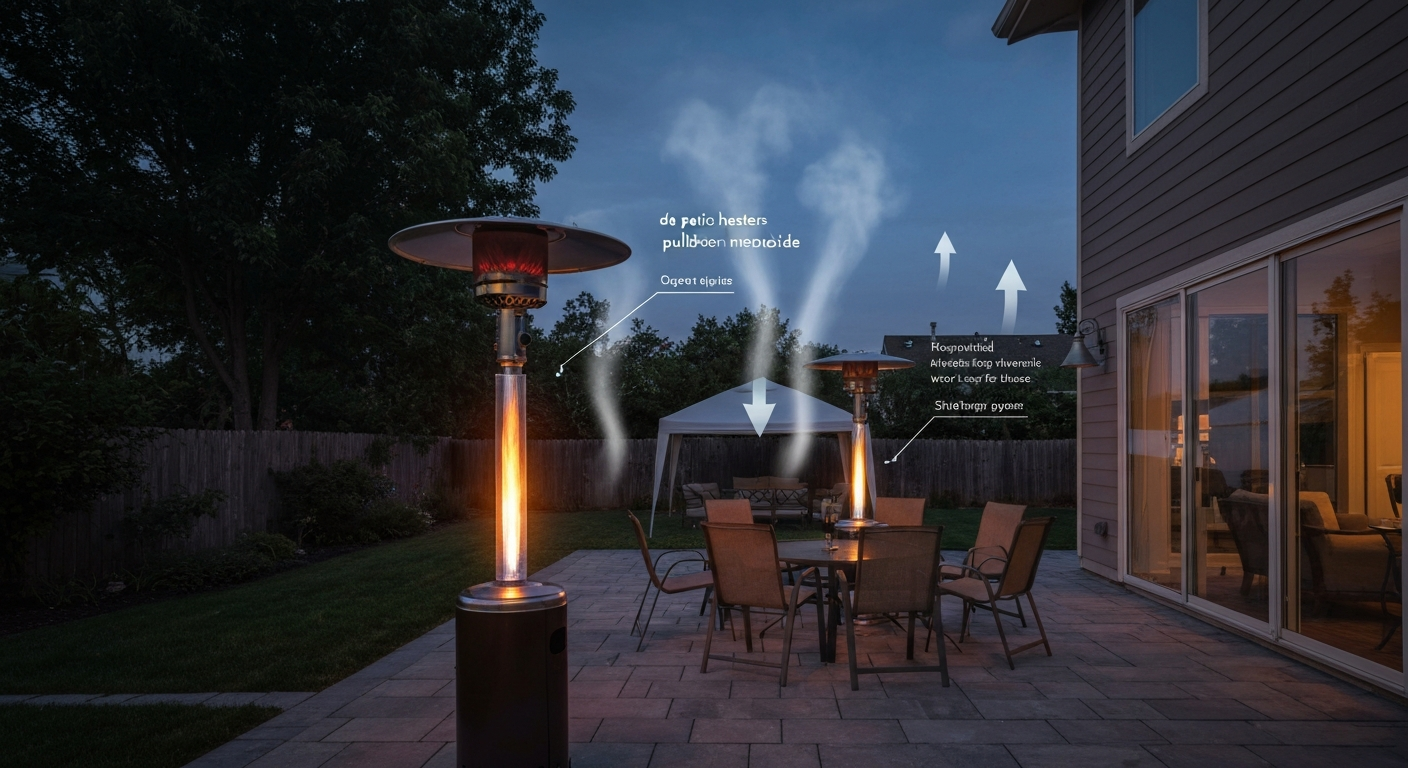
How combustion creates carbon monoxide
Every fuel-burning heater runs on the same basic chemistry: fuel plus oxygen produces heat, water vapor, and carbon dioxide. That is complete combustion, and it is what a well-tuned burner aims for. But combustion is never perfectly complete. When there is not quite enough oxygen, when the fuel-to-air mixture runs rich, when the burner is clogged with soot, or when the flame temperature drops too low, some of the carbon in the fuel only partially oxidizes. Instead of CO2, you get CO, carbon monoxide.
What makes CO dangerous is that you cannot detect it without a monitor. It has no color, no odor, and no taste. At low concentrations it causes headache and nausea. At higher concentrations it displaces oxygen in the bloodstream and can be fatal within minutes. The NIOSH recommended exposure limit is 35 ppm over an 8-hour workday, with an absolute ceiling of 200 ppm that should never be exceeded. CPSC lab tests on portable propane radiant heaters measured peak CO concentrations up to 716 ppm in low-ventilation test chambers, and several units hit 100 ppm in under an hour. Those numbers put the risk into perspective.
For DIYers, the practical takeaway is this: anything you do that reduces combustion quality increases CO output. A dirty burner, a clogged air intake, a misaligned emitter screen, or a failing thermocouple that lets the flame run cool all push the combustion process toward incomplete, and toward more CO. Keeping your heater well-maintained is not just about performance, it is directly linked to how much CO it generates.
Propane and natural-gas patio heaters: CO output, failure modes, and real risk
Propane and natural-gas models are by far the most common patio heaters, and every major manufacturer, from Uniflame and Blue Rhino to Hampton Bay and Frontgate, labels them explicitly for outdoor use only because of CO production. The manuals do not bury this: the standard warning reads something like "this product can produce carbon monoxide (no odor) and must never be used in an enclosed or semi-enclosed space."
When a propane heater is running normally on a fully open patio, the CO it generates is real but it disperses before it accumulates. The problem is when the heater develops a fault. These are the failure modes I see most often that directly increase CO output:
- Clogged or partially blocked burner ports: unburned fuel bypasses complete combustion, sharply raising CO generation.
- Sooted emitter screen or reflector: blocks radiant heat and disrupts the combustion airflow pattern.
- Low-flame or flickering flame caused by a weak thermocouple signal: the burner runs at reduced temperature, producing more incomplete combustion.
- Wrong orifice size after a fuel conversion: a propane orifice on a natural-gas supply (or vice versa) produces a badly rich or lean mixture.
- Regulator failure producing over-pressure: the flame burns orange or yellow instead of blue, a reliable visual sign of rich combustion and elevated CO.
A healthy flame on a propane or natural-gas patio heater should be predominantly blue with small orange tips. A predominantly yellow or orange flame is your first warning that combustion is incomplete. If you see that, shut the heater off and inspect the burner before using it again. Clean the burner ports with a soft brush and compressed air, check the air shutter is open and unobstructed, and confirm the regulator is delivering the correct pressure. If the flame stays off-color after those steps, the issue may be a regulator fault or an orifice problem that warrants closer diagnosis.
Butane and patio gas: what it is, CO risk, and cold-weather limits
"Patio gas" is a common commercial name for LPG sold in specific cylinder types, and its composition matters for understanding both CO risk and usability. For related pricing information, see why is patio gas more expensive than propane which explains cost differences between patio gas and standard propane. In most markets, patio gas is propane or a propane-heavy propane/butane blend, packaged in cylinders with a clip-on regulator designed for patio heaters and outdoor appliances. Pure butane cylinders are also widely used with smaller portable heaters. See our guide "Can patio gas be used on BBQs" for compatibility, regulator, and safety details. If you want the full breakdown of what is actually in these cylinders and how they differ from standard propane, the composition question is worth understanding separately. For a concise explanation of what is the difference between propane and patio gas, see the discussion (3f86b3af-4ebd-4a5c-b565-5391b5757342). If you want the full breakdown of what is actually in these cylinders and how they differ from standard propane, the composition question is worth understanding separately, see is patio gas propane or butane for details.
From a CO standpoint, butane and propane behave similarly: both produce CO through incomplete combustion. Published field measurements and household studies have found that small portable butane heaters can raise indoor CO to levels of concern very quickly in poorly ventilated rooms, alongside measurable oxygen depletion. Field/incident analyses and indoor measurements citing portable LPG/butane heater CO exposures (literature summaries / public health case discussions) document measurable CO peaks and oxygen depletion when small butane/LPG heaters are used inside or in poorly ventilated shelters. Using any butane or patio-gas-fueled heater inside a tent, a screened enclosure, or a room is genuinely dangerous for this reason.
There is also a cold-weather limitation specific to butane: it stops vaporizing reliably below about 0°C (32°F). In cold conditions, a butane-fueled heater may produce a poor, incomplete flame, which is exactly the combustion condition that generates the most CO. If you are running a portable heater through a cold evening and notice the flame weakening and becoming more yellow, the fuel itself may be the cause, not just a dirty burner.
Pellet and wood-fuel patio heaters: smoke, particulates, and CO
Pellet-burning patio heaters are a growing category, and they do produce both CO and particulate matter. Accredited lab testing of pellet-fired heaters under EPA certification protocols (ASTM E2779) has measured average CO emission rates around 0. A PFS‑TECO accredited test report (KP130 pellet‑fired room heater), EPA certification / ASTM test data (device.report mirror of lab report) documents average CO emissions ≈0.41 g/min (≈24.6 g/hr) and reports particulate emission rates under ASTM E2779 blank" rel="noopener noreferrer">PFS‑TECO accredited test report (KP130 pellet‑fired room heater) — EPA certification / ASTM test data (device.report mirror of lab report). 41 grams per minute, which works out to roughly 24.6 grams per hour under integrated test conditions. That is substantially higher per unit time than a well-tuned propane heater in the open air, and it comes packaged with fine particulate emissions that propane and natural-gas heaters do not produce in meaningful quantities.
If you are wondering whether pellet patio heaters produce visible smoke, the honest answer is yes, particularly during startup, during transitions between burn cycles, and when the pellet quality is inconsistent. The combination of CO and particulate output means pellet heaters deserve the same (or greater) caution around enclosures as gas models. They should only be used in genuinely open outdoor spaces, positioned downwind of any seating area, and never under a low overhang where exhaust can accumulate.
Electric and infrared patio heaters: zero CO, but not zero risk
Electric patio heaters, whether resistive coil or electric infrared (quartz tube or halogen element), produce no combustion products. There is no fuel burned, so there is no CO, no CO2 from combustion, and no particulate output. Manufacturer literature for electric infrared heaters consistently describes them as producing "clean electric heat, no combustion, no carbon monoxide," and from a CO safety standpoint, that is accurate.
This makes electric models the obvious choice for any installation that cannot guarantee genuinely open, unobstructed airflow: covered patios, pergolas, screened porches, tented dining spaces, and outdoor hospitality venues. The trade-off is that they require a reliable outdoor electrical supply with appropriate weatherproof outlets and circuit protection, and they typically cost more to run per hour than gas in most regions. But if you are in a situation where gas use creates real enclosure risk, the electric option eliminates CO exposure entirely. That is not a trivial advantage.
One caveat worth stating plainly: electric heaters still carry electrical hazards. A damaged power cord, a water-exposed element, or an undersized circuit breaker can create fire or shock risks. Those are real concerns, but they are not CO concerns, and they are addressed through standard electrical safety practices rather than ventilation.
When outdoor use is not safe enough: enclosures, awnings, wind, and backdrafting
"Use outdoors only" sounds clear, but the line between outdoor and semi-enclosed is where most real-world CO incidents happen with patio heaters. CPSC and NIOSH data confirm that running combustion equipment even in a garage with the door partly open can hit the NIOSH 200 ppm ceiling within minutes. The same physics apply on a covered patio or inside a gazebo.
Here are the specific placement and installation scenarios that meaningfully increase CO risk with any gas or fuel-burning patio heater:
- Covered patios with three or more walls, even partially open ones: CO can build up faster than it dilutes, especially when wind is calm.
- Party tents, event canopies, and marquees: these are functionally enclosed spaces and have been directly associated with CO incidents.
- Gazebos and pergolas with close-fitting side curtains: even fabric panels significantly reduce air exchange.
- Low fixed awnings, especially on still nights: exhaust gases rise and pool directly under the canopy rather than dispersing.
- Proximity to building air intakes, open windows, or doors: wind can push heater exhaust directly into indoor spaces (backdrafting), raising indoor CO without anyone sitting near the heater.
- Screened porches and sunrooms: even fine mesh screens restrict airflow enough to allow accumulation under the right wind conditions.
Backdrafting is worth understanding specifically. If your home or a nearby building is under negative pressure relative to outside (which happens when exhaust fans, kitchen hoods, or HVAC systems create a draw), combustion exhaust from a heater placed near an air intake or open window can be pulled indoors. You can have the heater 10 feet from a door and still see rising indoor CO if the placement and pressure conditions are wrong. Building codes and ASHRAE guidance explicitly flag this as a hazard from combustion equipment positioned near building openings.
Who faces the most risk: vulnerable people, common scenarios, and what to watch for
Carbon monoxide affects everyone, but some people reach dangerous blood CO levels faster and at lower concentrations. If any of these groups are present during heater use, the safety margin needs to be wider, not narrower.
| Group | Why they are higher risk | Practical implication |
|---|---|---|
| Infants and young children | Smaller body mass means CO saturates blood faster; cannot report symptoms | Keep out of any semi-enclosed space with a gas heater running |
| Elderly individuals | Reduced cardiovascular reserve; less able to compensate for reduced oxygen delivery | Prioritize electric heaters for enclosed outdoor dining areas used by older adults |
| Pregnant women | CO crosses the placenta and affects fetal hemoglobin, which binds CO more tightly than adult hemoglobin | Avoid prolonged exposure near any fuel-burning outdoor heater in enclosed settings |
| People with heart or lung disease | Reduced tolerance for even modest CO elevations; increased risk of cardiac events | Even mildly elevated CO can trigger arrhythmia or angina |
| Pets (especially cats and small dogs) | Pets sit or lie close to floor level and in close proximity to heaters; smaller body mass | Animals may show symptoms (lethargy, vomiting) before humans do — treat as an early warning sign |
| Intoxicated individuals | Alcohol impairs recognition of CO symptoms, which overlap with intoxication | Common scenario at outdoor parties with covered tenting and patio heaters |
The scenario I see most often in incident reports is an outdoor party or gathering under a tent or marquee with one or more propane heaters running. People are inside for hours, wind is low, and the gradual CO rise mimics the headache and drowsiness that people attribute to alcohol or tiredness. By the time someone recognizes what is happening, blood CO levels can already be clinically significant.
The symptoms to recognize: persistent headache, dizziness, nausea, unusual fatigue, confusion, and shortness of breath. These come on progressively. If multiple people in the same space develop similar symptoms at the same time, CO should be your first assumption, not a coincidence.
What to do if you suspect CO exposure
If a CO alarm activates, or if people near a gas patio heater develop symptoms, act immediately. Do not wait to confirm the diagnosis.
- Turn off the heater if it is safe to do so without lingering.
- Move everyone, including pets, to fresh outdoor air immediately.
- Call 911 if anyone has severe headache, confusion, vomiting, loss of consciousness, or chest pain.
- Do not re-enter the space until emergency services have confirmed it is safe.
- If you were exposed but feel okay, call Poison Help (U.S.: 1-800-222-1222) for guidance on whether you need medical evaluation.
- At the hospital, first-line treatment is high-flow oxygen; severe cases may require hyperbaric oxygen therapy.
CO detector placement and testing for patio heater users
A CO detector near any covered outdoor space where you run a gas heater is not optional, it is basic safety infrastructure. Battery-powered or plug-in detectors rated for outdoor or semi-outdoor use are available. Place the detector at breathing height (roughly 4 to 5 feet from the ground) in the area where people will be sitting, not at the ceiling where CO first accumulates in a rising warm column from the heater. Test the detector with the test button monthly, replace batteries annually, and replace the entire unit every 5 to 7 years regardless of apparent function, because the electrochemical sensor degrades over time.
For indoor spaces adjacent to covered outdoor areas where a gas heater is used, a detector near any connecting door or window is also worthwhile, specifically to guard against the backdrafting scenario described above.
Maintenance checks that reduce CO output
A well-maintained gas patio heater produces less CO than a neglected one. These are the checks worth doing at the start of each season and after any period of storage:
- Inspect and clean the burner ports: use a soft brush to remove debris and spider webs, which are a very common blockage in stored heaters. Blocked ports create an uneven, incomplete flame.
- Check the emitter screen: a cracked or heavily sooted emitter disrupts combustion airflow. Clean with a dry cloth and replace if visibly damaged.
- Inspect the air intake path: make sure the air shutter at the base of the burner is open and unobstructed. Debris, rust flakes, or paint overspray can partially close it, richening the mixture.
- Check flame color on startup: after lighting, observe the flame for 60 seconds. Stable blue with small orange tips is normal. Predominantly yellow, orange, or flickering flame is a warning.
- Test the regulator and hose: check the hose for cracks or damage. Apply soapy water to all connections to check for leaks. A faulty regulator can deliver incorrect pressure, affecting combustion quality.
- Inspect the thermocouple: a weak or dirty thermocouple causes flame instability and low-temperature operation, both of which increase CO. Clean the tip and check the connection; replace if the unit struggles to stay lit.
- Clear the area around the heater base: lint, leaves, and debris drawn into the base air intake restrict combustion air and degrade burner performance.
Fuel type comparison: CO risk and practical guidance
| Heater fuel type | Produces CO? | Risk level in open air | Risk level in enclosure | Best use case |
|---|---|---|---|---|
| Propane | Yes | Low | High | Open patios with no overhead cover or walls |
| Natural gas | Yes | Low | High | Permanent outdoor installations with full open-air clearance |
| Butane / patio gas | Yes | Low | High | Open-air use only; cold weather reduces performance and raises CO |
| Wood pellets | Yes (+ particulates) | Low-moderate | High | Open outdoor spaces downwind of seating; not for any enclosure |
| Electric / infrared | No | None | None | Covered patios, pergolas, tented spaces, semi-enclosed areas |
The bottom line on gas patio heaters and CO
Every fuel-burning patio heater produces carbon monoxide. That is not a design flaw, it is chemistry. In a properly open outdoor environment with good airflow, that CO disperses and poses minimal risk. The danger comes when the heater is used in a space that traps exhaust: covered patios, tents, pergolas with curtains, screened porches, or anywhere near building air intakes. Maintain your heater well, watch flame color as a combustion quality indicator, use a CO detector in any covered outdoor space, and switch to an electric model when the installation does not allow reliable open-air ventilation. If you’re wondering whether are gas patio heaters banned in your area, see the guidance on legal restrictions and bans for gas patio heaters. Those four steps cover the vast majority of the real-world risk. For more on changing outdoor dining habits and the history of TV-style patio meals, see our related piece titled "what happened to patio tv dinners.".
FAQ
Do patio heaters give off carbon monoxide (CO)?
Yes. Any fuel‑burning patio heater that uses propane, natural gas, butane/patio gas, pellets or wood produces carbon monoxide as a normal combustion byproduct when combustion is incomplete or when exhaust is not diluted. Electric patio heaters do not produce CO.
Under what conditions do patio heaters pose a CO poisoning risk?
Risk is highest when a fuel‑burning heater is used in a confined or semi‑enclosed space (garages, tents, screened porches, under low roofs/awnings), when ventilation is restricted, when combustion is poor (sooted burners, incorrect fuel/air mix), or when exhaust is drawn back into occupied spaces by wind or negative building pressure (backdrafting). Tests show dangerous CO buildup can occur within minutes to an hour in low‑ventilation situations.
How much CO can a patio heater produce?
Measured CO generation from portable gas radiant heaters varies widely; laboratory tests by the U.S. CPSC recorded peak concentrations up to several hundred ppm in low‑ventilation chambers and generation rates that can produce hazardous indoor concentrations if not ventilated. Exact output depends on fuel type, appliance condition, and ventilation.
Are electric patio heaters safe from CO risk?
Yes. Electric resistive and electric infrared heaters have no combustion and therefore produce no carbon monoxide during normal operation. They are the safer option for semi‑enclosed spaces or locations near building openings.
Are propane and ‘patio gas’ the same?
Not always. 'Patio gas' is a market term that can refer to LPG blends (propane, butane or mixes) sold in disposable cylinders. Propane is a specific fuel (propane, C3H8) commonly used in patio heaters and differs from butane in vapor pressure and cold‑weather performance. Check the appliance manual for approved fuels.
Can I use patio gas (LPG) on a BBQ or for cooking?
Only if the cylinder and regulator are approved for multi‑appliance use and the appliance manuals allow it. Many disposable patio‑heater cylinders and dedicated patio‑gas fittings are not intended for cooking appliances. Always follow manufacturer instructions and local fuel codes; use certified connections and regulators when coupling cylinders to other equipment.