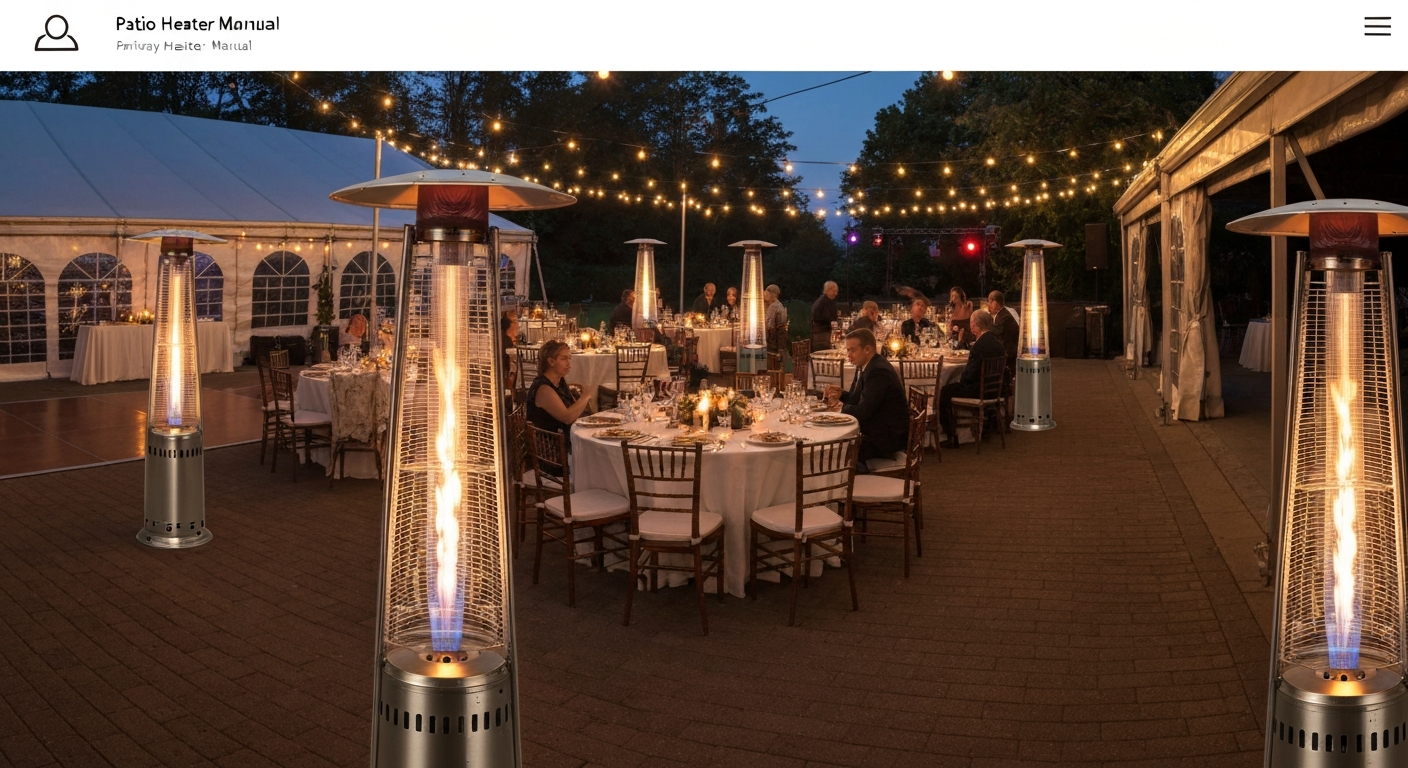
For most weddings, plan on one 48,000 BTU propane patio heater for every 150 square feet of occupied outdoor space under calm or semi-sheltered conditions. A small backyard reception of 30 guests seated in roughly 300 square feet needs 2 heaters. A medium tented dinner for 75 guests covering around 1,200 square feet needs about 8 heaters. A large open-lawn event for 150 guests is a different animal entirely, at that scale, zoning the space and mixing heater types will serve you far better than trying to blanket the entire lawn.
How Many Patio Heaters Do I Need for Wedding Receptions
Grant Mercer
9 Aug 2026
What actually changes your heater count
Before you commit to a number, five factors can push that count up or down significantly. Ignoring even one of them, especially wind, is the most common reason a reception ends up cold despite having plenty of heaters on paper.
- Guest count and layout: More guests mean more occupied square footage, but dense seating concentrates people (and their body heat) in less space. Spread-out cocktail layouts with wide circulation paths need more heaters than a tightly seated dinner.
- Total area and square footage: This is the raw input to every sizing formula. Measure the actual seating, dining, and dancing zones — not the whole backyard.
- Wind and exposure: Wind is the single biggest wild card. A steady 10–15 mph breeze can cut effective heater coverage nearly in half for traditional mushroom-style units. Directional infrared heaters handle wind better but are still affected.
- Enclosure type: A fully open lawn loses heat in every direction. A tent with drop sidewalls traps radiant and convective heat and can meaningfully reduce your heater count. A covered patio with walls on two or three sides performs even better.
- Target comfort temperature: Sizing for 55°F ambient (a cool fall evening) versus 35°F ambient (a cold late-October night) requires very different outputs. The colder the night, the more heaters you need — or the more aggressively you need to zone and shelter.
The assumptions behind these numbers
Every sizing recommendation in this guide is built on a specific set of conditions. When your situation differs, you adjust, I'll show you exactly how.
- Ambient temperature: 40–55°F (a typical cool fall or spring evening in most of the U.S.). Below 40°F, add 25–50% more heater capacity.
- Wind conditions: Calm to light breeze, under 8 mph. This is the threshold where most manufacturers, including Bromic, still claim full rated performance for their infrared units.
- Coverage approach: Zone heating, meaning heaters are positioned over occupied areas (seating, dining, dance floor) rather than attempting to heat open lawn or unoccupied space.
- Heater output: 48,000 BTU per unit, the most common size available to rent or buy for events.
- Coverage band used: The 'typical' band of 150 square feet per 48,000 BTU heater — appropriate for semi-sheltered, semi-calm backyard conditions with traditional mushroom or pyramid-style propane heaters.
How to size heaters yourself: the BTU-to-square-footage method
This is a repeatable four-step method you can run with a tape measure and a calculator. I use it for every event sizing question that comes my way.
- Measure the occupied area: Sketch your layout and measure only the zones where guests will spend time — seated dinner area, cocktail area, dance floor. Do not include open pathways, the stage, or the bar if guests won't be standing there long. Write down the total in square feet.
- Pick your coverage band: Use 100 sq ft per 48k heater for windy/fully exposed open lawn; 150 sq ft per 48k heater for a semi-sheltered backyard, patio, or tented space; 200–215 sq ft per 48k heater only if you are using directional infrared units (like the Bromic Tungsten series) in calm, partially enclosed conditions.
- Apply the formula: Number of heaters = Total occupied square footage divided by your chosen coverage figure per heater. Example: 900 sq ft in a semi-sheltered tent / 150 sq ft per heater = 6 heaters.
- Apply wind and cold adjustments: If sustained wind is 8–20 mph, multiply your heater count by 1.25–1.5. If ambient temperature is below 40°F, add at least 25% more capacity. Round up, never down.
The formula in plain terms: Heaters needed = Occupied area (sq ft) / Coverage per heater (sq ft). The coverage-per-heater figure is your main variable and it is entirely dependent on heater type, wind exposure, and enclosure.
Worked examples for real wedding setups
Small backyard reception, 30 guests
Scenario: 30 guests seated at round tables in a semi-sheltered backyard. Occupied dining area measures roughly 300 square feet. Light wind, no tent, ambient temperature around 50°F.
- Typical band (150 sq ft): 300 / 150 = 2 heaters
- Conservative band for breezier conditions (100 sq ft): 300 / 100 = 3 heaters
- Directional infrared in calm conditions (200 sq ft): 300 / 200 = 2 heaters, but positioned precisely
- Recommendation: 2 heaters as a baseline, 3 if wind is a concern or the temperature drops below 45°F
Medium tented dinner, 75 guests
Scenario: 75 guests in a 40x30 foot pole tent with drop sidewalls. Net occupied floor area around 1,200 square feet (accounting for tables, dance floor, and circulation). Field worked example: a medium tented dinner (30–60 guests) with a net floor area of ≈1,200 ft² implies, per Party‑rental sizing examples and consumer sizing rules used by rental firms (illustrative basis for worked example), about 8 heaters at the typical 150 ft² per 48k BTU figure (or up to 12 heaters using a conservative 100 ft²/48k assumption); increase heater count by roughly 25–50% for open or gusty conditions. The sidewalls are a significant advantage here, they retain heat and you can safely use the typical coverage band.
- Typical band (150 sq ft): 1,200 / 150 = 8 heaters
- Conservative band if sidewalls are open or it's windy (100 sq ft): 1,200 / 100 = 12 heaters
- Recommendation: 8 heaters with sidewalls down; increase to 10–12 if sidewalls are open or wind is sustained above 8 mph
Large open-lawn reception, 150 guests
Scenario: 150 guests across a mix of seated dinner tables, a dance floor, and cocktail standing areas on an open lawn. Total occupied area is approximately 4,000 square feet. This is where raw heater math breaks down quickly.
- Typical band (150 sq ft): 4,000 / 150 = about 27 heaters
- Conservative band (100 sq ft): 4,000 / 100 = 40 heaters
- Practical recommendation: Do not try to heat the full open lawn as a single zone. Instead, divide the space into smaller enclosed or semi-enclosed zones — tent the dinner tables, use perimeter heaters around the dance floor, and add tabletop units at the cocktail area. A forced-air tent heater for any fully enclosed tent section will outperform a dozen standing propane units. Target 15–20 standing propane or infrared heaters for the zones that matter most.
Tented or partially enclosed layout, any guest count
Partial enclosure is a multiplier in your favor. A tent with three sidewalls down reduces effective heat loss enough that you can often drop your heater count by 20–30% compared to the same footprint fully exposed. The key rule: position heaters inside or at the open edge of the enclosed zone, never outside it trying to push heat through canvas. Place standing heaters near the perimeter pointing inward, or use overhead infrared strip heaters mounted to tent poles if the tent is rated for it.
Heater types for weddings: what actually works
Not all patio heaters perform the same outdoors. At an event, the wrong heater type in the wrong spot will leave guests cold even if your BTU math was perfect. Here is what I've found works and what doesn't.
| Type | Heat Pattern | Effective Coverage | Best For | Main Limitation |
|---|---|---|---|---|
| Propane standing (mushroom/pyramid) | Omnidirectional radiant + convective | 100–150 sq ft at 48k BTU | General outdoor receptions, rentals, flexibility | Wind-sensitive, fuel logistics, top clearance required |
| Directional infrared (e.g., Bromic Tungsten) | Focused radiant beam, 215 sq ft at 38,500 BTU | 200–215 sq ft per unit | Tented events, seated dinner zones, calm conditions | Higher purchase cost ($2,000+), less flexible placement |
| Electric infrared (wall/ceiling mount) | Directional radiant | 50–150 sq ft per unit depending on wattage | Covered patios, permanent venue setups | Requires 240V circuit, not portable, setup cost |
| Tabletop propane | Short-range radiant, ~5–8 ft radius | 30–50 sq ft | Cocktail tables, supplemental close-range warmth | Not a primary heat source, frequent tank swaps |
For most DIY-hosted weddings, rented 46,000–48,000 BTU propane standing heaters are the practical default. They are widely available, movable, and require no electrical work. Directional infrared units are worth considering if you are purchasing rather than renting and you host events regularly. Tabletop units are best used as supplements at cocktail tables, not as a replacement for full-size heaters.
Is a 48,000 BTU patio heater the right size?
Yes, for most wedding receptions a 48,000 BTU unit is the practical sweet spot. If you’re asking whether 48,000 BTU is good for a patio heater, the short answer is yes for typical sheltered or semi‑sheltered wedding spaces, though wind and exposure can reduce effective coverage is 48000 btu good for patio heater. The Amazon Basics 46,000 BTU unit, for example, covers up to a 9-foot radius (roughly 250+ square feet) under ideal conditions. The Bromic Tungsten Smart-Heat freestanding unit puts out 38,500 BTU and claims 215 square feet of coverage, but it does so with directional infrared heat that outperforms raw BTU numbers in calm conditions. blank" rel="noopener noreferrer">Bromic product wind‑resistance statements and independent reviewer notes on wind sensitivity (basis for conservative % adjustments).
Where a 48,000 BTU unit falls short: fully exposed open lawn with steady wind above 10 mph. At that point, the radiant heat from a mushroom-style unit disperses too quickly to be felt more than a few feet away. You would need either more units, better placement, or some form of wind shelter. It's also worth knowing that 48k BTU is near the top of what consumer propane heaters produce, stepping above that typically means moving to commercial or forced-air units, which involve more complex setup and fuel handling.
One more practical note: at 48,000 BTU on a standard 20-pound propane tank, you'll get roughly 8–9 hours of run time (more on that math below). For a 5–6 hour reception with setup time, one tank per heater is usually enough with a margin to spare, but always have at least one spare tank on hand per three heaters.
Propane consumption and run-time math
This is the math I walk through every time someone asks me how many tanks to order. Propane has a heating value of approximately 91,900 BTU per liquid gallon (published by the National Bureau of Standards) or about 21,680 BTU per pound. A standard 20-pound nominal propane cylinder holds roughly 4.7–4.8 gallons of liquid propane, giving you approximately 431,000 BTU stored energy per full tank.
Run time formula: Tank run time (hours) = Total stored BTU / Heater BTU rating. If you need more detail on fuel rates and real-world consumption, see our guide on how much propane does a patio heater use. So for a 48,000 BTU heater: 431,000 / 48,000 = approximately 9 hours. Real-world run times are typically reported as 8–10 hours on high, which matches this math closely. Wind, cold ambient temperatures, and regulator condition can push you toward the lower end of that range.
| Heater Output (BTU/hr) | Tank Size | Stored BTU (approx.) | Estimated Run Time | Practical Range |
|---|---|---|---|---|
| 40,000 | 20 lb | 431,000 | 10.8 hours | 9–11 hours |
| 46,000 | 20 lb | 431,000 | 9.4 hours | 8–10 hours |
| 48,000 | 20 lb | 431,000 | 9.0 hours | 8–9 hours |
| 48,000 | 1 lb (tabletop) | 21,700 | 0.45 hours (~27 min) | 20–30 min on high |
| 38,500 (Bromic Tungsten) | 20 lb | 431,000 | 11.2 hours | ~8 hours per Bromic spec |
| 48,000 | 30 lb | 647,000 | 13.5 hours | 12–14 hours |
For event planning, the practical rule is simple: one 20-pound tank per heater for a reception up to 6 hours, with one spare tank on standby for every three heaters. If the forecast is cold (below 40°F) or it is a late-night event, swap to 30-pound cylinders or plan a mid-event tank exchange.
Renting versus buying: a quick decision guide
For a one-off wedding, renting almost always makes more financial sense than buying. If you need current pricing estimates, see our guide on how much to rent a patio heater. Typical rental rates in the U.S. run $60–$150 per heater per day, with most party rental shops in the $75–$115 range. Some vendors include a propane tank in that price; others charge $20–$40 extra per tank. Delivery and setup fees vary, budget $50–$100 additional if you want the rental company to deliver, place, and pick up.
If you are buying, consumer freestanding propane mushroom or pyramid heaters retail between $100 and $400 and are widely available at home improvement stores and online. Premium commercial infrared units like the Bromic Tungsten start around $2,000 per unit. Buying makes sense if you host outdoor events multiple times per year and have secure, weatherproof storage for the units off-season.
| Factor | Rent | Buy (Consumer) | Buy (Commercial/Infrared) |
|---|---|---|---|
| Upfront cost per heater | $75–$150/day | $100–$400 | $2,000+ |
| Maintenance responsibility | Rental company | You | You |
| Flexibility | High — order what you need | Limited to units you own | Limited to units you own |
| Best for | 1–2 events per year | 3+ events per year | Frequent events, permanent venue |
| Propane included? | Often add-on ($20–$40/tank) | No | No |
| Delivery/setup available? | Yes, for a fee | No | No |
Spacing, placement, and safety clearances
Placement is just as important as quantity. You can have the right number of heaters and still have cold pockets if they are in the wrong spots. Here is the setup approach I recommend for a wedding reception.
- Position heaters at the perimeter of seating zones, not in the center. Heat radiates outward from a standing mushroom heater — placing it at the edge of a table cluster means that radiant heat sweeps across the guests rather than over their heads.
- Space heaters evenly. For 150-square-foot coverage per unit, aim for roughly one heater per 12–13 linear feet along the perimeter of a zone.
- Keep mandatory clearances: most consumer standing patio heater manuals (including Fire Sense models) require at minimum 18 inches of top clearance and 24 inches of side clearance from any combustible surface. Never position a heater under tent fabric, string lights, paper lanterns, or fabric draping without confirming the tent is rated for overhead heat.
- Face directional infrared units toward occupied areas. Aim the heat bloom at seated guests, not at walls or open space.
- Never block a heater with chairs, décor, or linen. Blocked airflow is a fire hazard and reduces heat output.
- Anchor each heater. Use the base water-fill option if your unit has it — most consumer standing propane heaters have a fillable base ballast. On grass or uneven ground, check that the unit is perfectly level before igniting. The tilt-switch safety cutoff will trigger if a heater leans even slightly, causing it to shut off unexpectedly.
Setup, maintenance, and troubleshooting checklist
I always run through this checklist the day before an event. Discovering a failed igniter or a leaking connection on the day of the wedding is stressful and avoidable. Most issues with rented or stored heaters fall into a handful of predictable categories.
Before the event
- Inspect every propane hose and regulator connection for cracks, brittleness, or debris. Apply soapy water to every fitting and watch for bubbles — any bubbling means a leak and that heater should not be used until repaired or replaced.
- Test ignition on each unit at least 24 hours before the event. If the piezo igniter clicks but does not light, the issue is often a dirty or misaligned thermocouple or pilot tube. A thermocouple that won't hold the flame after ignition is a common failure point — the unit will light, then shut off within 30–60 seconds.
- Check the tilt switch by gently tilting the unit 10–15 degrees — it should shut off the gas. If it does not, do not use that heater. A non-functioning tilt switch is a safety hazard.
- Verify that all tank connections are hand-tight plus a quarter turn with a wrench. Do not overtighten plastic fittings.
- Fill base ballast reservoirs with sand or water if the venue is on soft ground or turf.
- Confirm you have at least one spare 20-pound propane tank for every three heaters.
During and after the event
- Never leave a lit heater unattended near guests who are not aware of it — particularly children. Assign someone to do a heater walk-around every 30–45 minutes.
- If a heater shuts off unexpectedly, the most likely causes are: the tilt switch triggered (check level), the tank is empty, or the thermocouple has cooled and needs a relight sequence. Follow the manufacturer's relight procedure — hold the control knob in for 20–30 seconds after lighting to seat the thermocouple.
- After the event, close the tank valve first, let the residual gas in the line burn off, then turn off the control knob. Never store a connected propane tank indoors.
- If you own the heaters, wipe down the reflector and burner area before storage and cover the unit. A clogged burner orifice from spider webs or debris is one of the most common causes of ignition failure the next season.
Common problems and quick fixes
| Symptom | Likely Cause | Quick Fix |
|---|---|---|
| Clicks but won't light | Thermocouple misaligned or dirty; pilot tube blocked | Reposition pilot tube toward spark; clean orifice with compressed air |
| Lights then shuts off in 30–60 sec | Thermocouple not staying hot; connection loose | Hold knob in longer (30 sec); check thermocouple lead connection at valve |
| Won't stay lit in wind | Wind exceeding heater's rated resistance (~8 mph) | Add a windbreak; reposition heater; switch to directional infrared unit |
| Shuts off when tilted slightly | Tilt switch activating correctly | Re-level the unit on a flat, stable surface |
| No gas flow | Empty tank; regulator in bypass/lockout mode | Check tank level; fully close tank valve, wait 30 sec, reopen slowly |
| Low flame even on high | Low tank pressure (cold or nearly empty tank) | Warm tank slightly (do not use open flame); replace with full tank |
Thermocouple failures and tilt-switch issues are the two most common reasons rented or stored heaters misbehave at events. Both are repairable with basic tools if you own the units. If you are renting, contact the rental company immediately, a reputable shop will swap a faulty unit. If you own your heaters and want to dig deeper into thermocouple replacement or ignition diagnosis, those repair walkthroughs are covered in detail elsewhere on this site, along with assembly guides for specific models.
Putting it all together
The honest answer to 'how many patio heaters do I need for my wedding' is: it depends on your square footage, your enclosure, and the forecast, but it is entirely calculable. Start with your occupied area in square feet, divide by 150 for a typical semi-sheltered setup with 48,000 BTU heaters, then adjust upward for wind, cold temperatures, or an open lawn. For a quick calculator and step-by-step guidance, see our guide on what size patio heater do i need. For a deeper dive into selecting the correct output, see how many btu for patio heater. Rent before you buy unless you host events regularly. Run your pre-event checklist the day before, have spare tanks ready, and assign someone to monitor the heaters throughout the night. With that approach, you will not be standing outside in your wedding clothes wishing you had ordered two more heaters.
FAQ
Short answer: how many patio heaters do I need for a wedding reception (homeowner/DIY)?
Clear summary: For most backyard/DIY wedding receptions, plan heater counts by area and conditions, not strictly by guest count. Using a 48,000 BTU freestanding propane heater as a common baseline, use three sizing bands: conservative = 1 heater per 100 ft² (for exposed/windy conditions or mixed standing/seating), typical = 1 heater per 150 ft² (calm to semi‑sheltered backyard or tent with some sidewalls), optimistic/directional = 1 heater per 200–215 ft² (directional infrared units in calm, partially enclosed spaces). Example quick rules: 300 ft² → 2 (typical) or 3 (conservative); 1,200 ft² tent → 8 (typical) or 12 (conservative). Always increase counts by ~25% for breezy conditions and up to ~50% for very windy/exposed sites or if you want to ensure comfortable temps for guests standing up and moving.
What factors change the heater count and how should I adjust for them?
Key factors and how they change counts: - Guest count vs area: guests spread across a bigger area need more heaters; compute by heated floor area, not strictly number of people. - Wind/exposure: sustained breezes reduce effective coverage—add ~25% (moderate) to ~50% (windy) heaters. - Enclosure/retention: tents with sidewalls or partial enclosures retain heat; use the typical or optimistic band. Fully open lawns require conservative counts or zoning. - Target comfort: standing/circulation areas need more radiant coverage per person than seated dining. For warmer target (e.g., comfortable for standing dancing), increase heater count by 15–25%. - Heater type/directionality: directional infrared covers more effectively per unit (use optimistic band). - Ambient temperature: the colder the starting ambient, the less effective each heater is—below ~40°F, assume conservative counts and consider additional heaters or tenting. Assumptions to watch: the bands assume calm-to-moderate ambient (40–55°F) unless you explicitly add percent increases for colder or windier conditions.
Reproducible sizing method using BTU and square footage (step‑by‑step)
Method you can repeat: 1) Measure usable event area in ft² (tables + seating + circulation where guests will be). 2) Choose a baseline BTU coverage per heater based on your heater model (common baseline used here: 48,000 BTU). 3) Select a coverage band for that BTU: conservative = 100 ft² / 48k, typical = 150 ft² / 48k, optimistic = 200–215 ft² / 48k. 4) Compute raw heater count = area / chosen ft²-per-heater and round up to nearest whole heater. 5) Apply environmental adjustments: add ~25% for moderate wind/exposure, ~50% for windy/exposed sites, and add ~15–25% if many guests will be standing/dancing. 6) Zone if total becomes large (see guidance): create smaller sheltered heat ‘rooms’ or use tenting. Worked examples: - Small backyard reception: area 300 ft². Typical: 300 / 150 = 2 heaters (conservative → 3; optimistic → 2). - Medium tented dinner: area 1,200 ft². Typical: 1,200 / 150 = 8 heaters (conservative → 12; optimistic → 6). - Large open lawn: area 4,000 ft². Typical: 4,000 / 150 ≈ 27 heaters (practical approach: zone into smaller heated areas or use tenting/forced air rather than trying to heat entire lawn). Note assumptions: baseline uses a 48,000 BTU freestanding propane heater and ambient ~40–55°F with light-to-moderate wind unless adjusted.
Worked examples with a 48,000 BTU heater — exact calculations
Examples using 48,000 BTU and three bands: - Conservative (100 ft² each): Heaters = area / 100 ft². - Typical (150 ft² each): Heaters = area / 150 ft². - Optimistic (200 ft² each): Heaters = area / 200 ft². 1) 20–30 guests, seated patio area ≈ 300 ft²: conservative = 300/100 = 3 heaters; typical = 300/150 = 2 heaters; optimistic = 300/200 = 1.5 → round up to 2. Recommendation: 2–3 heaters; pick 3 if exposed/windy. 2) 30–60 guests in a tent ≈ 1,200 ft²: conservative = 12 heaters; typical = 8 heaters; optimistic = 6 heaters. Recommendation: 8 heaters for a semi‑sheltered tent; use 12 if no sidewalls and windy. 3) 100 guests on an open lawn ≈ 4,000 ft²: conservative = 40 heaters; typical = 27 heaters; optimistic = 20 heaters. Practical recommendation: do not try to heat open lawn wholesale — zone or tent high‑activity areas (dance floor, dining) and heat those instead.
Is a single 48,000 BTU heater appropriate? What does one unit cover and when is it enough?
When a single 48k unit works: one 48,000 BTU freestanding heater is typically appropriate for a small, semi‑sheltered gathering of about 150–215 ft² (optimistic directional coverage) or 100–150 ft² conservatively. Use one 48k heater for a compact seating area (e.g., small patio dining for 6–12 people) if wind is light and there is some shelter. When one is not enough: open yards, large tents, or standing/dancing zones need multiple units or zoning. If guests will stand and circulate, or if wind/exposure is present, assume a single 48k covers less area—use the conservative band. Assumptions: these coverage numbers assume calm-to-moderate wind, ambient ~40–55°F, and average clothing; colder temps or gusts reduce effective radius.
Propane consumption, run‑time math, and a ready table (20‑lb tank examples)
Key numbers and assumptions: - Propane energy ≈ 91,900 Btu/gal and a nominal 20‑lb cylinder contains ~4.7–4.8 gallons of LP fuel (usable energy ≈ 431,000 Btu total theoretical). - Use heater input BTU/hr (e.g., 48,000 Btu/hr) to compute ideal run time: run_time_hr ≈ total_Btu_available / heater_Btu_per_hr. - Practical run times vary (tank fill, regulator, wind, flame setting): manufacturers commonly quote ~6–10 hours on a 20‑lb tank for 48k units. Run‑time table (approximate, theoretical and practical): - 24,000 Btu/hr heater: theoretical = 431,000 / 24,000 ≈ 18.0 hr (practical ≈ 12–18 hr). - 36,000 Btu/hr heater: theoretical ≈ 12.0 hr (practical ≈ 8–12 hr). - 48,000 Btu/hr heater: theoretical ≈ 9.0 hr (practical ≈ 6–10 hr). - 60,000 Btu/hr heater: theoretical ≈ 7.2 hr (practical ≈ 5–8 hr). Example: For a 48k heater on high, expect roughly 6–9 hours on a full 20‑lb tank; if you plan a 6–8 hour event, one full tank per 48k heater is usually sufficient, but bring a spare tank per heater for safety/replacement and any extended run time. Note: these calculations assume the cylinder is reasonably full and are affected by regulator/valve limitations and heater setting; always follow NFPA/ cylinder filling conventions and your heater manual for safe limits.