
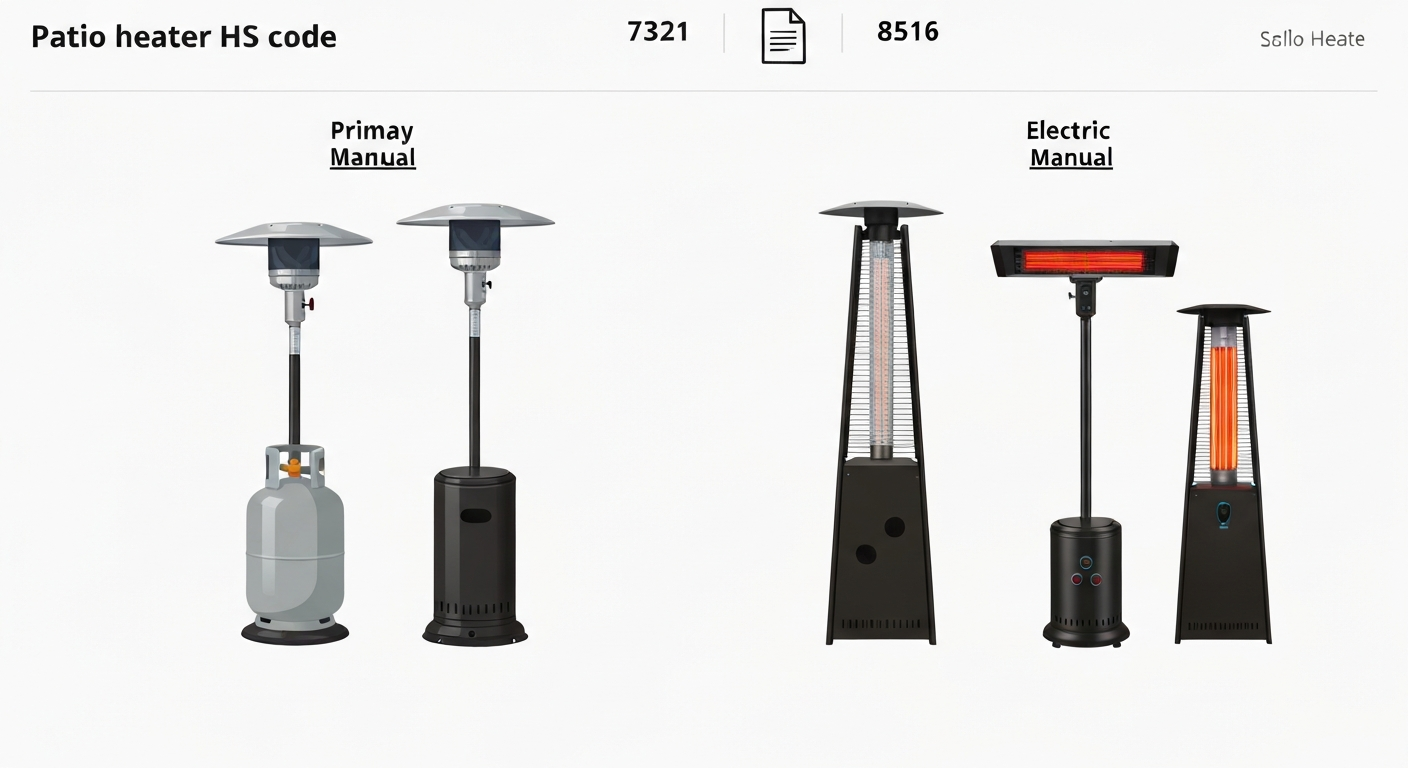
If you're importing a patio heater, shipping one internationally, or selling them online across borders, you need a Harmonized System (HS) code. For a propane or natural gas patio heater, that almost always lands in HS heading 7321 (non-electric domestic heating appliances). For an electric infrared or ceramic patio heater, you're looking at heading 8516 (electric space heating apparatus). The exact subheading, and the duty rate that comes with it, depends on fuel type, heat source, mounting style, and a handful of other product attributes. This guide walks you through every step of identifying, verifying, and documenting the right code, whether you're a homeowner ordering a single unit from overseas, a small seller sourcing stock, or a DIY importer figuring this out without a customs broker.
Patio Heater HS Code: How to Classify, Verify & Document

What an HS code actually is
The Harmonized System is a standardized international nomenclature maintained by the World Customs Organization (WCO). It assigns every traded product a six-digit code that customs authorities in over 200 countries use as the foundation for import duties, export controls, and trade statistics. Your country then extends that six-digit base into a longer national code: the U.S. uses a 10-digit Harmonized Tariff Schedule (HTS) number, the EU uses an 8-digit Combined Nomenclature (CN) code, the UK uses its own 10-digit UKGT code, and so on. The first six digits should be consistent across countries; the additional digits reflect national classification decisions and duty schedules.
Classification is determined by the WCO's General Rules of Interpretation (GRIs). In plain language: you first try to classify a product by heading text and the official Explanatory Notes. If a product could fit more than one heading, you use the GRI tiebreaker rules, which include matching the most specific description and, for composite goods, identifying the component that gives the product its essential character. For a patio heater, that usually comes down to one decisive question: does it generate heat electrically, or by burning fuel?
What counts as a patio heater
Customs authorities treat a patio heater as a domestic heating appliance designed for outdoor or semi-outdoor spaces. The term covers a wide range of products, and knowing which category yours falls into is the first step toward the right code.
- Freestanding propane or natural gas mushroom heaters: tall post-style units with a dome reflector, typically rated 40,000 to 48,000 BTU/hr, using a glass-tube or ceramic burner
- Tabletop gas heaters: compact propane units, typically 10,000 to 12,500 BTU/hr, with a column burner and smaller reflector
- Wall-mounted or ceiling-hung electric infrared heaters: hardwired or plug-in units using quartz or ceramic heating elements, rated in watts (commonly 1,500 W to 3,000 W)
- Freestanding electric patio heaters: pyramid or column-style units with a visible glowing quartz or halogen tube element
- Kerosene or liquid-fuel outdoor heaters: less common, but sometimes imported, using a wick or pressurized combustion system
- Propane fire pit heaters and combination units: fire pits or tables with an integrated gas burner, which may straddle classification categories
The intended use matters too. Standards like CSA/ANSI Z83.26 (for gas-fired outdoor infrared patio heaters) and UL 1278 (for movable and wall-hung electric room heaters) define the product category for North American markets. CSA/ANSI Z83.26 (published also as CSA 2.37) is the North American standard for gas‑fired outdoor infrared patio heaters, specifying scope, input ratings, tabletop vs patio distinctions, and acceptance of propane supplies; compliance and test reports to this standard are commonly required by North American buyers and regulators as evidence of safe function and market suitability CSA/ANSI Z83.26:20 • CSA 2.37:20 — Gas‑fired outdoor infrared patio heaters (standard overview). CE marking and EN 60335-series standards do the same in the EU. Test reports or certification documents referencing these standards are strong evidence of intended use when you need to support your classification.
Why getting the classification right matters
This isn't just paperwork. Misclassification has real financial and legal consequences, even for small importers and one-off purchases.
Duties and landed cost
Different subheadings carry different duty rates. In the U.S., electric space heaters under heading 8516 carry approximately 3.7% ad valorem under Column 1 (MFN) rates, while gas appliances under heading 7321 may carry a lower or different rate depending on the specific subheading. Getting the heading wrong by even one digit could mean overpaying duties or, worse, underpaying and facing a penalty on audit. If your unit is subject to additional Section 301 tariffs (which apply to many products from China), the correct subheading determines whether those extra duties apply.
Customs clearance
Customs authorities match your declared HS code against the physical goods. If the code doesn't match the product's description, fuel type, or power rating on the invoice and technical documentation, the shipment can be held for examination. A propane heater declared under an electric heater code, or a complete unit declared under a parts code, will trigger questions. Having the right code, backed by a proper spec sheet and user manual, gets your shipment cleared faster.
Compliance and market access
Some subheadings carry import restrictions, safety certification requirements, or mandatory conformity marks as TARIC measures (in the EU) or as CBP admissibility conditions (in the U.S.). An electric patio heater may need to demonstrate UL 1278 listing or an equivalent to clear U.S. customs and pass retail compliance checks. In the EU, a gas patio heater needs to comply with the Gas Appliances Regulation and bear CE marking. The HS code you declare signals which regulatory regime applies, so a wrong code can delay or block market access.
The attributes that drive classification
Before you look up a single code, gather the following information about your specific unit. These are the classification-relevant attributes customs authorities and tariff schedules actually care about.
| Attribute | Why it matters | Where to find it |
|---|---|---|
| Fuel type | The single biggest split: electric vs. gas/liquid fuel determines heading 8516 vs. 7321 (or other) | Product label, user manual, spec sheet |
| Heat source / element type | Infrared quartz tube, ceramic element, glass-tube gas burner, wick combustion — affects subheading and applicable standards | User manual, manufacturer datasheet |
| Power rating | Watts (electric) or BTU/hr (gas) — evidences the product category and may affect subheading | Rating plate on the unit, spec sheet |
| Mounting style | Freestanding, portable, wall-mounted, ceiling-hung — some national subheadings distinguish portable from fixed | Product description, assembly instructions |
| Materials of construction | Steel, cast iron, aluminum, glass tube — relevant for some tariff descriptions and material-based subheadings | Manufacturer spec sheet |
| Assembly state | Complete assembled unit vs. kit vs. parts — determines whether GRI 2(a) applies (unassembled complete articles) | Packing list, product description |
| Intended use / market | Domestic/residential vs. commercial — affects applicable standards and sometimes subheading | Product manual, certification documentation |
Your user manual is one of the most useful documents here. Manufacturer manuals for common freestanding and tabletop patio heater models routinely state fuel type, BTU/hr or wattage rating, assembly state, and sometimes the applicable safety standard. If you've misplaced yours, the manufacturer's website or a manual-lookup resource can help you track down the spec sheet for your exact model.
Step-by-step: how to identify the right HS code
Follow this decision flow in order. Each step either locks in a classification path or narrows the options before you open a tariff lookup tool.
- Confirm the heat source: Is it electric (powered by mains electricity or a cord)? Or does it burn a fuel (propane, natural gas, kerosene, or other liquid fuel)? This is your primary split. Electric units go toward heading 8516; fuel-burning units go toward heading 7321 (for gas and some liquid fuels) or potentially other headings for kerosene combustion heaters.
- For electric patio heaters: navigate to heading 8516 in your national tariff schedule. Look at the subheadings for 'electric space heating apparatus and soil heating apparatus.' In the U.S. HTSUS, subheading 8516.29 covers 'other' electric space heaters not specifically listed. U.S. CBP rulings (including NY N309563) have classified electric patio heaters here. Check your national schedule for the 8-digit or 10-digit subheading that matches your unit.
- For gas patio heaters (propane, natural gas, LPG): navigate to heading 7321 in your national tariff schedule. In the U.S., CBP ruling NY R01432 (February 23, 2005) classified a propane-fuelled patio heater in HTSUS subheading 7321.81.1000 ('other appliances, for gas fuel or for both gas and other fuels, portable'). Multiple subsequent CROSS rulings (including N159236) confirm this as consistent U.S. practice. In the EU, CN 7321.81 covers gas-fuelled non-electric domestic appliances; Member State BTIs confirm this for gas patio heaters.
- Check the portable vs. fixed distinction: Some national subheadings within 7321 and 8516 separate portable/freestanding units from wall-hung or ceiling-mounted units. A freestanding propane mushroom heater is portable. A hardwired wall-mounted infrared electric heater is fixed. This affects which subheading you choose at the 8- or 10-digit level.
- Check for any additional national measures: In the U.S., look up the specific 10-digit HTS subheading on the USITC HTS portal to see if additional Section 301 tariffs or antidumping/countervailing duties apply based on the country of origin. In the EU, check the TARIC online consultation tool for any third-country duty, VAT measures, or import restrictions attached to the CN subheading.
- Look up published binding rulings: In the U.S., search the CBP CROSS Ruling Search database using product terms like 'patio heater,' 'propane heater,' or 'infrared heater.' Rulings are publicly searchable and show you how CBP has classified products that are similar or identical to yours. In the EU, the EBTI (European Binding Tariff Information) database lists published BTIs for Member States.
- If the product is a kit, a bundle, or includes accessories: Apply GRI rules carefully (see the borderline cases section below). A heater shipped unassembled but as a complete article is still classified as the complete heater. A heater sold bundled with a cover or hose is classified by its essential character (the heater).
- Document your classification logic: Write down which heading and subheading you've selected, the ruling or explanatory note that supports it, and the product attributes that drove the decision. You'll need this if the shipment is queried at customs.
Verifying your code and keeping the right paperwork
Looking up a code yourself is a good start, but verification is what protects you. Here is what to use and what to keep on file.
Official lookup tools
- U.S. importers: USITC Harmonized Tariff Schedule portal (usitc.gov) — official 10-digit HTS, duty rates, and applicable footnotes for 8516 and 7321 subheadings
- U.S. ruling database: CBP CROSS Ruling Search (rulings.cbp.gov) — search published classification rulings by keyword or HTS subheading
- EU importers: European Commission TARIC online consultation (ec.europa.eu/taxation_customs/dds2/taric) — 10-digit TARIC measures, BTIs, and duty rates
- EU binding rulings: EBTI-3 database — published BTIs from EU Member States, searchable by CN heading
- WCO tools: WCO HS Nomenclature and Explanatory Notes — authoritative explanation of heading scope; accessible via the WCO Trade Tools portal
- UK importers: HMRC Trade Tariff (trade-tariff.service.gov.uk) — 10-digit UKGT codes, duty rates, and commodity measures
When to ask the manufacturer or a customs broker
If your product has an unusual heat source, dual function, or atypical construction, don't guess. Contact the manufacturer's export compliance team and ask for their declared HS/CN code and the basis for it. Many larger manufacturers have already obtained binding rulings or have a customs classification opinion they can share. If the stakes are high (large shipments, ongoing imports, or a product with ambiguous attributes), a licensed customs broker or trade attorney can provide a written classification opinion, which is defensible documentation if CBP or another authority ever questions your declaration.
Documentation to keep on file
Keep all of the following for at least five years (the standard CBP record-retention period in the U.S.; EU rules vary by member state but five years is a safe baseline):
- Commercial invoice showing the product description, declared HS code, country of origin, unit price, Incoterms, and total value
- Packing list confirming assembly state and contents
- Manufacturer's spec sheet or datasheet showing fuel type, power rating (watts or BTU/hr), element type, and mounting style
- User manual or assembly instructions (the version shipped with the unit, not a generic download)
- Photos of the unit, rating plate, and packaging — especially useful if the description on the invoice is vague
- Certification documentation: UL 1278 listing (electric), CSA/ANSI Z83.26 test report (gas), CE declaration of conformity (EU) — these confirm intended use and support classification
- Any CBP CROSS rulings, BTIs, or broker classification opinions you used to support your code
- ASTM F2644 test reports if available — relevant for commercial patio heaters and useful supporting evidence
- Customs entry documents and any CBP responses or queries related to the shipment
Gas vs. electric: a quick classification comparison
| Factor | Gas patio heater (propane/NG) | Electric patio heater (infrared/ceramic) |
|---|---|---|
| Primary HS heading | 7321 (non-electric domestic appliances) | 8516 (electric space heating apparatus) |
| U.S. ruling precedent | 7321.81.1000 or 7321.81.5000 (CBP NY R01432, N159236) | 8516.29 subheadings (CBP NY N309563) |
| EU CN heading | CN 7321.81 (gas fuel or gas/other fuel) | CN 8516.29 (other electric space heaters) |
| Applicable safety standard (N. America) | CSA/ANSI Z83.26 (gas outdoor infrared heaters) | UL 1278 (movable/wall-hung electric heaters) |
| Typical U.S. Column 1 duty | Low single-digit % (varies by subheading) | Approximately 3.7% (varies by subheading) |
| Key classification attribute | Fuel type and portable vs. fixed | Element type (quartz/ceramic) and portable vs. fixed |
| Section 301 tariff risk (China origin) | Check 7321 subheading on USITC portal | Check 8516 subheading on USITC portal |
Borderline cases and common pitfalls
Most standard patio heaters classify cleanly once you know the fuel type. But several common scenarios create genuine classification difficulty, and these are exactly the cases where errors happen.
Multi-function units (fire pit tables, fire pit/heater combos)
A gas fire pit table serves as outdoor furniture, a decorative fire feature, and a heat source. Which heading wins? Under GRI 3(b), you classify composite goods according to the component that gives the article its essential character. If the unit is primarily a functional heating appliance with a decorative fire element, heading 7321 is defensible. If it is primarily an outdoor furniture piece with an incidental gas burner, furniture headings could apply. Get the manufacturer's declared code and any available BTIs before you commit to a classification on a high-value item like this.
Parts vs. complete units
Importing a replacement burner assembly, reflector dome, or heating element as a standalone item changes the classification entirely. Parts and accessories for gas domestic appliances of heading 7321 are classified under heading 7321 only if the tariff schedule specifically includes parts in that heading's coverage; otherwise they may fall under Chapter 73 (articles of iron or steel) or other specific parts headings. Electric heating elements for 8516 appliances may fall under heading 8516 as parts if they are identifiable as parts of such appliances. Don't assume a component inherits the parent product's code: check the parts subheadings explicitly.
Unassembled or disassembled units (kits)
A patio heater shipped in flat-pack form, requiring assembly, is still classified as the complete heater under GRI 2(a), provided all essential parts are present. This is important because suppliers sometimes ship units disassembled to reduce freight costs. If the packing list and invoice describe it as a 'kit' or 'parts,' but it contains everything needed to assemble a complete heater, customs may (and should) classify it as the complete appliance. Make sure your invoice description matches the actual contents: 'freestanding propane patio heater, unassembled' is clearer and more accurate than 'heater parts.'
Bundled goods (heater plus cover, hose, or regulator)
Retail packs that combine a heater with a weather cover, a regulator, or a gas hose are classified by essential character: the heater. The accessories don't pull the classification toward a different heading. However, make sure the invoice value and description cover all components in the pack. If a propane regulator is declared separately on the invoice, it may need its own HS code (regulators typically fall under heading 8481, taps, cocks, valves, and similar devices). Customs officers can and do scrutinize bundled packs where the declared code covers only part of the package.
Kerosene and liquid-fuel heaters
Kerosene-fuelled outdoor heaters don't fit cleanly in heading 7321 (which focuses on gas and solid-fuel appliances) or 8516 (which is strictly electric). CBP rulings (including HQ 951941) have addressed kerosene heaters specifically, distinguishing them from both electric heaters (not heading 8516) and standard gas appliances (not straightforwardly heading 7321). If you're importing a liquid-fuel combustion heater, treat it as a borderline case from the start and either search specifically for CBP rulings on that product type or consult a broker.
Ambiguous heat source labels ('infrared' gas vs. 'infrared' electric)
Many gas patio heaters are marketed as 'infrared heaters' because their ceramic or glass-tube burners emit radiant infrared heat. So do electric quartz heaters. The word 'infrared' on a product listing or marketing sheet does not tell you the fuel type. Always confirm the power source from the technical specification, not the marketing copy. A ceramic-element gas heater is still classified under heading 7321. U.S. blank" rel="noopener noreferrer">CBP ruling NY R01432 (Feb. 23, 2005) concluded propane‑fuelled patio heaters are classifiable in HTSUS subheading 7321.81.1000 (other appliances, for gas fuel or for both gas and other fuels, portable). An electric quartz tube heater is still classified under heading 8516. The heat-transfer mechanism (radiant/infrared) is not the classification criterion; the energy source is.
A note on customs valuation
Once you have the right HS code, the duty amount you owe is calculated on the customs value, not just the invoice price. Under the WTO Agreement on Customs Valuation, the primary method is transaction value: the price actually paid or payable, adjusted for freight, insurance, and any assists (tooling, design work, or materials you provided to the manufacturer for free). If you're importing on CIF terms (cost plus insurance plus freight), customs value is usually the invoice price. If you're importing on FOB terms, you'll need to add the cost of freight and insurance to get to the customs value. Keep your Incoterms clearly stated on the commercial invoice and retain all freight and insurance invoices alongside your classification documentation.
From HS code to getting your heater working
Once your unit clears customs, the practical side begins: assembly, lighting, and making sure everything functions safely. Need it urgently? Check options for patio heater pick up today to arrange immediate collection. The user manual that helped you confirm the BTU rating and fuel type for classification purposes is the same document you'll need for initial setup and safe operation. For step-by-step guidance on assembly, lighting, and safe operation, see our patio heater setup instructions. See our patio heater size guide for help choosing the right heater dimensions and output for your space. If you're working through a first-time setup, the assembly and lighting procedures differ significantly between gas and electric models, and getting them right from the start prevents the most common ignition and safety issues. For practical setup, safety checks, and troubleshooting guidance, see our patio heater tips. For step-by-step guidance on assembly and safe ignition, see patio heater lighting instructions. If your heater is a propane model that won't stay lit after clearing the import process, that's usually a thermocouple or ODS issue rather than a shipping fault, but it's worth running through a proper diagnostic before assuming damage occurred in transit.
FAQ
What is an HS code and why does it matter for patio heaters?
An HS code (Harmonized System code) is an internationally standardized number used to classify traded goods. For patio heaters the correct HS classification determines import duties, import clearance requirements, applicable taxes, statistical reporting, and whether product‑specific rules or restrictions apply. Misclassification can cause delays, unexpected duties, fines, seizure, or refusal of entry.
How do I describe a patio heater in plain language for customs purposes?
Describe the product by its intended use and key technical attributes: whether it is a space/outdoor heating appliance, its fuel or power source (electric, propane/LP gas, natural gas, kerosene/other liquid fuel), heat element type (infrared/quartz/ceramic/burner), mounting (freestanding, tabletop, wall/ceiling), construction materials, input/power rating (W or BTU/hr), and whether it is sold assembled, in parts, or as a kit.
What is the step‑by‑step method to determine the right HS classification?
1) Gather product facts: fuel/power type, heating method, mounting, power rating, materials, intended use. 2) Read relevant HS headings and Explanatory Notes (start with headings covering electric space‑heating apparatus and non‑electric domestic appliances/stoves). 3) Apply the WCO General Rules of Interpretation (GRIs): classify the complete article, decide essential character for composite items, and use GRI tie‑breakers if needed. 4) Use national tariff lookup tools to find candidate subheadings. 5) Check authoritative rulings and precedents for similar models. 6) If borderline, request a Binding Tariff Information (BTI) or formal ruling from customs, or consult the manufacturer or a customs broker.
Which product attributes most strongly determine classification for patio heaters?
Primary attributes are fuel/power type (electric vs gas/combustion), heat‑generation method (electro‑thermal element or fuel burner/infrared burner), and intended function as a space/outdoor heater. Secondary attributes that affect subheading choice: mounting (portable freestanding vs fixed), presence of built‑in controls, material composition, and power rating (W/BTU).
How do electric and gas (propane) patio heaters typically differ in HS treatment?
Electric patio heaters that generate heat by electro‑thermal elements are normally classified with other electric space‑heating apparatus under the electric heating heading. Gas‑fuelled patio heaters (propane, natural gas) are commonly classified with non‑electric domestic appliances/stoves for gas fuel under the stoves/grills/appliances heading. The distinction follows the HS text, Explanatory Notes, and wide customs precedent.
Can you give checklist items I can use right now to prepare classification evidence?
Yes — prepare: 1) Commercial invoice and packing list with full product description. 2) Manufacturer datasheet/manual showing fuel type, heat element, BTU/hr or W rating, mounting and assembly state. 3) Photographs (assembled, components, burners/elements, nameplate). 4) Test reports or listings (UL/ETL, CSA/ANSI, CE/UKCA) and standard references (UL 1278, CSA/ANSI Z83.26, ASTM if available). 5) Technical drawings or exploded views for kits/parts. 6) Any prior customs rulings or BTIs for the same model. 7) Incoterms and invoice terms for valuation.